
Review meeting on preparedness of Kharif Season
- Published By: Tech Team
- July 11, 2017 / 03:24 AM IST


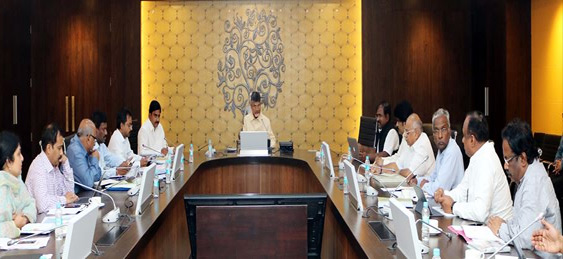
Chief Minister Shri N. Chandrababu Naidu reviewed the agriculture department’s preparedness for the Kharif season in which he examined the availability of seeds, micro-nutrients and held discussion on the monsoon forecast.
The officials reported on the status of e-crop booking, micro-irrigation schemes and distribution of micro-nutrients.
As of today, 11thJuly, 35% of the sown land in the state has been geo-tagged using e-crop booking by trained groups of students from engineering colleges. Officials reported to the Chief Minister that the capacity can be doubled by increasing the number of students and ensuring regular follow-ups.
The Chief Minister said that the payment for the groups of students and workers can be increased for the benefit of this project. Engineering and B. Sc. students must be addressed through video conferences and their skill development should be our utmost priority.
Giving a deadline of July 26th, when the next Bankers’ Committee Meeting will be held, the Chief Minister said that productivity should be maximized, and all the sown land must be geo-tagged.
In view of diversifying from cotton crops, the departments will encourage the cultivation of pulses, millets and oil seeds by offering a 75% subsidy. So far, 2.6 lakh hectares is used for cotton cultivation, which will be restricted to 6.5 lakh hectares to promote alternative crops for the coming Kharif season.
The government has set the target for the banks to distribute agricultural loans worth ₹50, 919 crore, and has achieved 38% (19.5 crore) through different bank schemes. Besides this, ₹8700 crore has been earmarked to provide credit for tenant farmers.
The Chief Minister assured the officials, that money will no longer be an obstacle for the subsidies of micro-nutrients. He made a sweeping declaration, that a 100% subsidy on micro-nutrients will be provided for all farmers, irrespective of how much land they own. Officials reported that this will lead to an increase in an average of 8% increase in crop productivity.
“I want to see maximum yield, by implementing benefits like distribution of micro-nutrients and micro-irrigation in saturating quantities. This will allow us to gauge the requirement of resources, such as seeds, other elements for soil health and the best farming practices”, he said at the meeting.
There are 5 micro-irrigations companies that have associated with the GoAP, to start the rain-guns experiment and take micro-irrigation to all the cultivable land. “Confidence must be built within my people, and they should believe in this technique to mitigate dry spells”, said the Chief Minister, addressing the companies.
There will be a workshop held in Anantapur on July 14th, to educate the people about dry spell mitigation and micro-irrigation (M.I.). This will be attended by B. Rajashekhar, Principal Secretary (Agriculture), the Commissioner, the district level authorities and the M.I. companies.
“The people must learn how to detect stress or dry spells and mitigate it immediately using the M.I. method. Using mobile lift irrigation, all available water must be used to fill reservoirs, and keep the state ready for any dry spells in the coming season”, the Chief Minister said.
The Chief Minister has agreed to participate in the World Food Prize Symposium in Iowa, to be held from 18th to 20th of October 2017. He also said that the Mega Seed Park, an association between the GoAP and the state of Iowa, must make some progress prior to his visit.
The departments have proposed to conduct “Agriculture Hackathons”, to encourage innovation in agriculture. The Chief Minister said that all demonstrations of the technology we use, like geo-tagging of crops, online portal for e-crop booking, should be displayed at the event, and there must be a productive exchange of knowledge of the latest technologies in agriculture.