
Andhra Pradesh’s SDG initiatives receive appreciation at UN
- Published By: Tech Team
- July 18, 2017 / 06:26 PM IST


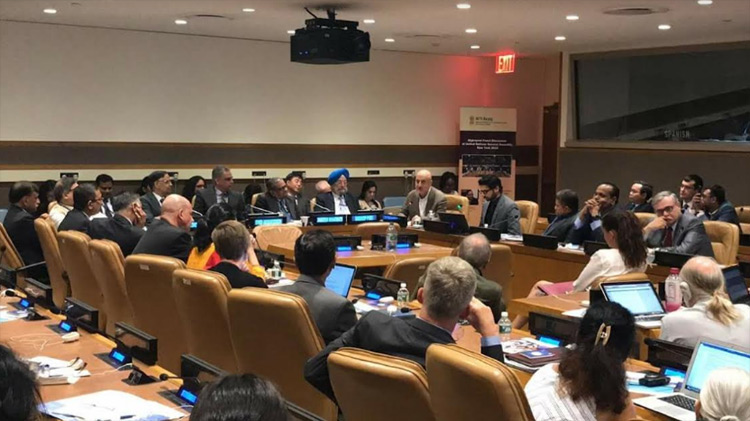
Chandrababu Naidu’s e-governance schemes get international acclaim The meeting of the High-Level Political Forum (HLPF) on Sustainable Development, 2017 convened under the auspices of the United Nations Economic and Social Council, is seeing a participation from 44 countries that volunteered to present their national reviews. The event is being held in New York for 8 days from July 10 to July 19. The primary theme for discussion is “Eradicating poverty and promoting prosperity in a changing world”. Andhra Pradesh is the only State from India to take part in this High-Level Political Forum (HLPF).
Mr. Alen John Samuel C from Vision Management Unit, Planning Department represented Andhra Pradesh and made a detailed presentation addressing the excellencies and distinguished audience. The presentation included the state’s Sustainable Development Goals which focused on the “achieved” and “to-be achieved” by 2019 goals. The quick take-aways from the presentation are on Saturation, Assurances, Awareness, and E-Governance.
Mr. Alen John Samuel C., proudly claimed in his presentation that Andhra Pradesh has achieved saturation in providing electricity, social protection through pensions, clean and safe cooking fuel and affordable food through Public Distribution System. The saturation target for 2019 includes goals such as adequate water for all, connectivity using all-weather roads, high-speed internet in every village, literacy, and coverage of Individual Household Latrines. Saturation-mode development is the State’s strategy to ensure that no one is left behind. The assurances provided in the state include elementary education for all children, 100 days of wage employment per year under MGNREGS (Mahatma Gandhi National Rural Employment Guarantee Scheme), free health care coverage for Below Poverty Line families, safe and adequate water for all, affordable health care coverage for Above Poverty Line families, Kutumba Vikasam (Family Welfare), Maha Sankalpam (Pledge for state- building).
The awareness programmes in the state such as Badi Pilustondi (school is calling), Polam Pilustondi (Agriculture Development), Swachh Andhra (Clean and Hygienic Andhra Pradesh), Janma Bhoomi (for grievance redressal), Neeru Pragathi (Water Management), Vanam-manam (Forest Conservation) are conducted for seeking people’s participation in achieving key goals. The e-governance initiatives in the state are e-Pragathi enterprise architecture), Mee-Seva online and mobile app (online government services), CORE Dashboard, Single Desk portal, People First (an online grievance redressal system). The presentation also included economic development initiatives like the Coastal Economic and Employment Zones, industrial corridors, MSME Development Corporation, Economic Cities, retail parks, and promotion of small manufacturers and retailers, which are the key initiatives for attracting investments and creating jobs.
India as a signatory country organized a side event with Syed Akbaruddin, Ambassador and Permanent Representative of India to the United Nations, Dr. Arvind Panagriya, Vice-Chairman of NITI Aayog, Dr. T.C.A. Anand, Chief Statistician of GoI, Hardeep Singh Puri, Ambassador and Prof. Jagdish Bhagwati as panelists. The e-governance initiatives of Andhra Pradesh highlighted by Dr. Panagariya received immense appreciation, notably, the Chief Minister Office Real-Time Executive Dashboard (CORE Dashboard).
The State also received several requests for collaborations and partnerships. As a first mover on a full-fledge effort to oversee the governance of projects and basic services, it is timely for the state to attract investor confidence in its pursuit of Vision 2029. Double digit economic growth from 2015-2029 is a priority tool for the state to achieve its ambitious goals. HLPF carries out regular voluntary reviews of the 2030 Agenda which will include developed and developing countries as well as relevant UN entities and other stakeholders. The reviews will be state-led, involving ministerial and other relevant high-level participants, and provide a platform for partnerships, including through the participation of major groups and other relevant stakeholders.