
‘Will the Drug Work?’.. What If AI Tests It on a ‘Digital Human’ First?
- Published By: Tech Team
- August 14, 2026 / 04:00 PM IST


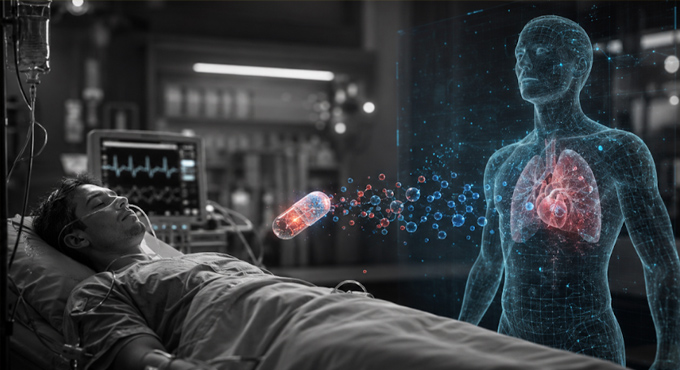
Imagine an ICU late at night. A patient is fighting for life. The heart monitor keeps beeping. Outside the room, the family is waiting anxiously. Inside, the doctor has a new drug in hand. At that moment, the drug is not just another prescription. It could be the patient’s last hope. But there is one question even the doctor cannot answer with certainty: Will this drug actually work for this patient?
A drug that worked very well for one patient may not work the same way for another. That is because every human body is different. Our DNA is different. Our cells behave differently. Even the way our bodies react to the same medicine can vary from person to person.
That creates a difficult situation for doctors. If the patient is seriously ill, there may not be much time to wait. The drug has to be given, but its exact effect may not be known in advance. So the question becomes very simple, but extremely important: What if we could know more before giving the drug?
That is where a new idea involving AI is entering the picture.
What if the drug could be tested first?
Imagine that before giving a drug to a patient, scientists could create a digital model of that patient’s biological system inside a computer. The drug could then be tested in that digital system first.
Scientists could try to see how cells might react, how biological processes could change and what kind of result the treatment might produce.
It sounds like something from a science-fiction movie. But researchers are now seriously working toward this kind of biological simulation.
A team led by Eric Xing has published a paper in Nature Medicine titled “How to Build an AI-Driven Digital Organism.” The paper presents a roadmap for a system called AIDO.
The basic idea is quite ambitious. Instead of studying DNA, proteins, cells and tissues as separate pieces, AI models could connect them into one larger system. The goal is to understand how a change at one level could affect the next level, eventually leading to an impact on human health.
In simple terms, imagine a chain reaction inside the body. A change in DNA can affect a protein. That protein can change the behaviour of a cell. The change in cells can affect tissues. Eventually, the entire process can influence health.
If AI can simulate such a chain of events, scientists may be able to understand the possible effects of a drug or genetic change before testing it in the real world.
A flight simulator for medicine
Xing compared this idea to a flight simulator for medicine.
A pilot does not learn how to handle every dangerous situation for the first time in a real aircraft. A flight simulator can recreate different situations and allow the pilot to see what might happen.
The researchers want biology to work in a similar way.
Instead of immediately testing every possibility in the real world, scientists could first use AI-based biological simulations to explore what might happen when a drug or other intervention enters a biological system.
That does not mean a computer will replace doctors or clinical trials. It means AI could become an additional step before expensive and time-consuming real-world testing.
The ‘Digital Human’ is still far away
There is an important point to understand here. Scientists have not already created a complete digital human that behaves exactly like a real person.
That is still a much bigger challenge.
The near-term goal is more realistic: building systems such as a virtual cell that can combine different kinds of biological information and predict how cells may respond to different interventions.
GenBio AI, the company co-founded by Xing, is also working on virtual-cell technology. The broader scientific community is exploring similar ideas, with several research groups trying to build AI systems that can understand and predict cell behaviour.
So this is not about creating a digital person tomorrow. It is about gradually building the pieces needed to simulate biology at different levels.
Why could this matter?
Developing a new drug takes years and costs a huge amount of money. Many potential drug candidates fail somewhere along the way.
If AI can help scientists identify weak drug candidates much earlier, they may be able to avoid spending years testing treatments that are unlikely to work.
It could also help researchers ask better questions.
Instead of simply asking, “Does this drug work?”, they could begin asking, “Under what biological conditions is this drug most likely to work?”
That difference could become very important in the future of medicine.
The biggest promise is not that AI will suddenly become a doctor. The real opportunity is that AI could become a powerful filter and simulation tool before a drug reaches expensive animal studies and clinical trials.
But there is a big problem
The human body is not a simple computer program.
Every person has biological differences. Medical data can contain gaps and biases. And AI can sometimes find a relationship between two things without proving that one actually causes the other.
So even if a computer simulation predicts that a drug may work, that does not automatically mean the drug will work in a real patient.
That is why researchers see these systems as a support tool, not a replacement for real-world testing.
Finally…
If this technology succeeds, it could change one of the most important questions in medicine.
Today, we often ask:
“What drug works for this disease?”
In the future, we may be able to ask something much more personal:
“What drug is most likely to work for this patient?”
That is the real promise behind the idea of an AI-driven digital organism.
It is not about replacing the human body with a machine. It is about trying to understand the human body before making a decision that could affect it.
And if scientists can eventually make that possible, the day may come when a drug is not simply tested and then given to a patient.
It may first be tested in a digital version of biology — before the real patient ever receives it.
— Suryaprakash Josyula