

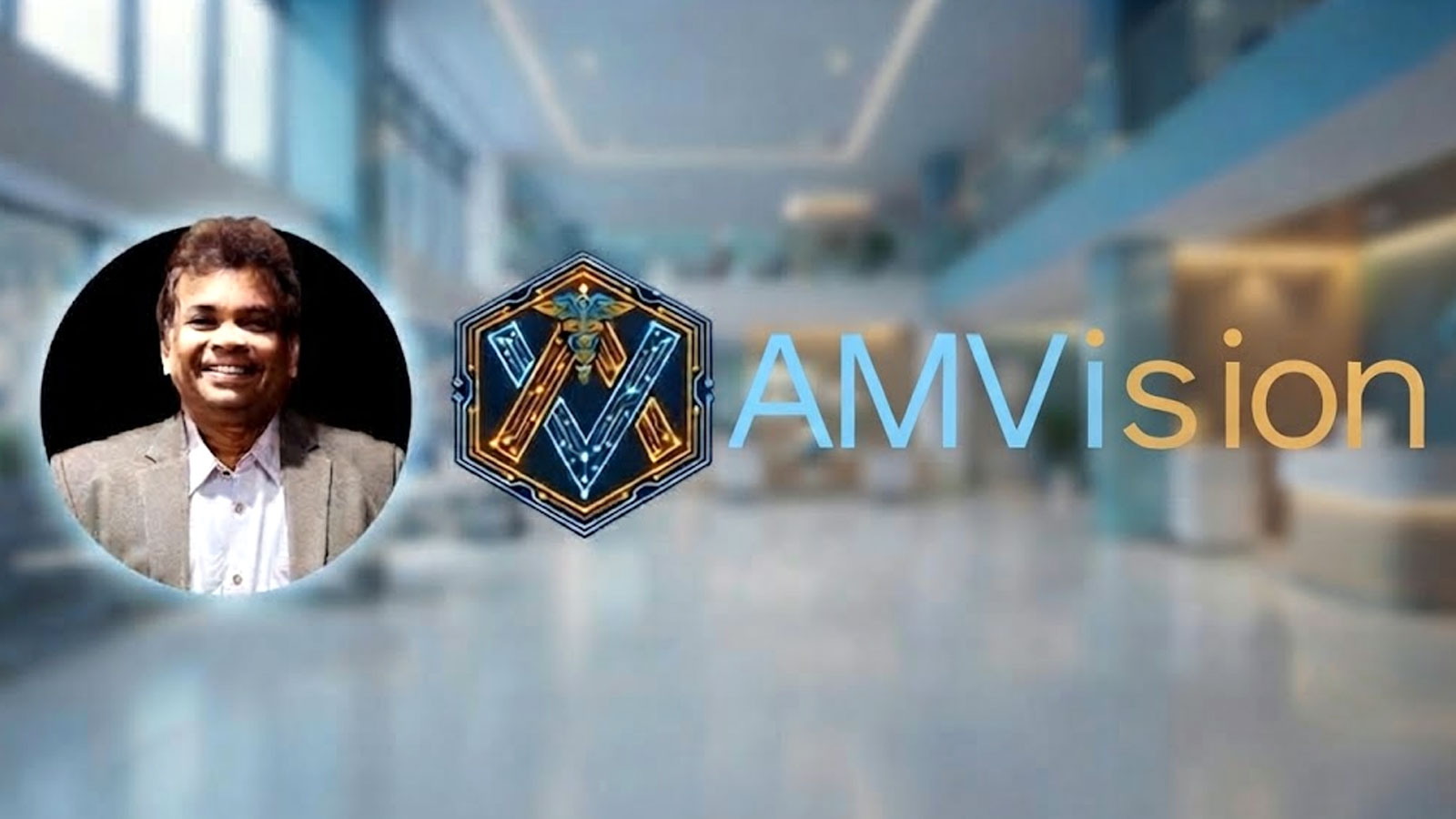
Transforming Healthcare Technology: Inside AMVIsion with Desai Siddabathula
- Published By: Tech Team
- September 20, 2026 / 01:38 PM IST


- Telugu Times Exclusive
Desai Siddabathula CTO, AMVI Software Inc, COO, Paladin ITC, the visionary behind AMVIsion, recently sat down for an exclusive interview with Telugu Times to discuss how this advanced browser-based medical imaging and radiology platform is transforming the healthcare technology sector.
1. First of all, what is AMVIsion and how does it work?
AMVIsion is a browser-based medical imaging and radiology platform. The basic idea is to make it easier for physicians to access, review, and compare medical images without depending on a specific workstation or heavy desktop software.
It includes a DICOM viewer, radiology workflow, our Glass Pane View, and AI-assisted capabilities in one environment. It supports a wide range of medical imaging, including X-ray, CT, MRI, mammography, ultrasound, dental imaging, and many other studies.
Our focus is to make imaging information easier for physicians to access and use while keeping the clinical decision with the medical professional.
2. When and how did you get the idea to develop a zero-footprint, entirely browser-based AMVIsion, unlike traditional medical imaging methods?
The idea came from our experience working with healthcare technology and medical imaging.
We saw that many imaging applications depend on software installed on individual workstations. That creates additional installation, maintenance, and upgrade requirements and can also limit where a physician can conveniently access images.
We felt that modern web technology could simplify that experience. That led us toward a zero-footprint, browser-based approach, where an authorized user can access AMVIsion through a browser without installing a large imaging application on every workstation.
It started with a simple question: Can we make medical imaging easier to access without making the technology more complicated for the physician?
3. How does this platform completely remove the hassle of installing heavy desktop software in hospitals?
Because AMVIsion is browser-based, the main application does not have to be installed separately on every physician’s workstation.
Users can access the platform through a supported browser, subject to the hospital’s security and access controls. Improvements and application updates can also be managed centrally rather than requiring the same software to be updated individually across many workstations.
For hospitals and IT teams, this can simplify deployment and ongoing maintenance. For physicians, the benefit is a more consistent way of accessing imaging without being tied to one particular computer.
4. Since it is said that the AI assistant in AMVIsion does not replace doctors, how does it provide accurate results in reducing doctors’ workload?
We see AI as an assistant to the physician, not as the physician.
During our development and evaluation work, we have evaluated more than 1,000 imaging studies, with results showing accuracy within industry-acceptable levels. We continue to evaluate and improve the technology as we work with additional studies and clinical environments.
AI can help identify information that may deserve the physician’s attention and assist with some of the repetitive aspects of reviewing imaging information. The intention is to help the physician work more efficiently, not to allow AI to independently make a clinical decision.
The physician reviews the information and remains responsible for the final clinical interpretation and patient-care decision.
5. How does the agreement with the Kathmandu Institute of Child Health (KIOCH) in Nepal help to further improve your platform in a real clinical environment?
The KIOCH collaboration is important because there is a difference between developing technology in a controlled environment and understanding how it fits into everyday healthcare.
Working with Kathmandu Institute of Child Health gives us an opportunity to learn from healthcare professionals using the technology in a real clinical setting. Their feedback can help us understand what works well, what needs to be simplified, and where improvements are needed.
For us, the purpose is not simply to deploy AMVIsion. It is also to listen, learn, validate, and improve the platform based on real healthcare needs.
6. What security standards are followed in securing patient-related private medical images and data on the cloud platform?
Patient privacy and security are fundamental considerations in the design of AMVIsion.
The platform uses security practices such as controlled access, authentication, encryption of information during transmission and storage, role-based permissions, and auditing of access and activity.
Healthcare requirements can also differ depending on the country and organization where the platform is deployed. We therefore work with healthcare organizations to address the privacy, security, and regulatory requirements applicable to each implementation.
We view security as an ongoing responsibility rather than a one-time feature.
7. How much does examining CT and MRI images in Axial, Coronal, and Sagittal angles help doctors in diagnosis?
CT and MRI studies contain information that can be viewed from different perspectives. Axial, Coronal, and Sagittal views allow physicians to examine the same anatomy from different directions.
AMVIsion provides these viewing capabilities directly within the browser-based imaging environment. This gives physicians the flexibility to navigate the study according to their clinical needs rather than being limited to a single view.
These are established and important tools in medical imaging, and our objective is simply to make them easy and responsive for the physician to use.
8. What were the technical challenges you faced in bringing data from different devices like X-ray, CT, MRI, ultrasound, and ECG onto a single platform?
One challenge is that healthcare environments are rarely uniform. Hospitals may have equipment from different manufacturers, different generations of technology, and different types of imaging.
The challenge was therefore not simply displaying an image. We needed to build an environment capable of handling information from many different sources while giving physicians a consistent experience.
AMVIsion supports more than 300 DICOM SOP Classes, covering a broad range of imaging types. We have tried to use established healthcare standards wherever possible rather than expecting hospitals to change their existing equipment around our platform.
There is still more work to do as we encounter different environments, and interoperability continues to be an important area of development for us.
9. How much faster are radiologists and clinicians reviewing reports than usual by using this platform?
We expect AMVIsion to reduce some of the time physicians spend searching for previous studies, moving between systems, or accessing imaging from different locations.
For example, Glass Pane View makes it easier to bring current and previous studies together for comparison, while the browser-based approach can simplify access to imaging.
However, we are not currently putting a specific percentage on how much faster a radiologist can work. That needs to be measured properly in real clinical workflows and across a meaningful number of users.
We prefer to collect that data and publish measurable results rather than make an estimate.
10. Are there any thoughts of bringing more new features or services through AMVIsion in the healthcare sector in the coming days?
Yes, AMVIsion will continue to evolve, but we want that evolution to be driven by actual healthcare needs rather than simply adding more features.
We are continuing work around AI-assisted imaging, Glass Pane, radiology workflow, advanced viewing, collaboration, and integration with other healthcare systems.
Feedback from physicians and healthcare organizations will influence our priorities. If a feature does not make the physician’s work easier or contribute to better access to information for patient care, there is little value in adding it simply because the technology is available.
11. What is your advice to youngsters who want to come to the healthcare technology sector from a software engineering and management background?
My advice is to understand the healthcare problem before trying to solve it with technology.
Software engineers naturally want to build things, and today there is tremendous excitement around AI. But healthcare is an area where accuracy, reliability, privacy, and patient safety are extremely important.
Spend time with doctors, radiologists, technicians, nurses, and the people actually using healthcare systems. Listen to the problems they face before deciding what technology they need.
For someone coming from management, it is equally important to understand both sides—the technology and the clinical environment.
You don’t have to know everything when you start. Be willing to learn, listen to the healthcare professionals, and remember that behind the technology there is ultimately a patient.
For more information about AMVIsion: amvi.ai
Related News

Can Humans Have Sex in Space? And What Happens If They Do?

Why Did America’s Spy Agency, the CIA, Come Looking for Steve Jobs?

The Shocking Truth a Mother Found on TikTok After Her Son Died

America Moves First in Venezuela’s Oil Hunt. Where Does That Leave India?

Why Did Elon Musk Name His Son ‘Sekhar’? The Story of the Great Indian Scientist Behind the Name