

The Shocking Truth a Mother Found on TikTok After Her Son Died
- Published By: Tech Team
- September 3, 2026 / 11:00 AM IST


Losing a child is a pain no parent can ever truly overcome. It is even harder when the child has barely begun to experience life. But what if the parents later discover that their child’s death may have been connected to TikTok? What if they learn that the child had been part of an experiment conducted by the app itself?
“A 16-year-old boy may have lost his life because of an experiment conducted by an app.”
That may sound exaggerated at first. But this is the disturbing question now hanging over TikTok in the United States.
The boy’s name was Chase Nasca. His death left his family searching for answers. What exactly was TikTok’s experiment? And how did Chase become part of it? The story begins there.
Chase was a 16-year-old boy from Long Island, New York. He was known as a good student and a talented athlete. He had plenty of friends and was close to his family. According to his family, he had no known history of mental health problems.
But in early 2022, something began to change.
Until then, Chase had mostly shared funny and entertaining TikTok videos with his friends. Suddenly, he began sharing videos related to suicide. His friends did not understand what was happening. His family, too, did not see any clear signs that he was going through such deep emotional pain.
Then, just a few weeks later, Chase took his own life.
His family was left with a question they could not answer: Why?
That was when his mother began looking through his social media accounts.
The Clue Hidden in His TikTok Account
What Chase’s mother found on his TikTok account came as a shock.
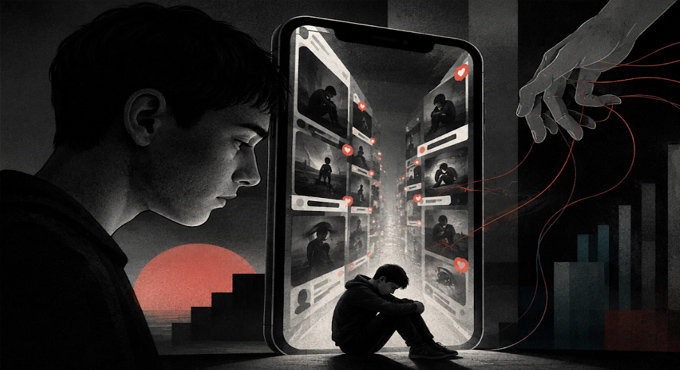
The app appeared to be showing him the same kind of content again and again.
Depression. Loneliness. Hopelessness. Suicide.
Video after video seemed to lead him deeper into the same dark world. Later reports said that some of the content he watched was related to suicide and self-harm, while some videos were found to have violated TikTok’s own rules.
Until then, Chase’s family had no idea what he had been watching in the days before his death. Looking at his TikTok account left them with one troubling question:
Why was a 16-year-old being shown so much disturbing content?
The question did not end there.
A Journalist’s Question Triggered an Internal Investigation
Nearly a year after Chase’s death, Bloomberg Businessweek journalist Olivia Carville began investigating his story.
After examining the videos connected to Chase’s TikTok experience, she approached the company with a direct question: Why had Chase’s account been shown such a large amount of content related to depression and suicide?
That question reportedly led TikTok to conduct an internal investigation.
The company went back and examined the videos Chase had watched in the days before his death. It analyzed his viewing history. According to an internal report, TikTok reviewed 7,563 videos that Chase watched during his final two weeks.
What the investigation found was even more troubling.
About 73 percent of the videos Chase watched were reportedly related to depression, personal struggles, or emotional distress. Later, U.S. senators said that nearly 10 percent of the videos had violated TikTok’s own policies.
But the biggest shock was still to come.
The Safety System Was Not Working for Chase
In 2021, TikTok introduced a safety measure to prevent users from being trapped in a constant stream of the same harmful content.
The idea was simple. If someone began watching videos about depression, for example, the algorithm was supposed to avoid endlessly feeding that person more and more of the same kind of content. It was designed to break that pattern and prevent users from falling too deeply into a harmful “content bubble.”
But TikTok did not roll out this safety feature to everyone at the same time.
Instead, according to internal documents, about 10 percent of TikTok’s users in the United States were kept on the older system as part of an experiment. That group included roughly 15 million people.
Chase was one of them.
According to TikTok’s internal documents, the safety system was not missing from Chase’s account because of a technical mistake. He was part of an experiment.
Chase was reportedly placed in this experimental group in January 2022. After that, his account gradually became trapped in what has been described as a “filter bubble.” Videos about depression, self-harm, and suicide were repeatedly recommended to him.
Within a month, Chase was dead.
But Why Did TikTok Conduct This Experiment?
The confidential documents suggest that TikTok wanted to understand whether the new safety system affected user engagement.
Put simply, the company wanted to know: If users were protected from harmful content, would they spend less time on TikTok?
To find out, millions of users were divided into two groups.
One group received the new safety system. The other continued with the old system.
Chase was in the second group.
The revelations have now drawn strong criticism from U.S. Senators Marsha Blackburn and Richard Blumenthal. One question, in particular, has angered them:
Why were minors included in an experiment that involved withholding a safety feature?
In the End, One Question Remains
No one has yet established a direct causal link between TikTok’s experiment and Chase Nasca’s death. Suicide is a complex issue, and no single factor can automatically be blamed for such a tragedy. Investigations and further explanations from the company may still be needed to answer the questions surrounding his death.
But the case has revealed something deeply uncomfortable.
Experiments conducted by technology companies are no longer limited to changing the colour of a button or testing a new feature. Algorithms now influence what we see, how long we stay online, and how deeply we can be drawn into a particular kind of content.
And when human lives are caught somewhere inside those experiments, a bigger question emerges:
Who is responsible?
That is the question TikTok—and perhaps every major social media company—will increasingly have to answer.
— Surya Prakash Josyula
Related News

The Miracle Behind Every Dawn

Transforming Healthcare Technology: Inside AMVIsion with Desai Siddabathula
Can Humans Have Sex in Space? And What Happens If They Do?
Why Did America’s Spy Agency, the CIA, Come Looking for Steve Jobs?

America Moves First in Venezuela’s Oil Hunt. Where Does That Leave India?