Why Did America’s Spy Agency, the CIA, Come Looking for Steve Jobs?
- Published By: Tech Team
- September 3, 2026 / 11:45 AM IST


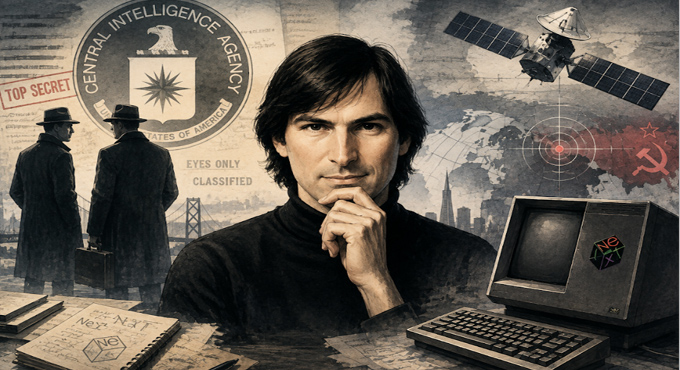
When we hear the name Steve Jobs, we immediately think of Apple, the iPhone, and the technology that changed the world. But imagine this: What if officials from America’s famous spy agency, the CIA, came looking for Steve Jobs? That would certainly be big news. Yet when it actually happened nearly 40 years ago, the story remained largely secret. Only now have details of this fascinating connection reached the public.
So, what did the CIA want with Steve Jobs? Did they want to recruit a brilliant man like him as a spy? Did they need his help for some secret mission? Not at all. The real reason was something completely different.
Steve Jobs Was Going Through a Difficult Time
This story happened in 1986. The Steve Jobs we remember today was one of the world’s most successful technology leaders, but his situation was very different at that time. He had been pushed out of his own company, Apple. Yes, Steve Jobs—the co-founder of Apple—had to leave the company that would later become one of the world’s most successful businesses.
After leaving Apple, Jobs started a new computer company called NeXT. But starting a company is one thing and making it successful is another. NeXT needed money, big customers, and a strong reputation in the market. While Jobs was trying to deal with all these challenges, some very unexpected visitors came looking for him.
They were officials from the CIA.
But what could America’s intelligence agency possibly want with Steve Jobs? That is where the real story begins.
The Cold War Created a Big Problem
At that time, the world was in the middle of the Cold War. The United States and the Soviet Union were closely watching each other. Spy satellites were flying above the Earth and taking huge numbers of photographs.
However, the CIA had a growing problem. Taking photographs was possible, but understanding everything inside those photographs was much more difficult. A satellite image might show a newly built missile base. Another could reveal military vehicles moving from one location to another. A third might show changes at a nuclear facility.
Going through thousands of such images with human eyes took enormous amounts of time. The intelligence agencies needed faster and more powerful ways to process and analyse information. Eventually, the CIA realised something important: they needed better computers.
Then the CIA Noticed Silicon Valley
At the same time, Silicon Valley was going through a major technological revolution. New companies were appearing, new software was being developed, and computers were becoming more powerful.
Some CIA officials began asking an important question: Could Silicon Valley’s latest technology be useful for intelligence work?
But there was another condition. Much of this work had to remain secret. The CIA needed advanced technology without revealing too much about what it was actually planning to do.
During this search, their attention turned towards Steve Jobs and his new company, NeXT.
The CIA was not interested in Steve Jobs because they wanted to turn him into a spy. What interested them was the advanced computer technology being developed by his company.
“How Many Computers Can You Make?”
CIA representatives eventually met Steve Jobs and asked him a simple but unusual question:
“How many computers can you manufacture in a year?”
Jobs reportedly did not immediately understand what was behind the question, but he knew that something unusual was happening. The CIA officials were not revealing their real purpose.
Jobs was also careful about discussing his company’s production capacity. Instead, he asked them how many computers they needed.
The answer was surprising.
20,000 computers.
The CIA wanted thousands of NeXT workstations. However, there was one major detail they did not fully explain to Jobs: exactly what those computers would be used for.
Steve Jobs Knew It Was a Secret
This was not an ordinary business deal. It was connected to a highly secret government program, and the CIA did not reveal the complete details of its mission to Steve Jobs.
Jobs understood that this was a sensitive and secret operation. According to accounts of the meeting, he reportedly made it clear that he did not want to know information that he did not need to know.
For Jobs, the details of the secret operation were not the main concern. What mattered was the business opportunity. An agreement was reached, and NeXT began working on the order.
Why Was This Deal Important for Jobs?
At that time, NeXT needed money and major customers. It was a new company selling expensive computers, and its business was still far from secure.
So, the possibility of a large order involving thousands of computers was a major opportunity for Steve Jobs and his company.
It was not only about money. When a major customer shows interest in a company’s technology, it also sends an important message to the market:
“This technology is worth taking seriously.”
For a young company trying to establish itself, that kind of confidence could be extremely valuable.
The Interesting Twist
When CIA officials came looking for Steve Jobs in 1986, nobody could have predicted what would happen in the years ahead.
Eventually, Apple bought NeXT. Steve Jobs returned to Apple, and the company’s history changed dramatically.
Mac OS X arrived. Then came the iPod. Later, the iPhone changed the mobile phone industry and transformed Apple into one of the world’s most valuable and influential technology companies.
That is why the connection between the CIA and Steve Jobs’s NeXT company remains such an interesting story today.
Nearly 40 years ago, Steve Jobs was trying to build a new company after being forced out of Apple. At that difficult moment, one of America’s most secretive intelligence agencies came looking for him.
And they were not looking for a spy.
They were looking for his technology.
— Surya Prakash Josyula
Related News

The Miracle Behind Every Dawn

Transforming Healthcare Technology: Inside AMVIsion with Desai Siddabathula

Can Humans Have Sex in Space? And What Happens If They Do?

The Shocking Truth a Mother Found on TikTok After Her Son Died

America Moves First in Venezuela’s Oil Hunt. Where Does That Leave India?