

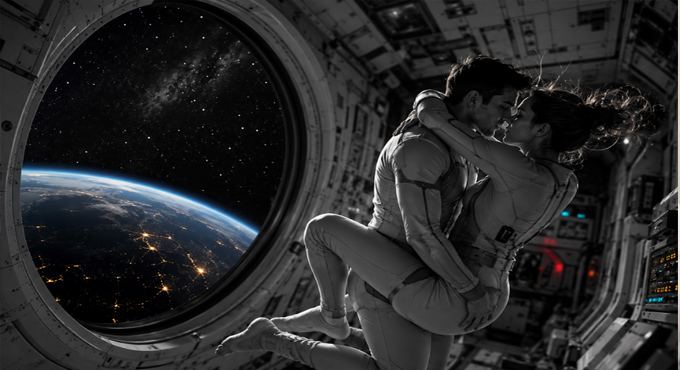
Can Humans Have Sex in Space? And What Happens If They Do?
- Published By: Tech Team
- September 3, 2026 / 03:00 PM IST


—Surya Prakash Josyula
Space entrepreneurs like Elon Musk hope that humans will settle on Mars within the next few decades. It sounds exciting, of course, but the reality of living beyond Earth could bring a number of completely new challenges. Scientists are now beginning to explore some of these questions, including one that may sound strange at first but could be extremely important for the future of humanity.
Just imagine the year 2050. Humans have already established settlements on Mars. Small colonies have been built, houses are occupied, and food crops are being grown. Perhaps, one day, children may even be going to school there.
But wait. Children going to school?
That raises a much bigger question: Can children actually be born on Mars?
This is one of the questions we often forget when talking about the future of Mars. We discuss rockets, space colonies and plans to send thousands of people to another planet. We think about how people will build houses, produce food and survive in an unfamiliar environment. But one very basic question still remains unanswered: Can humans have sex outside Earth, and can they reproduce there?
It may sound unusual, but the answer could be critical to the long-term future of human settlements beyond our planet.
What Happens When Space Tourism Becomes Normal?
Space travel may not remain limited to professional astronauts forever. In the coming decades, ordinary people with enough money could also travel into space. Several companies are already working on plans for commercial space stations and hotels that could orbit the Earth.
That naturally raises some interesting questions about human behaviour. One researcher jokingly pointed out that everyone knows what people sometimes do when they stay in hotels. After all, humans will still be humans, whether they are on Earth or hundreds of kilometres above it.
However, sex in space may be far more complicated than it sounds.
Has Anyone Ever Had Sex in Space?
The surprising fact is that there has never been an officially confirmed case of humans having sex in space. Humans have been travelling into space for decades. They have walked on the Moon and spent months living aboard space stations. Yet, we still do not know exactly what a sexual encounter in zero gravity would be like.
Science fiction films may have imagined it for years, but real life presents a very different set of challenges.
Before asking how sex would physically work in space, scientists have another question to consider: Would people even feel interested in sex during a demanding space mission?
Does Space Travel Kill the Mood?
Some researchers have studied volunteers living in environments designed to simulate Moon or Mars missions. These participants spent weeks in isolated conditions with limited contact with the outside world. They had little privacy, restricted food supplies and strict daily schedules.
The results were interesting. In many cases, sexual desire and arousal dropped significantly. The combination of stress, lack of privacy and the demanding nature of the mission appeared to reduce people’s interest in sex.
Researchers have even used the term “Mission-Imposed Abstinence” to describe this situation. In simple terms, the conditions of a space mission themselves may make people less interested in sexual activity.
So, reaching Mars may be exciting, but living there could be stressful enough to affect even the most basic human desires.
But What If People Do Want to Have Sex?
This is where zero gravity creates an entirely different problem.
On Earth, gravity keeps our bodies firmly in place. In space, however, everything floats. If two people push against each other, Newton’s Third Law comes into play: both bodies can move in opposite directions.
In other words, something that happens naturally and easily on Earth could become physically difficult in a weightless environment.
Scientists and space enthusiasts have already suggested possible solutions, including special suits or systems that could help two people remain close together. Human beings are known for finding creative solutions to difficult problems, so the physical challenge itself may eventually be solved.
But sex is not the biggest issue.
The Real Question Is Pregnancy
Things become much more serious when pregnancy enters the picture.
Imagine that a woman becomes pregnant during a space mission. Would the fetus develop normally? Could the pregnancy continue safely for nine months? How would doctors monitor the mother and the developing baby? And how would childbirth take place in space?
The truth is that scientists still do not have complete answers to these questions.
Human life has evolved on Earth under the influence of gravity for billions of years. Our bones, muscles, heart and blood circulation have all developed in an environment where gravity is always present. The process of pregnancy and fetal development has also evolved under Earth’s gravitational conditions.
So, what happens when gravity is greatly reduced—or disappears altogether?
We simply do not know enough yet.
How Would Doctors Perform Pregnancy Tests in Space?
Even basic medical procedures could become difficult in zero gravity. On Earth, an ultrasound examination is relatively simple. The patient lies on a bed while the doctor performs the scan.
In space, however, the patient could be floating, the doctor could also be floating, and even medical equipment might need to be carefully secured.
Scientists are already studying how medical examinations can be carried out in weightless conditions. Some experiments have taken place on special aircraft that briefly create microgravity by flying in a parabolic pattern and entering short periods of free fall.
During these brief moments of weightlessness, researchers have tested ultrasound techniques involving the female reproductive system. These experiments may seem small today, but they could become extremely important in the future.
If a female astronaut faces a medical emergency during a long space mission, doctors may not have the luxury of sending her back to Earth immediately. Medical teams will need to know how to diagnose and treat reproductive health problems in space.
What If Natural Pregnancy Is Not Possible?
Scientists are also exploring other possibilities, including IVF, or in-vitro fertilisation.
A Netherlands-based company is developing a small IVF system designed to operate in zero gravity. The idea is to create technology that could eventually help scientists understand whether embryos can develop safely in space.
The company has already tested a prototype space incubator. Its first mission involved sending yeast cells into space, and the cells survived the journey. The next step could involve sending fertilised mouse embryos into space to study how early development is affected by the space environment.
If these experiments are successful, research into human reproduction beyond Earth could eventually move into a completely new phase.
Would a Baby Born in Space Be Different?
This is perhaps the biggest question of all.
Scientists already know that spending long periods in space can affect the human body. Astronauts can experience bone loss, muscle loss and changes in blood circulation. Spaceflight may also affect the immune system and even the eyes.
Now imagine a fetus developing in that environment.
A developing baby is not simply adapting to space after being born. Its entire body, including its bones, brain, muscles and organs, would be forming under conditions that humans have never experienced during normal pregnancy.
Would the child develop normally?
Could a human born on Mars eventually become physically different from a human born on Earth?
At the moment, nobody knows.
Could a Child Born on Mars Ever Return to Earth?
This question may sound like science fiction, but scientists are taking it seriously.
Imagine a child who is born and raised on Mars. Their body would grow under much lower gravity than Earth’s. They would also live in a very different environment and may be exposed to a completely different range of microbes.
If that person later travelled to Earth, could their body handle Earth’s much stronger gravity? Would their bones and muscles be strong enough? Could their immune system cope with the enormous variety of bacteria and other microorganisms found on Earth?
These questions still do not have clear answers.
It is possible that humans born and raised on another planet could find returning to Earth physically difficult—or even dangerous.
The Biggest Challenge of Living Beyond Earth
Humanity may soon develop rockets capable of carrying people to Mars. We may build houses, grow food and establish entire colonies there.
But building a permanent human civilisation on another planet will require much more than rockets and buildings.
At some point, people would need to answer a much bigger question: Can humans safely reproduce and raise healthy children beyond Earth?
Going to Mars is one thing. Living there permanently is another. But building families and creating future generations there could be the greatest challenge of all.
The first human to walk on Mars will undoubtedly make history. But perhaps an even more extraordinary moment will come when the first healthy child is born beyond Earth.
Because that would not simply be the birth of a baby.
It could mark the moment when humanity truly becomes a multi-planet species.
Related News
The Miracle Behind Every Dawn

Transforming Healthcare Technology: Inside AMVIsion with Desai Siddabathula

Why Did America’s Spy Agency, the CIA, Come Looking for Steve Jobs?
The Shocking Truth a Mother Found on TikTok After Her Son Died

America Moves First in Venezuela’s Oil Hunt. Where Does That Leave India?