
AI is borrowing billions to build the future. But who will pay the interest?
- Published By: Tech Team
- August 18, 2026 / 09:27 AM IST


— Surya Prakash Josyula
We all know the story behind the name “Vaddi Kasula Vadu”, popularly associated with Lord Venkateswara of Tirumala. According to the traditional story, Srinivasa needed money for his wedding with Padmavati Devi. He approached Kubera, the god of wealth, and borrowed money to meet the wedding expenses.
But a loan is never just a loan. There is always interest attached to it. The traditional belief says that Srinivasa would repay Kubera through the offerings made by devotees during the Kali Yuga. That is how the idea of the “Vaddi Kasula Vadu” became part of the Tirumala tradition.
Now comes the strange part. The AI industry is beginning to look surprisingly similar.
AI companies are spending enormous amounts of money today, hoping that tomorrow’s AI business will generate enough revenue to justify that spending. The difference is that AI has no temple hundi. It has investors, bond markets, customers and cash flows.
And the numbers are getting difficult to ignore.
AI Needs Its Own Kubera
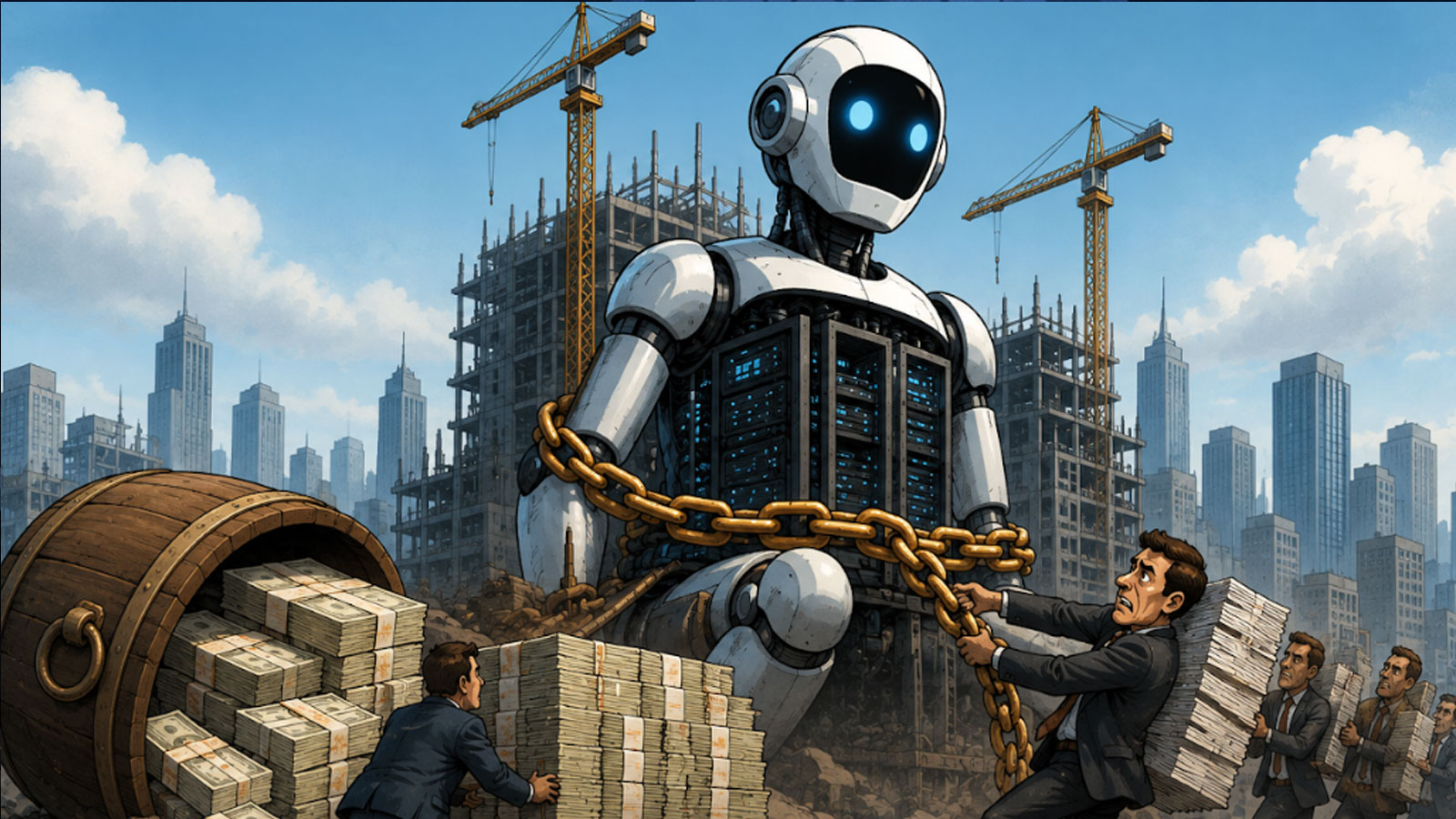
The biggest cost of AI is no longer simply developing an AI model. The real expense comes from running these systems at enormous scale.
Millions of users need computing power. That means massive data centers, advanced AI chips, servers, cooling systems and huge amounts of electricity. Companies are also investing in power infrastructure because the next generation of AI will require enormous amounts of energy.
All of this requires capital.
A lot of it.
That is why technology companies are increasingly turning to the debt market. According to Goldman Sachs Research, AI-related debt issuance in 2026 is approaching ₹5 lakh crore.
That is not the borrowing of a single company. It represents a much wider financing wave around hyperscalers, data centers, project finance and the broader AI ecosystem.
In other words, AI has found its own Kubera.
Except this time, Kubera is not sitting in a mythological story. He is sitting in the global bond market.
So, Who Is Giving AI All This Money?
This is where the story becomes more interesting.
When a company needs billions of dollars, it does not necessarily walk into a bank and ask for a giant loan. Large technology companies can raise money by issuing corporate bonds.
Investors then buy those bonds. These investors can include insurance companies, pension funds, asset managers, banks, mutual funds and private-credit firms.
So when we say that a technology company has borrowed money, the lender may actually be part of a much larger financial network.
And nobody in that network is lending money for free.
They want a return.
That return is the interest.
The Debt Comes With a Bill
Suppose an AI company wants to build a massive new data center. The project may cost billions of dollars, so the company raises part of that money through bonds.
Investors provide the capital. The company gets the money and builds the infrastructure.
But the story does not end there.
The company now has to make regular interest payments. When the bond reaches maturity, it also has to return the principal amount to investors.
That means the data center has to do more than simply operate.
It has to generate enough economic value to support the debt behind it.
This is the part that often gets lost in the excitement around AI.
The chips are expensive. The electricity is expensive. The data centers are expensive. And the money borrowed to build them is not free.
And Then AI Wants Another Data Center
Here is where the financial cycle becomes interesting.
An AI company builds one data center. Demand grows. It needs another one. Then it needs more GPUs, more servers, more power and more computing capacity.
The company therefore needs more capital.
If its own cash is not enough, it can raise more debt.
And that new debt comes with another interest bill.
So the cycle starts looking like this:
More AI demand → more infrastructure → more capital → more debt → more interest → more revenue needed.
If AI revenue grows fast enough, this can become a powerful growth machine.
But if revenue does not grow as expected, the same machine can start looking very different.
It can become a debt trap.
This Is Where the Venkateswara Story Comes Back
The comparison with the traditional Tirumala story is surprisingly simple.
In the traditional belief, devotees make offerings at the temple, and those offerings are associated with the repayment of Srinivasa’s debt to Kubera.
AI has no hundi.
It has customers.
Companies pay for cloud services. Businesses pay for AI software. Users pay subscriptions. Enterprises pay for computing power and other AI services.
That revenue is expected to support the enormous cost of building and running AI infrastructure.
So the characters have changed.
Kubera has become the investor.
The hundi has become revenue.
The offerings have become customer payments.
And the debt still has to be serviced.
The story has changed.
The accounting has not.
But What If the Money Stops Coming In?
This is where investors have started paying closer attention.
What happens if AI revenues grow more slowly than expected? What if companies spend billions on data centers but the returns take much longer to arrive? What if interest rates stay high and refinancing becomes more expensive?
The pressure would first appear in the company’s financials.
Interest payments would consume more cash. Credit metrics could weaken. Credit ratings could come under pressure. Raising new debt could become more expensive.
And if the situation becomes severe, a company could face restructuring or even default.
That is when an AI problem can become a credit-market problem.
And Who Takes the Loss?
The answer is not necessarily just the AI company.
Remember who bought those bonds.
Insurance companies. Pension funds. Banks. Asset managers. Private-credit investors.
If a borrower cannot meet its obligations, investors holding that debt can face losses, depending on the structure and seniority of the bonds.
That is why this story is bigger than technology.
It is about the credit market that is financing the AI boom.
The important question is no longer simply how much money AI companies are spending.
The more important question is:
Who is financing that spending, and how confident are they that they will get their money back?
The Biggest Bet Is Not on AI. It Is on Future AI Revenue.
The AI industry is effectively making a huge bet on the future.
Companies are spending heavily today because they believe AI demand will be much larger tomorrow.
Investors are providing the capital because they believe those companies will generate enough cash to service the debt.
So underneath the AI boom sits a very simple financial equation.
Borrow today. Build today. Grow tomorrow. Pay the interest along the way.
The equation works beautifully if AI revenues explode.
But if the revenues disappoint, the debt remains.
And unlike a software bug, you cannot simply update it and restart.
The ₹5 Lakh Crore Question
Nearly ₹5 lakh crore of AI-related debt is now part of the broader financing story.
That number represents something bigger than the size of the AI investment.
It represents the scale of the financial bet being made on AI’s future.
The technology industry is betting that today’s massive infrastructure spending will create tomorrow’s massive cash flows.
Bond investors are making a similar bet.
They are effectively saying:
“We will give you the money today. You show us the returns tomorrow.”
That is where the AI story becomes a financial thriller.
Because AI may be changing the world.
But sooner or later, the bond market will ask a very old-fashioned question:
Where is the money to pay the interest?
And after that comes the even bigger question.
Will AI repay its mountain of debt — or will it keep paying the interest while the principal keeps growing?
At that point, even “Govinda” may be worth remembering.
Related News

CREDAI Hyderabad Announces Property Show 2026 at HITEX; Asserts Steady Real Estate Growth
Hyundai Motor India and Radio Mirchi Launch Traffic Quality Index (TQI) Across Seven Cities

Atlantic Watches Curates Special Swiss Timepiece Collection for Raksha Bandhan

Vedanta Power Reaffirms Commitment to India’s Energy Security on Independence Day
Cognizant Introduces Talent Accelerator Program for 489 New B-School Graduates in India