

Major Changes Coming to ChatGPT for Teens.. Shocking New Rules
- Published By: Tech Team
- August 19, 2026 / 10:40 AM IST


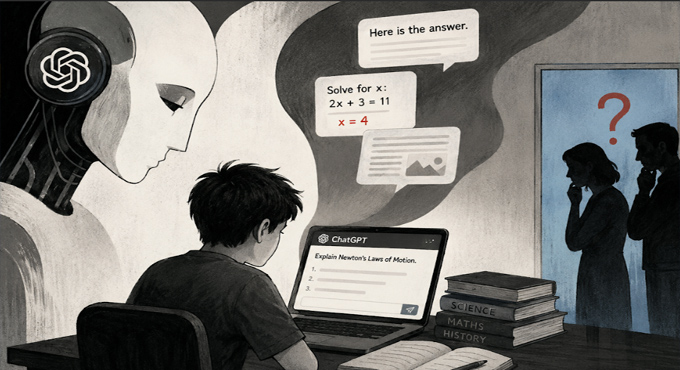
It is 7 p.m. There are school books on the table and a homework notebook next to them. But the 14-year-old boy is not opening his books. Instead, he takes out his phone, clicks a picture of the question and uploads it to ChatGPT. A few seconds later, the full answer appears on the screen. He copies it into his notebook, and his homework is finished in just 10 minutes.
His mother gets suspicious. “Finished so quickly?” she asks. The boy smiles and nods. But there is something she does not know. That day, her son finished his homework, but he did not actually learn the lesson.
And this is not just a one-day problem. What if AI gives him the answer to every maths problem? What if it writes every essay for him? What if it solves every doubt before he gets a chance to think? After some time, a child may stop asking, “What is the answer?” and start asking, “How should I ask ChatGPT?”
That is becoming a major concern for parents. Is AI making learning easier for children? Or is it slowly taking away their need to think? Could children become too dependent on ready-made answers from AI?
The Solution
OpenAI now says it has a solution for this problem. The company is rolling out ChatGPT for Teens, specially designed for users between 13 and 17 years old.
This is not simply another version of ChatGPT for children. It comes with new rules about how AI should interact with teenagers, how it should handle homework, and how it should respond to sensitive situations.
No More Direct Homework Answers
This is one of the biggest changes in Teen ChatGPT. Suppose a student asks ChatGPT to solve a maths problem. Instead of immediately giving the complete answer, the AI will guide the student through the problem step by step.
In simple terms, it is moving from “Here is your answer” to “Think about it first. I will help you.” The new Study Mode is designed for this purpose. It encourages students to understand the problem instead of simply copying the answer.
There will also be “responsible homework reminders.” These are designed to remind students when they appear to be using AI simply to finish an assignment instead of actually learning from it.
The idea is simple: AI should not study for children. AI should help children study.
AI Will Also Tell Them to Take Breaks
The concern is not only about homework. Teenagers may also spend a lot of time talking to ChatGPT. So during long sessions, Teen ChatGPT will give more frequent break reminders.
If a teenager spends too much time chatting, the AI may suggest taking a break. It will also remind users that they are talking to AI, not a real person.
Because no matter how natural AI sounds, it is still not a human being.
ChatGPT Should Not Become a “Friend”
This is another important change. ChatGPT will not use romantic language or terms of endearment with teen users. It will also be more strongly instructed not to make teenagers believe that it has feelings, emotions or consciousness.
The reason is simple. A child should use AI as a technology tool, not as a replacement for a real person. OpenAI is trying to reduce the risk of teenagers becoming emotionally dependent on AI.
Parents Will Get More Control
Parents will also get new controls. They can set Study Hours, during which Study Mode can be turned on by default. They can also set Quiet Hours, during which ChatGPT can be blocked completely.
So even if a child has access to a phone, parents will have some control over when ChatGPT can and cannot be used.
What If ChatGPT Detects Something Dangerous?
This is one of the most sensitive parts of the new system. If a conversation involves topics such as suicide, self-harm, eating disorders or violence, the system can trigger safety notifications.
This does not mean parents will automatically see every normal conversation their child has with ChatGPT. But if the system detects serious signs of danger, the safety system is designed to bring adults into the situation.
In other words, AI should not be the only one handling a serious problem involving a child.
Why Is OpenAI Being So Careful?
This is where the bigger story begins. OpenAI is facing lawsuits from some families who claim that interactions with ChatGPT harmed their children.
At the same time, more teenagers are using AI for schoolwork, advice and personal questions. That makes safety much more important.
For an adult, an AI answer can be questioned or ignored. But a teenager may be more likely to believe what an AI says. That is why OpenAI is now trying to change the way ChatGPT interacts with younger users.
The goal is not to keep children away from AI completely. Instead, the company is trying to put limits and safety rules around the way children use it.
When Will These Changes Start?
This is not a feature coming sometime in the future. OpenAI started rolling out the new Teen ChatGPT experience on August 18, 2026.
However, the changes may not appear for every user at the same time. The rollout is happening gradually, so if your teenager uses ChatGPT, the new rules may take some time to appear on their account.
The bigger change, however, is already here.
ChatGPT is no longer just trying to give children the right answer. It is being redesigned to make them think before getting the answer.
— Surya Prakash Josyula
Related News

A Remote Control That Could Control Your Body Like a TV! South Korean Scientists’ Shocking Experiment

Are More Indian Techies Returning From America? What Is Really Happening?

Special Update on Chiranjeevi’s Birthday for Mega158

“Panasapalli Fans Association” Movie Motion Poster Released

Sri City Celebrates 80th Independence Day with Patriotic Zeal