
Are More Indian Techies Returning From America? What Is Really Happening?
- Published By: Tech Team
- August 19, 2026 / 10:13 AM IST


For years, going to America meant one thing for many Indians — you had made it in life. For tech professionals, the US was the dream destination, offering higher salaries, big companies, global projects and better career opportunities.
That is why thousands of Indian tech professionals moved to America. But now, the direction is slowly changing. Some of those techies are coming back to India.
And the numbers are interesting. According to data from Bengaluru-based talent consulting firm Xpheno, around 9,800 Indian professionals returned from the US in 2024. The number rose to about 15,100 in 2025. So far in 2026, another 7,300 have reportedly returned.
But there is an important point. They are not all coming back because they failed to find jobs in America. The bigger problem is the growing uncertainty around those jobs.
For many tech workers, the question is no longer just “How much will I earn in America?” It is increasingly becoming “Will I still have this job next year?”
The US technology industry is already going through major layoffs. Companies are cutting jobs because of AI, automation and cost reduction. And for foreign workers, losing a job can create a much bigger problem.
Many Indian tech professionals in the US are on H-1B visas. If an H-1B worker loses a job, the person generally gets up to 60 days to find a new employer.
If a new job is not found within that period, the worker may have to leave the US.
So for an American worker, losing a job is one problem. For an H-1B worker, it can become two problems at the same time: “I lost my job, and I may also have to leave the country.”
That fear is becoming stronger as the US moves toward tougher immigration policies.
The proposed $100,000 fee for certain new H-1B applications created a major debate. Even though the policy has faced legal challenges, the larger message is clear: bringing foreign talent into America is becoming more expensive and complicated.
There has also been discussion around an additional $4,000 surcharge for certain H-1B extensions and renewals. For Indian tech workers, all these changes are forcing a rethink.
The calculation is changing from salary alone to salary plus stability.
And this is where India has changed dramatically.
Ten years ago, many high-skilled technology opportunities were concentrated in the US. Today, India has a much stronger technology ecosystem of its own.
The country now has nearly 2,000 Global Capability Centres, or GCCs. These are no longer just back-office operations. Many of them are working on AI, software, cloud computing, cybersecurity, product development and advanced engineering.
Industry data suggests that GCCs have been hiring roughly 100,000 people every year since 2023. Leading GCCs have also been hiring thousands of mid- and senior-level technology professionals.
Some of those professionals are returning from the US.
That changes the equation. Earlier, an Indian techie often had to go to America to get global experience. Today, that experience can be brought back to India.
Of course, there is still one major issue — salary.
A tech professional may earn much more in America than in India. But salary is no longer the only factor.
A high salary in America can come with visa uncertainty. A good job can still disappear during a layoff. And for families, immigration uncertainty can make long-term planning difficult.
In India, the salary may be lower. But there is one major advantage: you do not have to worry about leaving the country because your visa-linked job disappeared.
For some professionals, that stability is becoming more valuable than a bigger paycheck.
And this trend is not limited to India.
China is seeing something similar. Large numbers of students who studied abroad are returning after completing their education. Reports citing China’s Ministry of Education say around 536,000 students returned to China in 2025.
China’s growing domestic technology industry is giving many of them new opportunities at home.
So this is not simply a story about Donald Trump’s immigration policies.
There is another, equally important reason: America’s technology industry itself is changing.
Companies are cutting costs. AI is changing the way work is done. And companies now have more choices about where that work can be performed.
If hiring a foreign worker in America means dealing with visa sponsorship, immigration rules and additional costs, a company may decide to move some of that work to India instead.
That is where the story becomes important for India.
When an experienced tech professional returns from America, India is not simply getting another employee. It is getting someone who understands how global technology companies work.
These professionals bring experience in AI, product development, cloud computing, cybersecurity and technology management. They also understand international customers, global projects and American corporate culture.
In other words, India is getting back more than its people. It is getting back their global experience.
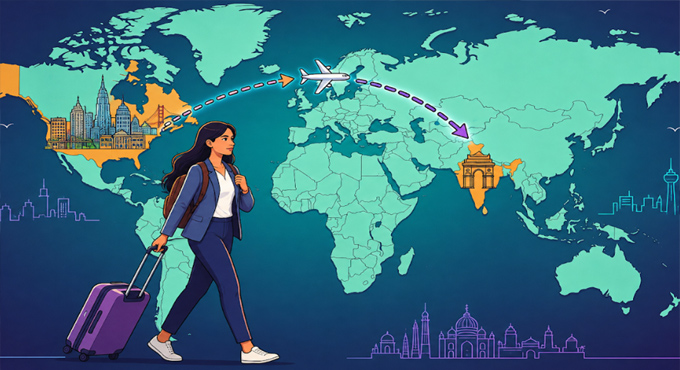
For decades, the talent movement was largely one-way:
India → America.
Now another route is becoming visible:
America → India.
That does not mean the American dream is over. The US will continue to attract global talent.
But the balance is changing.
And there is a lesson here for America too.
Talent does not stay in one country forever. If it becomes too difficult or too expensive to bring skilled workers into the country, companies can move the work elsewhere.
US Congressman Raja Krishnamoorthi has also warned that making it harder to bring foreign talent into America could encourage companies to move more work overseas.
That could be the real twist in this story.
America may have spent decades attracting India’s best tech talent. Now, some of that talent could be returning with something even more valuable — global experience.
The question is no longer simply whether Indian techies are leaving America.
The bigger question is:
Is India finally becoming good enough for them to come back?
— Surya Prakash Josyula
Related News

A Remote Control That Could Control Your Body Like a TV! South Korean Scientists’ Shocking Experiment
Major Changes Coming to ChatGPT for Teens.. Shocking New Rules

Special Update on Chiranjeevi’s Birthday for Mega158

“Panasapalli Fans Association” Movie Motion Poster Released

Sri City Celebrates 80th Independence Day with Patriotic Zeal