

A Remote Control That Could Control Your Body Like a TV! South Korean Scientists’ Shocking Experiment
- Published By: Tech Team
- August 19, 2026 / 11:40 AM IST


— Surya Prakash Josyula
Imagine you are given a medicine. Your body needs it, but there is one problem — the medicine should work only when it is needed. If it works too much, it may cause side effects. If it works too little, the treatment may not work properly.
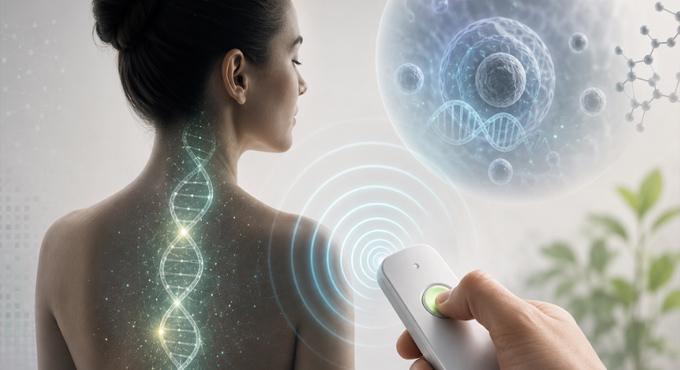
Now imagine that you have a small switch in your hand. When the medicine is needed, you turn it ON and its effect starts inside your body. If it becomes too much, you turn it OFF. When you need it again, you simply turn it ON.
It sounds like something from a science-fiction movie, but scientists are now trying to make a similar idea possible. However, they are not trying to control a medicine. They are trying to control genes inside the body.
What is the experiment?
Researchers at Dongguk University in South Korea have developed a “gene switch” that can activate specific genes inside living mice using an electromagnetic field.
The interesting part is that when the electromagnetic signal was stopped, the activity of the gene returned to its normal level. In simple words, scientists found a way to turn a gene on from outside the body and then allow it to switch back off.
This could one day give gene therapy something similar to a remote control.
Why is this important?
Gene therapy works by making changes at the genetic level to treat certain biological problems or help the body produce a protein it needs. But controlling exactly when a gene should work, how long it should remain active and when it should stop is a major challenge.
Imagine that your body needs a particular protein. If there is too little of it, there could be a problem. But if the same protein keeps being produced in large amounts all the time, that could also create problems.
So scientists have been looking for a way to control genes more precisely. The basic idea is simple: What if a gene could have an ON/OFF switch?
How does the switch work?
The researchers did not send electricity directly into the body. Instead, they used an electromagnetic field, or EMF.
They first exposed mouse brain cells to an electromagnetic field of 2.0 millitesla at 60 hertz and studied which genes responded to it. They found that a gene called Lgr4 showed a strong response.
The researchers then used the regulatory region of Lgr4 to create what they call an Electromagnetic-field-inducible, or Ei, gene switch.
When the mice were exposed to the electromagnetic field, the gene was activated. When the field was switched off, the gene activity gradually returned to its normal level.
The researchers also showed that they could target specific parts of the body rather than simply activating genes everywhere. That means this technology could potentially give scientists more control over where a gene works, when it works and how long it stays active.
What could this mean for ordinary people?
This is where the technology becomes really interesting. Today, this is only a preclinical experiment in mice, so it is not a treatment that people can use yet.
But if the technology is eventually proven safe and effective in humans, it could make some gene therapies much easier to control. For example, if a particular treatment requires the body to produce a protein only at certain times, doctors may one day be able to activate the relevant gene from outside the body instead of relying on a treatment that keeps working continuously.
In simple terms, the idea is this: the treatment stays inside the body, but the doctor may be able to control when it works.
That could be particularly useful for therapies where too much or too little biological activity can create problems. Researchers also believe such systems could potentially be controlled using external devices in the future, although that is still a long way from becoming a real-world medical treatment.
But there is a big catch
The technology is still at an early stage. The experiments were performed in mice, and many questions need to be answered before anything like this can be tested as a routine human treatment.
Scientists still need to understand its long-term safety, how precisely gene activity can be controlled in different tissues, how the immune system might respond and whether the same results can be achieved safely in larger animals and eventually humans.
So this is not a case of scientists already giving people a remote control for their genes.
It is something more interesting at this stage: scientists have demonstrated a possible way to control gene activity from outside a living body.
Finally…
Until now, we have usually thought of medicine as something we put inside the body and then allow it to do its job.
The future could be different. A gene therapy could remain inside the body, while an external signal decides when it should work and when it should stop.
In other words, medicine may one day move from simply giving the body a treatment to actually controlling that treatment from outside the body.
And that is why South Korean scientists’ gene-switch experiment could be an important step toward the next generation of gene therapy.
Related News

Major Changes Coming to ChatGPT for Teens.. Shocking New Rules

Are More Indian Techies Returning From America? What Is Really Happening?

Special Update on Chiranjeevi’s Birthday for Mega158

“Panasapalli Fans Association” Movie Motion Poster Released

Sri City Celebrates 80th Independence Day with Patriotic Zeal