Why Can’t You Sleep in a New Place? Here’s a Simple Fix
- Published By: Tech Team
- August 18, 2026 / 08:53 AM IST


You check into a hotel after a long day of travel. The room looks comfortable. The bed is good. The air conditioner is working. There is no major noise outside.
Still, sleep does not come easily.
You close your eyes, but your mind seems to stay awake. You wake up several times during the night. You turn around in bed, check the time and try to fall asleep again.
The next morning, you may feel as if you hardly slept at all.
If this sounds familiar, there is nothing unusual about it. Many people experience the same thing when they sleep somewhere new.
Scientists call it the “first-night effect.”
Your bed has not changed. Your brain has.
At home, your brain knows the surroundings almost without thinking. It knows the sounds outside, the position of the door, the noise of the fan or air conditioner and even the small sounds that happen during the night.
In a new place, none of that is familiar.
So even when you are asleep, your brain may stay slightly alert. It is quietly taking in new sounds and movements and checking whether everything around you is safe.
You may not notice this happening consciously. But your brain is still processing the unfamiliar environment in the background.
That is one reason why sleep can be lighter and shorter on the first night in a new place.
Research has found that people may sleep around 20 to 30 minutes less in a new environment. For some people, the difference can be even greater.
Why does the brain do this?
Scientists believe the first-night effect may have evolutionary roots.
Thousands of years ago, sleeping in an unfamiliar place could be dangerous. A new environment could mean unknown sounds, animals or other threats.
Being slightly more alert while sleeping may have helped humans stay safe.
Today, you may be sleeping in a modern hotel with a locked door, security cameras and other safety measures. But the brain does not always care about that.
It may still react to a new environment with an old survival response.
In simple terms, your brain may be saying:
“This place is new. Stay a little alert.”
Your brain does not completely switch off
Studies have found that some areas of the brain can remain more active when people sleep in a new environment.
That may explain why the first night can feel different from a normal night at home.
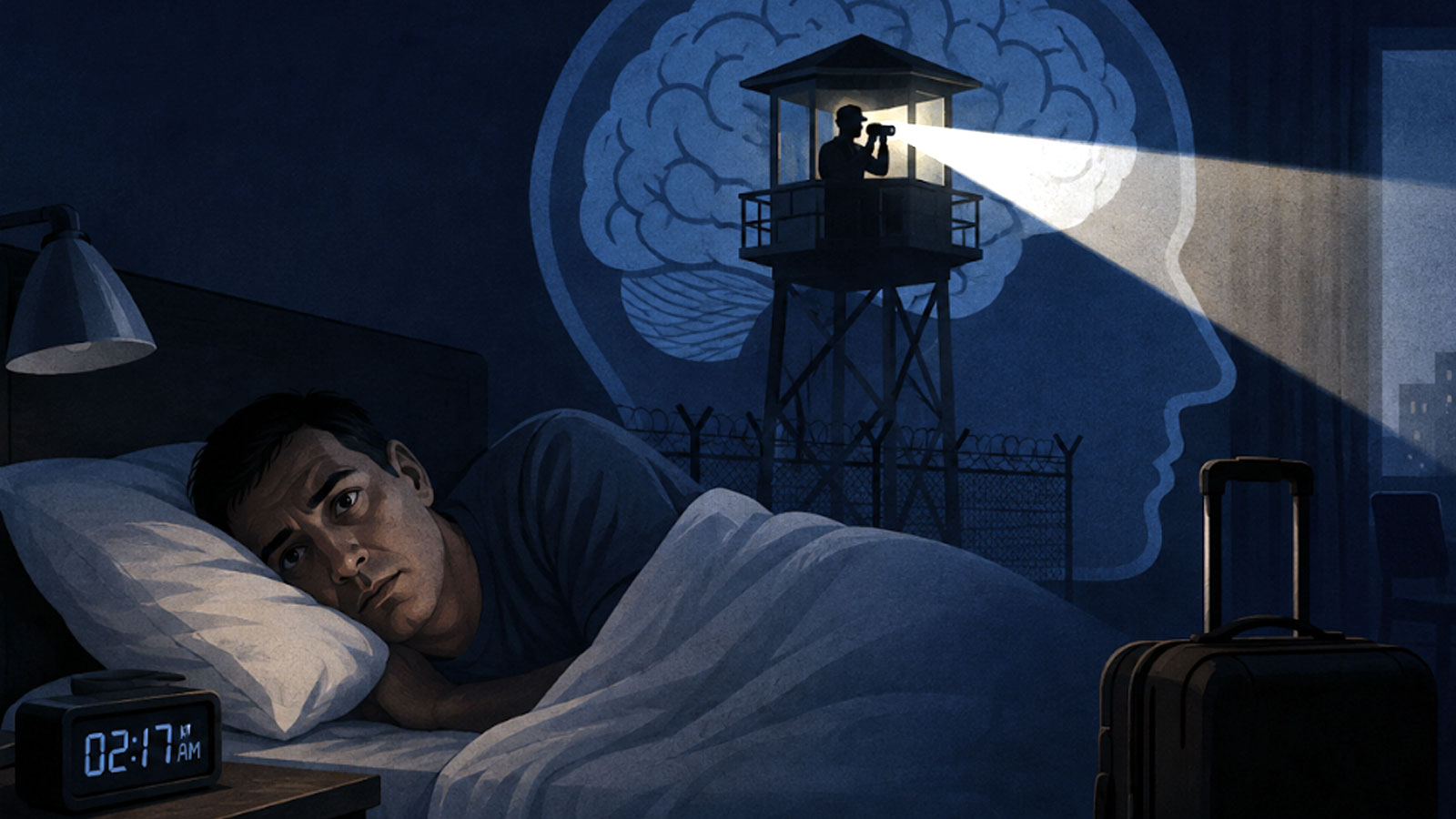
Think of it like this: your body is sleeping, but a small security guard inside your brain is still on duty.
It is not fully awake. But it is not completely relaxed either.
Age can make a difference
The first-night effect does not affect everyone in exactly the same way.
Research suggests that children, teenagers and older adults may experience it more strongly. People in their 20s may be less affected.
But age is not the only factor.
Your emotional state also matters.
For example, staying at a relative’s house may feel very different from sleeping in your own bedroom. If you are worried, uncomfortable or under pressure, your brain may take even longer to relax.
The thought that can make sleep worse
There is another problem that often starts after the first bad night.
You lie down on the second night and think, “What if I can’t sleep again?”
That simple thought can create anxiety.
You start thinking about how tired you will be tomorrow. You check the clock. You calculate how many hours are left before you have to wake up.
Now your brain is even more alert.
The more you worry about sleep, the harder it can become to sleep. This can turn into a cycle where the fear of losing sleep becomes part of the problem.
That is why people who are already more anxious may be more vulnerable to the first-night effect.
But there is an interesting twist
A new place does not always mean worse sleep.
For some people, the opposite can happen.
People who regularly struggle to sleep at home may sometimes sleep better in a new environment.
The reason may be surprisingly simple.
Your bedroom at home can become associated with previous nights of poor sleep. The bed, the room and even your usual bedtime can remind your brain of those difficult nights.
A new room has none of that history.
So for some people, sleeping somewhere new can actually feel like starting fresh.
How can you sleep better on the first night?
You cannot completely switch off the first-night effect. But you can make a new place feel less unfamiliar.
One simple trick is to take something familiar with you. It could be your favourite pillow, a small blanket or another object you normally use at home.
You can also spend some quiet time in the new room before going to sleep. Read a book, listen to something relaxing or simply lie down and get comfortable.
The goal is not to force yourself to sleep.
It is to give your brain some time to understand that the new environment is safe.
Keeping your normal bedtime routine can also help. Try to sleep at roughly the same time you do at home. Keep the room cool and dark, and avoid using your phone or laptop just before bed.
Have an important day tomorrow?
This is especially useful if you are travelling for something important.
Suppose you have an interview, an exam, an important meeting or a major presentation the next morning.
If possible, reach the destination one night earlier.
That first night gives your brain time to adjust to the new surroundings. By the second night, the room may feel much more familiar.
You are then more likely to sleep in a way that feels normal to you.
The bottom line
So, the next time you struggle to sleep in a hotel, at a relative’s house or in another unfamiliar place, do not immediately assume that you have a sleep problem.
Your brain may simply need a little time to trust the new environment.
At home, everything is familiar. Your brain knows the sounds, the room and the surroundings.
In a new place, it takes a little longer to relax.
So while you are lying in bed wondering why you cannot sleep, your body may actually be doing its job perfectly.
Your body is resting.
Your brain’s little security guard is simply taking one more look around.
That is the first-night effect.
— Surya Prakash Josyula
Related News

Traditional to Nutritional Curd Emerges as a Staple Food Across South India with 80% Consumption

How Did Maruti Become Hanuman? What Really Happened That Day?

Tata Sampann Poha Ada Pradhaman: A Fusion Twist on a Classic Delicacy

New Study Reveals Anthocyanin-Rich Foods Support Heart and Metabolic Health in Healthy Adults

EuroKids Celebrates Independence Day with Nationwide Preschool Festivities