

Humanoid Robots Take the Scalpel: Is This the Future of Healthcare?
- Published By: Tech Team
- July 10, 2026 / 08:42 AM IST


Doctor in America… Operation in Our Village! Is This the Future of Medicine?
–By Surya Prakash Josyula
The operating room doors slowly closed. Inside, the patient was prepared, the nurses were in position, the monitors beeped steadily, and the surgical instruments were set. However, the one person everyone was waiting for—the doctor—was nowhere to be seen. In that critical moment, the clock was ticking, as every second counts when a life is on the line.
Normally, a familiar story would unfold from here, filled with anxious whispers of the doctor being delayed, or suggestions to rush the patient to another hospital. But this story took a completely different turn.
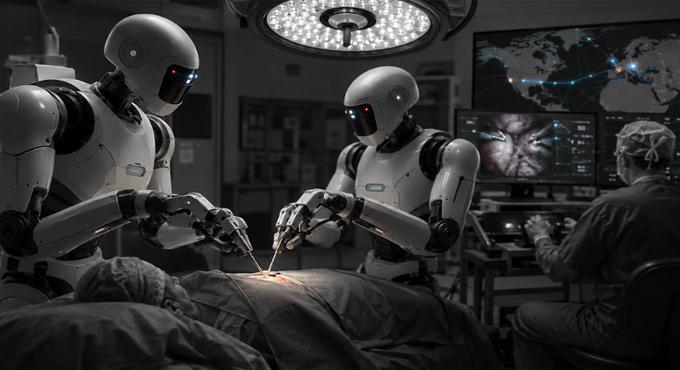
A few moments later, a humanoid robot standing right beside the operating table moved its arm. The scalpel moved, and the surgery began. Yet, it was not the robot making the choices; its movements were being guided by a surgeon sitting hundreds of miles away. The doctor’s hands had essentially become the robot’s hands. By the time the procedure successfully concluded a few minutes later, it raised a fundamental question: Does a doctor really need to be physically present in the operating room?
For over a century, the medical world confidently answered “yes.” But today, that very answer is beginning to change. This is neither a movie nor a work of fiction; it is a real-world scientific experiment that offers a glimpse into the future of healthcare.
Imagine a scenario where someone in a remote area like the Alluri Sitharamaraju district urgently needs specialized surgery, but no specialist is available locally. If an expert sitting in Hyderabad, Delhi, or anywhere else in the world could seamlessly perform the operation by controlling a robot remotely, the boundaries of medical care would change forever. While this may sound like wishful thinking today, scientists have just given this vision its very first physical form.
Researchers at the University of California San Diego recently utilized teleoperated humanoid robots to successfully perform experimental surgeries on large, non-primate mammals. The detailed findings of this study were published in the prestigious scientific journal Nature.
However, the most fascinating part lies in how the experiments were conducted. In the first trial, the robot was not left entirely alone; a human surgeon stood right next to it as an assistant, ensuring the new technology took its first steps with utmost caution. Together, they successfully completed a gallbladder removal surgery. In the second trial, human hands were completely absent from the operating table, leaving two humanoid robots to work side-by-side.
This sight might make one wonder if the robots were operating entirely on their own, but they did not make a single independent medical decision. Invisible yet entirely in control, remote surgeons directed their every move. This raises another interesting question: Why did the researchers design the robot to look exactly like a human?
The answer is remarkably simple. Every hospital in the world is built for humans. The doors, the operating tables, and the surgical instruments are all designed to be handled by human limbs.
Instead of attempting to redesign the infrastructure of hospitals, the researchers decided to adapt the robot to the human form by giving it two arms, two legs, and a human silhouette. Nicknamed “Surgie,” this robot stands five feet tall and weighs just 27 kilograms (60 pounds)—a stark contrast to existing specialized robotic surgery platforms that weigh hundreds of kilograms and require custom-built operating rooms.
Because Surgie is so lightweight and compact, it can easily be transported in a standard ambulance. Instead of modifying a hospital to fit a massive machine, the machine can now come directly to the patient. Ultimately, these robots are not replacing doctors; they are extending the doctor’s skill to places their hands cannot physically reach.
Nevertheless, this transition is not without its hurdles. Every new technology has its challenges, and the main obstacle in this story is latency. When a surgeon moves their hand, the robot must respond instantly, as even the slightest delay can be critical during a live procedure.
Another major challenge is time. During these experiments, the robots required recalibration multiple times, which made the surgeries take much longer than usual. However, scientists point out that the earliest traditional robotic surgeries also took several hours to complete, whereas those same procedures take only a fraction of that time today. This gives researchers immense hope that the technology will rapidly evolve.
Reading about this might lead one to assume that Artificial Intelligence performed the surgery, but that is a common misconception. The robots did not make any autonomous medical decisions; a human surgeon guided every action. Rather than replacing the doctor, AI is serving as a powerful tool to project a surgeon’s expertise across great distances.
As for when this technology will arrive in countries like ours, there is no definitive timeline yet. The technology is still in its infancy, having only completed preclinical trials on animals. It must still undergo rigorous human clinical trials, clear strict regulatory approvals, and overcome current technical limitations before it can be deployed in everyday hospitals.
What remains absolutely clear, however, is that a major shift is underway. Advanced healthcare, which was once restricted only to major metropolitan cities, may eventually reach remote villages, battlefields, ships at sea, and even outer space.
Every great revolution initially seems impossible, then becomes an object of wonder, and finally turns into an ordinary part of daily life. There was a time when no one believed we could carry a phone in our pockets to speak with anyone across the globe, yet today it is an inseparable part of our existence.
Perhaps in the near future, we will read a headline stating that a surgeon in Hyderabad successfully operated on a patient in Adilabad using a remote robot. On that day, we will look back at this early experiment and realize that the revolutions that change the world do not always begin with a loud roar; sometimes, they start silently, just as the doors of an operating room close.
Related News

Can Humans Have Sex in Space? And What Happens If They Do?

Why Did America’s Spy Agency, the CIA, Come Looking for Steve Jobs?

The Shocking Truth a Mother Found on TikTok After Her Son Died

America Moves First in Venezuela’s Oil Hunt. Where Does That Leave India?

Why Did Elon Musk Name His Son ‘Sekhar’? The Story of the Great Indian Scientist Behind the Name