

Good News for NRI Pensioners: No Need to Come to India for Life Certificate
- Published By: Tech Team
- August 13, 2026 / 08:15 AM IST


— Surya Prakash Josyula
For Indian pensioners living abroad, there is one common question every year: Do I have to come to India to submit my Life Certificate and continue getting my pension?
For elderly pensioners, this is not a small issue. Travelling thousands of kilometres, paying for flights and dealing with health problems just to submit one certificate can be difficult.
The good news is that NRI pensioners do not always have to travel to India to submit their Life Certificate. There are several ways to complete the process while staying abroad.
Why is the Life Certificate important?
A Life Certificate is used to confirm every year that a pensioner is alive and eligible to continue receiving the pension. If the certificate is not submitted on time, pension payments may be affected.
To make the process easier, the government introduced Jeevan Pramaan, a Digital Life Certificate system. It uses Aadhaar-based authentication to create a digital certificate. The certificate is stored digitally and can be accessed by the pension disbursing agency.
However, the process can be more difficult for pensioners living abroad. They may not have a Jeevan Pramaan Centre nearby. Visiting an Indian bank branch may also be difficult. For elderly pensioners, travelling in person may not always be possible.
That is why the alternative options available to NRI pensioners are important.
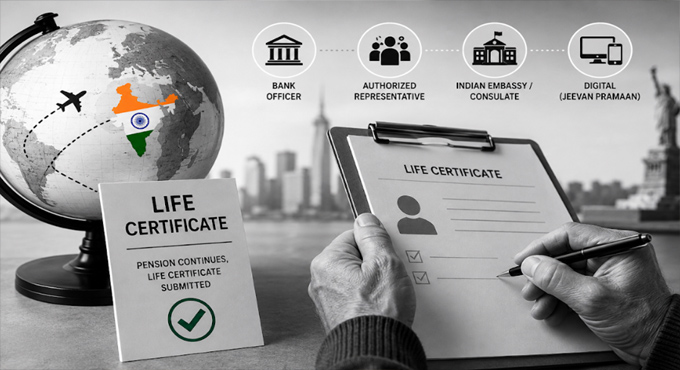
1. Through a bank officer
An NRI pensioner receiving a pension or family pension through an Indian bank may be able to use the bank route.
If the pension is being paid through a bank covered under the Second Schedule of the RBI Act, 1934, the Life Certificate can be certified by the relevant bank officer. In such cases, the pensioner does not necessarily have to appear personally before the pension authority in India.
However, pensioners living abroad should first contact their bank and ask about the exact procedure.
They should find out how the Life Certificate can be submitted from abroad, which documents are required and which bank officer can certify it.
2. Through an Authorized Representative
Another option for an NRI pensioner who cannot travel to India is an Authorized Representative.
In simple terms, if the pensioner cannot personally complete the process, a representative can submit the Life Certificate on their behalf to the relevant pension authority.
In some cases, a Magistrate, Notary, Banker or Indian Diplomatic Representative may be able to issue or certify the Life Certificate. The Authorized Representative can then submit it to the concerned pension authority.
But pensioners should check the rules in advance.
Who can act as an Authorized Representative? What type of certificate is required? Which documents have to be submitted? These details should be confirmed with the pension-paying authority beforehand.
3. Through an Indian Embassy or Consulate
For NRI pensioners who live permanently outside India, an Indian Embassy, High Commission or Consulate can also be an option.
The Indian diplomatic mission may verify the pensioner’s details using documents such as the Pension Payment Order (PPO), passport and photograph, along with any other required documents.
This can be especially useful for elderly pensioners who cannot travel to India just to submit a Life Certificate.
There may also be situations where a pensioner cannot personally visit the Embassy or Consulate because of age or health problems. In such cases, some missions may allow the required documents to be sent by post. A Medical Certificate may be required to explain why the pensioner cannot appear in person.
However, the procedure may differ from one Indian Mission to another. It is therefore better to contact the concerned Embassy or Consulate before sending the documents.
4. Digital Jeevan Pramaan from home
For pensioners who are comfortable using technology, Digital Life Certificate through Jeevan Pramaan can be the easiest option.
Jeevan Pramaan allows pensioners to create a Digital Life Certificate using Aadhaar-based authentication. With the Face Authentication facility, authentication can also be completed using a smartphone in eligible cases.
This can greatly reduce the need to carry a paper certificate to a bank or government office.
However, pensioners should prepare in advance. They should check their Aadhaar details, mobile access, the required app or device and whether their pension-paying organisation supports Jeevan Pramaan.
It is better to test the process early rather than waiting until the last minute.
Submitting the certificate is not the final step
This is something many NRI pensioners may overlook.
Creating and sending the Life Certificate does not mean the process is automatically complete.
Pensioners should check whether the certificate has reached the concerned pension authority and whether it has been updated in their records.
With Digital Jeevan Pramaan, the Life Certificate is stored in the digital repository after successful authentication and can be accessed by the pension disbursing agency.
If the certificate is submitted through a bank, Embassy or Authorized Representative, it is a good idea to keep the acknowledgement or receipt safely.
Because submitting the Life Certificate is one step. Making sure that it has been accepted and recorded is another.
Don’t wait until the last minute
NRI pensioners do not necessarily have to return to India every year just to submit a Life Certificate.
Depending on their situation, they can use a bank officer, Authorized Representative, Indian Embassy or Consulate, or Digital Jeevan Pramaan.
The important thing is to check the procedure with the pension-paying bank or organisation in advance, keep the required documents ready and confirm that the Life Certificate has been properly recorded.
For someone living thousands of kilometres away from India, a small Life Certificate can make a big difference to the continuity of their monthly pension.
Related News
A surprising new feature in smartwatches.. Could they detect the risk of diabetes early?

ChatGPT Is About to Become That Annoying Friend Who Gives Advice You Never Asked For

Gen Z’s Drinking Story Is Changing: Shocking Truths From a New Survey

Hollywood’s Age-Gap Obsession: What Younger Men See in Older Women

Paid for a Confirmed Berth, But Couldn’t Use It: Family Gets ₹75,000 From Railways