
America Is Fighting Russia. Why Could India End Up Paying the Bill?
- Published By: Tech Team
- August 25, 2026 / 08:15 AM IST


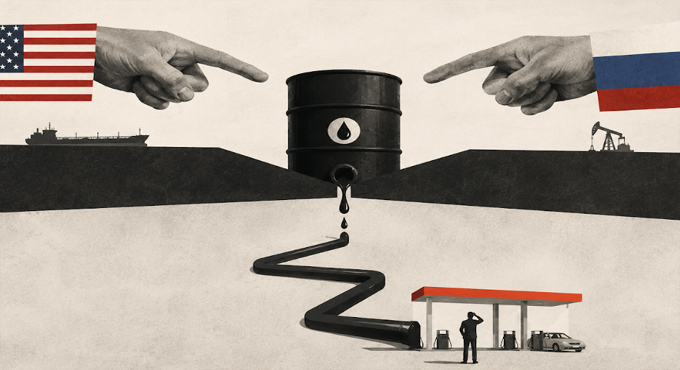
You go to a petrol station. Your car’s tank is almost empty and you need only a few litres of petrol. But how much will you have to pay? The price you see at the pump is not decided by the petrol station owner in your town. It is not controlled only by the Indian government either. Sometimes, the answer lies thousands of kilometres away, in a conflict between two powerful countries.
On one side is America. On the other is Russia. Their wars, sanctions and counter-sanctions may seem far removed from everyday life in India. But could India end up paying the price for a fight that is not its own? This is no longer just a hypothetical question. The consequences could eventually reach the petrol pump — and from there, the wallets of ordinary Indians.
So, What Exactly Is the Problem?
The conflict between America and Russia is not new. Since the war in Ukraine began, both countries have continued to impose sanctions and counter-sanctions on each other. But now, India could once again find itself caught in the middle. The US is targeting countries that continue to buy Russian oil, and a bill that would give the US President the power to impose heavy tariffs on such countries is moving through Congress.
If the bill becomes law, countries that continue to buy large amounts of Russian oil and gas could face tariffs of up to 100 per cent. India is among the countries on the list, along with China, Azerbaijan, Hungary and Slovakia. However, there is an important point: even if the bill becomes law, India would not automatically face a 100 per cent tariff. The decision to actually impose such tariffs would remain with US President Donald Trump.
But there is a bigger question for India. America may want to punish Russia, and that is its choice. But why should India get caught in the middle?
Why Can’t India Simply Stop Buying Russian Oil?
India’s decision to buy Russian oil is not simply about its relationship with Moscow. It is also about necessity. India imports nearly 90 per cent of the crude oil it needs, and Russia has now become its biggest supplier.
In June 2026, Russian crude accounted for 46 per cent of India’s total crude oil imports. India imported around 8.75 million tonnes of crude from Russia in that single month. West Asian countries were a distant second, supplying around 4.2 million tonnes.
That makes Russia much more than just another oil supplier for India. Russian crude has become an important part of India’s energy security.
Why Did Russian Oil Become So Important?
After Russia launched its full-scale invasion of Ukraine in 2022, Western countries imposed major sanctions on Moscow. European countries reduced their purchases of Russian oil, forcing Russia to look towards Asian markets. Russia began selling more crude to countries such as India and China, often at discounted prices.
For India, this was a major opportunity. The country continued to get the crude it needed while paying less than international market prices. As a result, Russia became India’s biggest oil supplier in FY25. India’s imports from Russia that year were worth $56.9 billion, or around ₹5.4 lakh crore.
That dependence on Russian crude has now become an important issue in India-US relations.
What Happens If US Pressure Increases?
This is not the first time Washington has put pressure on India over Russian oil. In 2025, the Trump administration imposed an additional 25 per cent penalty on certain Indian exports linked to purchases of Russian crude.
India subsequently reduced its imports from Russia. During the first half of FY26, imports from Russia fell 14 per cent year-on-year to $23.1 billion, or around ₹2.2 lakh crore. But India did not completely stop buying Russian oil.
The reason is simple: finding alternatives is not easy.
The Bigger Problem: Strait of Hormuz
If India reduces its purchases from Russia, it will have to depend more heavily on other oil-producing countries. But West Asia has its own problem — the Strait of Hormuz.
Nearly half of India’s oil and gas imports depend on this crucial sea route. Major suppliers such as Iraq, Saudi Arabia, the UAE and Kuwait also rely heavily on the route to transport their energy exports.
If shipping through the Strait of Hormuz is disrupted, bringing crude through alternative routes can become much more expensive. That is one reason Russian oil has once again become strategically important for India.
America Had Also Eased Its Pressure
For the same reason, Washington temporarily softened its position in February 2026. The aim was to prevent major disruptions in global energy supplies and avoid another sharp rise in oil prices. India was allowed to continue buying Russian oil for the time being.
But that flexibility now appears to be shrinking. Traffic through the Strait of Hormuz remains affected, while talks between Iran and the US have yet to produce a major breakthrough.
Oil prices have already reflected these tensions. Brent crude rose above $100 a barrel immediately after the conflict. Following a temporary ceasefire, prices fell below $80 in June. But by mid-August, they had climbed back to around $90 a barrel.
And this is where India’s real worry begins.
If Russian Oil Stops, Will Petrol Hit ₹200?
Not necessarily. It would be wrong to say that petrol prices will immediately double if India stops buying Russian oil. But one thing is clear: if the cost of importing crude rises, pressure on India’s economy will rise as well.
Prashant Vasisht, Senior Vice-President at ICRA, points to exactly this problem. Even if India is forced to stop buying Russian crude, it can turn to other suppliers. The problem is the cost of getting that oil.
Transporting crude from West Asia usually costs around 40-70 cents per barrel. Bringing crude from the US can cost around $2.5-$4 per barrel in transport costs. So the oil may still be available, but getting it could cost more.
The Big Number: ₹1.4 Lakh Crore
The bigger issue now is not simply how much discount India gets on Russian oil. The bigger question is what happens if global crude prices rise.
According to Anindya Banerjee, Head of Commodity and Currency Research at Kotak Securities, Russian crude was selling at a discount of around $15-$20 a barrel in 2022. Today, that discount has fallen to just $2-$3 a barrel. So India’s price advantage from Russian crude is much smaller than it was a few years ago.
But another number is far more significant. If the average international crude oil price rises by just $10 a barrel, India’s annual oil import bill could increase by around $15 billion, or nearly ₹1.4 lakh crore.
That is the real concern. The loss of the Russian discount is one issue. A sustained rise in global crude prices could be a much bigger problem.
So, Who Will Ultimately Pay the Bill?
The impact of higher oil prices will not stop at the petrol pump. Higher crude prices can push up transport costs, make it more expensive to move goods and increase production costs for businesses. Eventually, those higher costs can put pressure on the prices of everyday products.
That is when a geopolitical conflict thousands of kilometres away starts becoming an ordinary Indian household’s problem.
America may be fighting Russia. Russia may be fighting back. India, meanwhile, still needs oil — and lots of it. If the cost of that oil keeps rising, the consequences can spread through the entire economy.
Their war. Our bill?
That is the question India now has to answer.
— Surya Prakash Josyula