
Gov’t School Students Build AI Solutions at Tech Bootcamp
- Published By: Tech Team
- May 31, 2026 / 08:43 PM IST


VISAKHAPATNAM: In a remarkable display of grassroots innovation, a five-day residential bootcamp at GITAM Deemed University concluded this week, showcasing how public school students are leveraging cutting-edge technology to solve deep-rooted community issues. Named Hack to the Future 2026 (Andhra Pradesh Edition), the event brought together 111 students in 23 teams from six districts across Andhra Pradesh and Telangana, transforming young learners from tech consumers into active creators.
The residential hackathon represents the culmination of the Future Skills curriculum pilot, a massive digital literacy initiative spanning 742 government schools. The program has already trained over 1,500 educators and impacted more than 90,000 students. Organised by the Bengaluru-based non-profit Quest Alliance in partnership with Samagra Shiksha Abhiyan, Leadership for Equity, and GITAM University, the event challenged students to look closely at their own backyards for inspiration.
Over an intensive four-day design cycle, the ninth- and tenth-standard students moved rapidly through user research, iterative design, and prototyping. Utilizing accessible tech tools like MIT App Inventor, Scratch, Arduino, and basic robotics platforms, they built a suite of functioning hardware and software solutions.
Local Problems, Tech-Driven Answers:
What sets this hackathon apart is the raw, lived reality behind each prototype. Rather than chasing abstract corporate problems, the student teams engineered answers to the exact crises affecting their villages and families:
Public Safety: A smart emergency system for public buses that automatically unlocks doors during accidents or electrical fires.
Agricultural Support: A pedal-powered irrigation pump designed for small farmers struggling with unreliable rural electricity, alongside an AI-powered elephant alert system using motion sensors to mitigate human-wildlife conflict without harming animals.
Cybersecurity & Social Awareness: An interactive chatbot designed to educate rural communities about phishing, online fraud, and digital safety, alongside apps addressing child marriage.
Public Health: A sensor-based water quality monitor developed specifically to tackle high rates of kidney disease linked to contaminated drinking water in local villages.
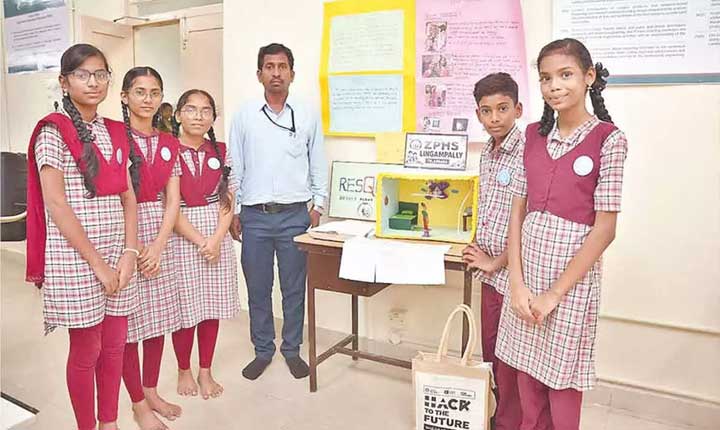
Perhaps the most poignant innovation came from a team from the Zilla Parishad High School in Lingampally, which developed a suicide detection device built directly into a ceiling fan.
“This fan is designed to sound an alarm and alert people if someone attempts to hang themselves,” explained Todelu Naga Divyasri, a ninth-standard innovator on the team. “One of our relatives died by suicide. It affected us emotionally, and that’s when my classmates and I started thinking why we couldn’t solve this problem. When we researched, we realised that the problem was much bigger and not ours alone.”
Reimagining Public Education:
The showcase on May 29 concluded with a critical panel discussion, Reimagining AI Literacy and Future Skills in Public Education. Educational officials, school leaders, and teacher mentors gathered to discuss how foundational competencies—like computational thinking, data literacy, and critical analysis can be permanently embedded into the public school ecosystem.
“Hackathons are a forum for us to bring students’ ideas to life,” said Neha Parti, Director of the Schools Program at Quest Alliance. “There is so much that the young learners are absorbing from their life experiences. Hackathons become spaces for them to articulate problems they feel deeply about and try to think of tech-based solutions. It instills self-belief in them that they have the agency to bring the change that they imagine.”
The closing ceremony also shifted focus to the teachers and district leaders, celebrating them as the vital engine making this curriculum shift possible. Now in its second year in Andhra Pradesh and active across five states, organizers of Hack to the Future are urging state education leadership to scale the Future Skills framework statewide, ensuring public school students across the region aren’t left behind by a rapidly evolving global workforce.
Related News
Maxivision Super Speciality Eye Hospital Inaugurates Second Facility in Vijayawada at Poranki
ReNew and Anakapalli District Administration Join Hands to Skill 300 Women for Clean Energy Jobs
Sri City IALA To Launch Free Internal Shuttle Bus Service
AP’s Principal Liaison for North America Investments, Satish Manduva Visits Sri City
Rotary Club of Madras East Delegation Visits Sri City