

A Heater Inside the Human Body? The Shocking Secret From the Ice Age
- Published By: Tech Team
- August 17, 2026 / 05:29 PM IST


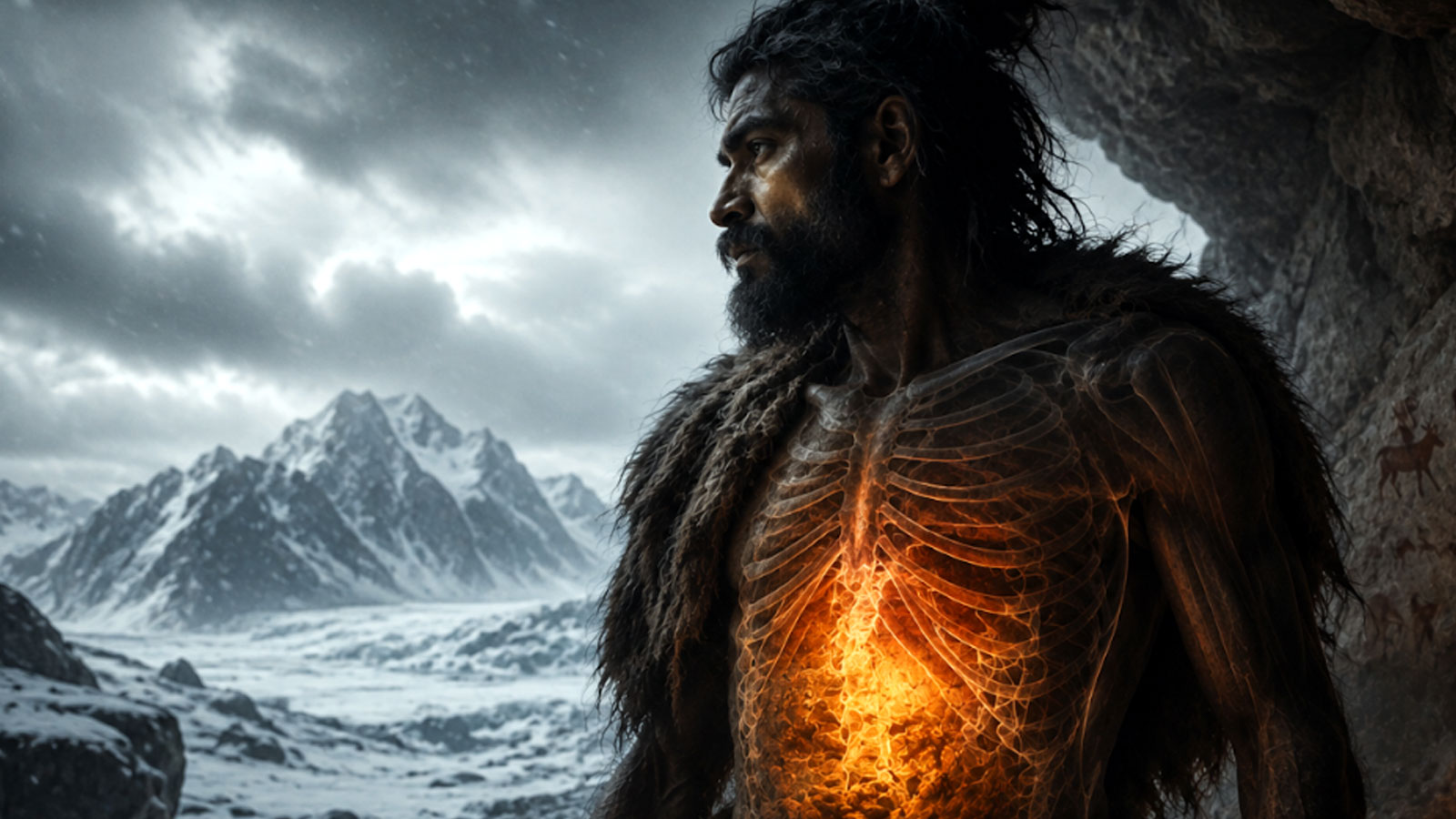
Year: 20,000 BC.
Imagine a world covered in snow. Temperatures have dropped far below freezing, the wind is painfully cold, food is difficult to find, and losing the fire could mean losing your life.
Inside a small cave, a human is sitting quietly. He has no heater, no thermal jacket and no modern medicine. Yet somehow, he is surviving the freezing conditions. His body itself may be producing extra heat.
It sounds like a scene from a science-fiction movie. But scientists studying how humans survived the Ice Age have found genetic clues suggesting that ancient humans may actually have developed something similar to a built-in heater inside their bodies.
So, how could that happen?
The Secret Behind the ‘Heater’
Thousands of years ago, during the last Ice Age, humans had to survive extremely cold environments. Their bodies may have slowly adapted to those conditions through changes that happened over many generations.
Scientists now believe that some of these changes may have helped the body burn fat more efficiently and turn that stored energy into heat. DNA from the ancient Jomon people of Japan is providing an important clue.
Researchers from the University of Tokyo studied the genomes of 42 Jomon hunter-gatherers. Their analysis found several genetic signals that may be connected to how their ancestors adapted to cold environments.
That means the Ice Age may have changed more than the way humans lived. It may have influenced their diet, the way their bodies processed fat and, over time, even some parts of their genetic makeup.
The ‘Heater’ Hidden Inside the Body
When we feel cold, our body normally starts to shiver. Those muscle movements generate heat and help maintain body temperature.
But there is another system that can produce heat without shivering. Scientists call it non-shivering thermogenesis. A special type of fat known as brown fat plays an important role in this process.
Unlike ordinary body fat, brown fat can burn energy and turn it into heat. Researchers found that some genetic variants connected to this process were unusually common among the Jomon people.
One important variant was found in about 73 percent of the Jomon individuals studied, compared with around 17 percent in present-day East Asians.
The researchers also found genetic signals linked to body size and the way the body processes fat. In a cold environment, that could have been useful because fat is not only a way to store energy. The body can also burn it when it needs fuel and heat.
In simple terms, the ancient human body may have worked like a battery and a heater at the same time. It could store energy and then use that energy to help keep the body warm.
Nature Took Thousands of Years
This transformation did not happen overnight. It was probably a slow process that unfolded over thousands of years.
As ancient populations moved into colder environments, natural selection may have favored genetic traits that helped them survive. Some traits may already have existed in their ancestors, while others became more common as populations faced harsher conditions.
Generation after generation, these small changes could build up.
Eventually, what started as a tiny genetic advantage could become a useful survival trait for an entire population.
That makes the story of human evolution even more fascinating. Our ancestors could not control the climate around them, so their bodies gradually adapted to the world they were living in.
The Man Inside the Ice Age Cave
The man sitting inside that Ice Age cave had no idea what was happening inside his body. He did not know about brown fat. He did not know the term non-shivering thermogenesis. And he certainly knew nothing about DNA or natural selection.
He only knew that the world outside was dangerously cold.
Yet his body had its own way of fighting that cold.
Thousands of years later, scientists are studying the DNA left behind by people like him to understand how that survival may have happened. The researchers are careful to point out that some of these interpretations are still speculative, because reconstructing the exact physiology and lifestyle of people who lived thousands of years ago is extremely difficult.
Still, the evidence gives us a remarkable glimpse into the past.
The Ice Age did not simply test human intelligence. It may have tested the human body itself.
And over thousands of years, the body may have answered that challenge by building its own survival system.
Once, humans had to survive a world of extreme cold.
Today, the challenge is changing. The planet is getting hotter, and humans are facing new environmental pressures.
Evolution does not follow a timetable that we can see.
So perhaps the most interesting question is not whether humans will evolve again.
It is this:
If the Ice Age helped our ancestors develop a biological ‘heater’ to survive the cold, what kind of biological changes could the next great environmental challenge leave behind in us?
Related News

One Click.. A List of Offices Where Bribes Are Reportedly Demanded!

From “Luxury Porn” to AI Power: The Shocking Cami Clark Story Behind Anthropic’s CEO

Who Left ₹1 Lakh Crore Behind? RBI Reveals the Shocking Pile of Unclaimed Bank Deposits
The Food Delivery App That Never Delivers – And Why Nearly a Million People Used It

“Got Old Emails? We’ll Buy Them!” – Who Is Buying Your Work Data?