
The Food Delivery App That Never Delivers – And Why Nearly a Million People Used It
- Published By: Tech Team
- August 15, 2026 / 01:20 PM IST


— Surya Prakash Josyula
It is 10 p.m. You do not feel like cooking. You do not want to go out either. So, you pick up your phone. For millions of people, the next step is almost automatic.
You open Swiggy or Zomato.
You may not even know what you want to eat. But you start scrolling through menus. A biryani catches your eye. Then a pizza. Then you notice an offer from another restaurant. You check for a coupon. Soon, something is sitting in your cart.
Then comes the most satisfying moment: “Place Order.”
The story does not end there. Where is the order now? Is the restaurant preparing it? Has the delivery rider started? How much longer will it take? We keep checking the map as a small bike moves towards us.
There is a strange little excitement in that process. Food delivery has become more than a way to get a meal. For many of us, checking menus, choosing food and tracking the delivery has become part of everyday life.
Now, turn that idea around.
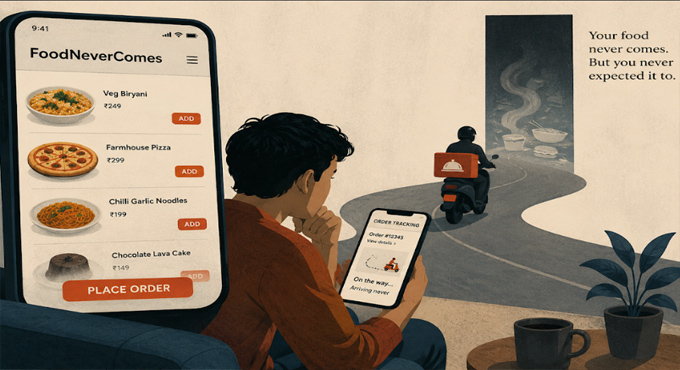
Imagine an app where you do exactly the same thing. You choose your food. You place the order. You track the delivery. You wait for it.
But the food never comes.
Such an app actually exists. It is called FoodNeverComes.
Why would anyone use it?
The name itself explains the idea. The app looks like a food-delivery service. You can browse a menu, select dishes, place an order and even track it.
There is just one problem.
There is no delivery.
The purpose is not to deliver food. It is to recreate the experience of ordering food.
And the surprising part is that nearly one million orders have already been placed through this kind of experience.
Why would people do that if they know they are not going to receive anything?
Because sometimes, we may not really want the food. We simply enjoy the feeling of ordering it.
Think about our own habits. We open food apps even when we are not very hungry. We browse restaurants when we are bored. We look at food photos during a break at work. Sometimes we spend several minutes choosing what to eat and then close the app without ordering anything.
There is a reason for that.
Choosing what to eat gives us a small sense of excitement. Finding a good deal feels satisfying. Adding something to the cart creates anticipation. And once we place the order, waiting for the delivery becomes part of the experience.
FoodNeverComes has simply taken that experience and removed the food.
This is part of a wider trend known as “dopamine apps.”
Some apps allow users to shop for clothes that will never actually arrive. Others simulate smoking, allowing people to experience the look and feeling of smoking without nicotine or the harmful effects of tobacco.
The idea is simple: you do not need the product. You only need the feeling associated with it.
The trend started in South Korea and is now spreading to other markets.
But this raises another important question.
If these apps are free, how do they make money?
The answer is more interesting than it first appears.
The real product may be your data
Every choice a user makes can tell a story.
What food did you select? Which dish did you look at for the longest time? What did you add to the cart and then remove? At what price did you decide not to continue?
These may look like small actions. For advertisers, however, they can become valuable signals about consumer behaviour.
Suppose you use FoodNeverComes and choose biryani. You do not spend a single rupee. No biryani reaches your home.
But the app may learn something useful about you:
You are interested in biryani.
A few days later, when you are actually ready to order food, you may start seeing more biryani-related advertisements.
That is where the business model becomes interesting.
The app may be free for the user. But the user’s behaviour can still have commercial value.
In other words, you may not be paying with money, but your choices can still become part of the business.
That is what makes FoodNeverComes more than a strange internet experiment.
It offers a glimpse into how consumer behaviour is changing.
Shopping is becoming entertainment
There was a time when people went shopping because they needed something.
Today, shopping itself has become a form of entertainment.
We scroll through products even when we have no intention of buying them. We compare prices. We add things to our carts. We check discounts. We come back later and look at the same products again.
Food apps are increasingly becoming part of the same behaviour.
We are not always using them because we are hungry. Sometimes we are simply browsing.
That is the opportunity these new “dopamine apps” are trying to capture.
They are selling something very different from a physical product.
They are selling the experience of wanting the product.
And that may be the most interesting business idea hidden inside this strange little food app.
The food never comes.
But the craving does.