

“Got Old Emails? We’ll Buy Them!” – Who Is Buying Your Work Data?
- Published By: Tech Team
- August 15, 2026 / 12:40 PM IST


— Surya Prakash Josyula
“Puppy, soap bar, matchstick — nothing is unfit for poetry,” wrote legendary Telugu poet Sri Sri. In today’s technology world, that idea seems to have found a strange new meaning: nothing is useless anymore — not even old emails and office chats.
Sounds strange? Think about a normal day at work. You send an email to your boss, reply to a customer, solve a problem in a team chat, spend an hour in a video meeting and record changes made to a project. At the end of the day, you shut your laptop and go home. For you, the work is over.
But your digital trail stays behind.
Those emails, chats, meeting recordings and code histories remain stored on company systems. Until now, they were mostly useful when someone needed an old reference, wanted to check what happened in a meeting or needed evidence of a past decision. Once that purpose was over, they were little more than old digital records.
Now, those records are becoming a product.
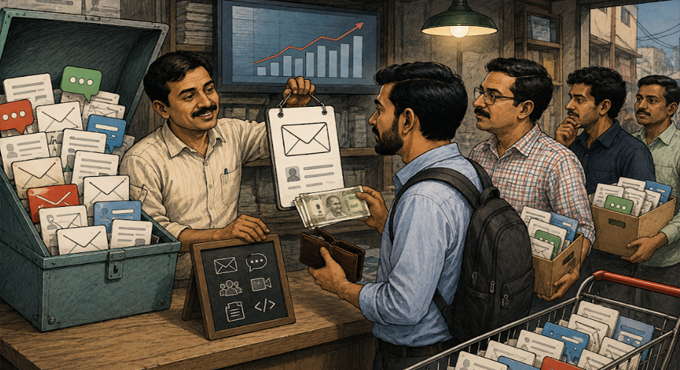
Remember how offices once collected old files, papers and outdated records in a corner and eventually sold them in bulk? Something similar is happening in the digital world. Except this time, the “scrap” is not paper. It is corporate emails, employee chats, meeting recordings and code histories.
And the surprising part is who wants to buy them.
OpenAI, Anthropic and other AI companies are increasingly interested in this kind of corporate data.
They Don’t Really Want Your Email
So, what would an AI company do with an old office email?
The answer is more interesting than it sounds. The email itself is not necessarily the valuable part. What matters is the human behaviour hidden inside it.
An email can show how an employee explains a problem, asks a question, responds to an angry customer or finds a solution. A meeting can show how managers debate an issue and eventually make a decision. A developer’s code history can show how a software problem was identified and fixed.
That is information AI cannot easily learn from a textbook.
This is why the next generation of AI systems needs something more than internet articles and books. If AI agents are expected to work like employees, they need to understand how real people actually work.
Imagine an AI agent that can read a customer email and respond, check an invoice and find an error, understand what happened during a meeting, identify a software problem or analyse a business decision.
For that kind of AI, knowing what to do is not enough. It also needs to learn how humans think while doing the job.
That makes an ordinary office email surprisingly valuable.
Your email can become a lesson. Your team chat can become a case study. Your meeting recording can become a training example. Your code changes can show an AI how a real developer solves a real problem.
The real value is not the message. It is the human experience inside the message.
The Internet Is Not Enough Anymore
For years, AI companies have relied heavily on publicly available information to train their models — books, websites, news stories, articles, social media posts and software code.
But the supply of high-quality human-written material is not unlimited.
Epoch AI estimates that the effective stock of high-quality public human-written text could be around 300 trillion tokens. Depending on how aggressively AI companies train their models, this supply could be consumed by leading AI systems between 2026 and 2032. Under more aggressive assumptions, the timeline could shrink to as early as 2027.
In simple terms, AI companies are consuming high-quality human-created information much faster than the internet is producing it.
That creates a problem.
Where do you find more human experience?
Inside companies.
Every day, millions of employees solve problems, answer customers, negotiate with colleagues, write code, analyse financial information and make decisions. Much of that activity leaves a digital record.
For AI developers, that record can be extremely valuable.
The office could become the next AI textbook.
There Is Already Serious Money In This Market
The growing demand for corporate data is creating a new market around it.
Bobby Samuels, CEO of data brokerage startup Protege, told The Information that his company’s gross transaction volume had risen from around $30 million last year to at least $100 million this year.
There is an even more striking example.
Warmly, an AI-agent startup later acquired by HubSpot, reportedly received four separate offers of up to $300,000 for its internal meeting notes and emails after the acquisition agreement was signed.
That is more than $2.5 million? No — it is about $300,000, or more than ₹2.5 crore, depending on the exchange rate.
Warmly reportedly rejected all four offers.
Think about that for a moment. A company’s old meeting notes and emails — documents that employees may have considered routine internal records — suddenly attracted offers worth crores.
Why?
Because they contain something AI companies desperately need: examples of humans solving real problems in the real world.
The New AI Gold Rush
This is why the AI data race is changing.
For years, the biggest AI battle was about computing power — chips, servers and massive data centres. Now another resource is becoming increasingly important: high-quality human data.
The more AI companies try to build systems that can act like employees, the more they need examples of how employees communicate, make decisions and solve problems.
That makes corporate data a new kind of business asset.
And it raises an uncomfortable question.
Who actually owns the value inside your work?
A company may own the email system. But the thinking inside that email came from an employee. A team may have spent years building knowledge through meetings, mistakes and solutions.
If that accumulated knowledge is turned into AI training data, who decides whether it can be sold? Who controls it? And who gets the value?
Those questions are likely to become much bigger as the market grows.
But There Is a Privacy Problem
There is another challenge that could become even more complicated: privacy.
A company can remove names, phone numbers and other personal details before sharing or selling corporate data. But is that enough?
Sometimes, a person can be identified without their name. A project, customer, department, job role and conversation can together reveal who wrote something.
That is why anonymising corporate data is becoming an important challenge for companies handling this market. The goal is to preserve the useful information while protecting the identity and privacy of the people who created it.
And that balance will not be easy.
Because the more valuable the data becomes, the greater the temptation to extract everything possible from it.
Your Old Email May Have a New Life
Until recently, an old office email was simply an old office email. You looked it up when you needed a reference, and otherwise forgot about it.
Now, that same email could have another life.
It could become training material for an AI system. A conversation that seemed insignificant when it happened could help an AI understand how a human handles a difficult customer. A meeting that nobody remembers could teach an AI how a business decision was made.
That is the strange new economics of AI.
Sri Sri once said, “Nothing is unfit for poetry.”
The AI economy seems to be creating its own version:
Nothing is useless data.
Not your old email. Not your office chat. Not your meeting recording.
Because hidden inside those ordinary digital records is something AI cannot simply manufacture:
the accumulated experience of how human beings actually work.
And that may be the real gold rush behind the AI boom.
Related News

The Food Delivery App That Never Delivers – And Why Nearly a Million People Used It

The World Is Worried About ‘Q-Day’. What Is It?
Ordered From Blinkit or Zepto? Check This Before You Accept It

‘Will the Drug Work?’.. What If AI Tests It on a ‘Digital Human’ First?

Elon Musk Is Getting Richer by ₹8,350 Crore a Day. But Nobody Is Paying Him