

When the Cockroaches Came Together
- Published By: shivaduvvuru
- June 18, 2026 / 12:39 PM IST


Cockroach Janata Party: Over the past few weeks, India has watched an unusual protest movement take shape one driven less by conventional ideology than by a generation’s sense of betrayal. A cascade of failures in the country’s high-stakes national examinations has pushed millions of students and job-seekers to the edge. The cancellation of the 2026 National Eligibility cum Entrance Test (NEET) over alleged paper leaks, together with persistent anxiety over the Central Board of Secondary Education’s (CBSE) On-Screen Marking (OSM) system, has turned private despair into public anger directed at a state that many young people see as detached and unaccountable.
The Scale of the Crisis:
The numbers are large. The cancelled NEET-UG 2026 exam held on May 3 and scrapped nine days later, on May 12 left more than 22 lakh (2.2 million) aspirants in limbo, competing for fewer than 130,000 medical-college seats; a re-examination is scheduled for June 21. Protesters and critics also point to the disruption faced by lakhs of CBSE students under the OSM system, along with CUET-PG candidates and SSC GD applicants. Taken together, the movement argues, close to a crore young people have had their plans thrown into uncertainty.
The human cost has been the sharpest part of the story. In a review of news reports, India Today documented roughly 93 NEET-linked suicides between 2021 and 2026, including at least 14 in 2026 alone several in the days immediately after the exam was cancelled. Protesters say these deaths point to a system whose leadership has refused to take responsibility, a characterisation the government rejects.
The Chief Justice’s Remark:
The spark came from the judiciary itself. During a court hearing in May, Chief Justice of India Surya Kant remarked that there are “youngsters, like cockroaches,” who lack employment and “don’t have any place in the profession,” adding that some of them turn to media, social media or RTI activism. A clarification followed soon after, but the phrasing had already landed hard. To a highly educated generation facing structural joblessness, being likened to cockroaches read as contempt from the top of the establishment.
The Rise of the Cockroach Janta Party:
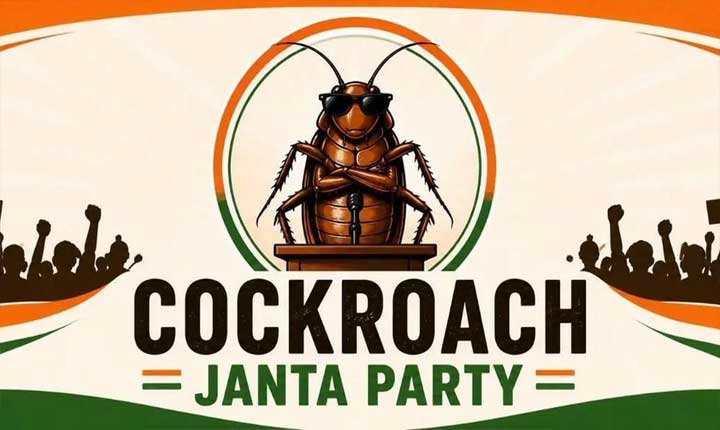
The response did not follow the usual script. Abhijeet Dipke, a 30-year-old Indian student based in Boston who had briefly worked for the Aam Aadmi Party, reacted with a simple online question: what if all the cockroaches came together? The post drew a flood of replies as young Indians embraced the insect a symbol of stubborn survival as a badge of resilience. On May 16, Dipke turned the moment into the Cockroach Janta Party (CJP), its name a pointed parody of the ruling Bharatiya Janata Party, and set up a website inviting people to pledge membership. What had begun as a joke became a movement: the CJP’s Instagram account gained more than 22 million followers in under a month, and its protest reels passed 400 million views.
Goals and Demands:
The CJP’s central demand is the resignation of Union Education Minister Dharmendra Pradhan, whom it blames for years of examination failures. At its Pune rally, the group released what it calls an “exam manifesto” setting out concrete asks:
• Compensation of 10,000 rupees per candidate whenever a paper leak occurs, to cover travel and preparation costs.
• A transparent testing process and the physical evaluation of answer sheets.
• An independent audit of the government contracts awarded to private agencies that conduct the exams.
Beyond these specifics, Dipke and the group’s spokespeople frame the wider aim as forcing a political cost for ignoring the young, and shifting the national conversation away from Hindu-Muslim polarisation toward education and employment. An online petition for Pradhan’s removal has gathered more than 800,000 signatures.
From Screens to Streets:
The movement’s shift offline has been uneven. Its debut rally at New Delhi’s Jantar Mantar on June 6 drew fewer than 2,000 people an outcome one participant called “a bit of an anti-climax.” Later rallies in Pune, Amritsar, Bengaluru, Hyderabad and Jaipur drew crowds in the thousands, marking a transition from online activism to street protest. At the Jaipur rally on June 15, Dipke was slapped repeatedly by men posing as supporters while he was being carried on their shoulders. “Physical attacks are a sign of fear and cowardice,” he wrote afterwards, vowing to keep protesting peacefully.
A Contested Verdict:
Observers disagree about what the CJP amounts to. Supporters and sympathetic commentators argue it has politicised a generation that usually avoids politics, and given many young people the confidence to speak up. Skeptics including some veteran journalists and opposition figures note that turnouts remain modest, that the movement lacks the backing of established civil-society names, and that the government’s willingness to let the protests proceed suggests it does not see them as a threat. Prime Minister Narendra Modi, without naming the CJP, posted on June 13 that his government was “working towards youth-led development” a claim the group dismissed as hypocrisy, given official silence on student suicides and paper leaks. Whether this anger hardens into lasting political change may depend less on the CJP itself than on whether the opposition chooses to ride the wave it has created.
Related News

Top 6 Stays in Dubai for Your Next Workation

SriLankan Airlines Restores Complete Middle East Network With Kuwait Service Resumption

Two Years After Trump’s Inflation Spotlight, Rising Grocery Prices Loom as a Political Vulnerability for Republicans Ahead of Midterms

US Imposes Up to 100% Tariffs on Drones to Curb Chinese Dominance and Bolster Security

Iran Mocks Trump Over Secret Aircraft Switch During Turkey Visit