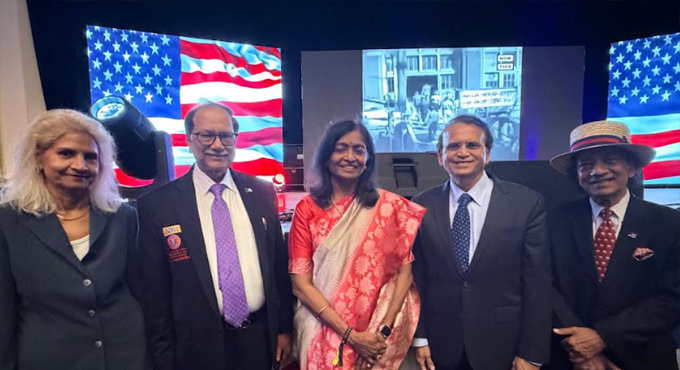

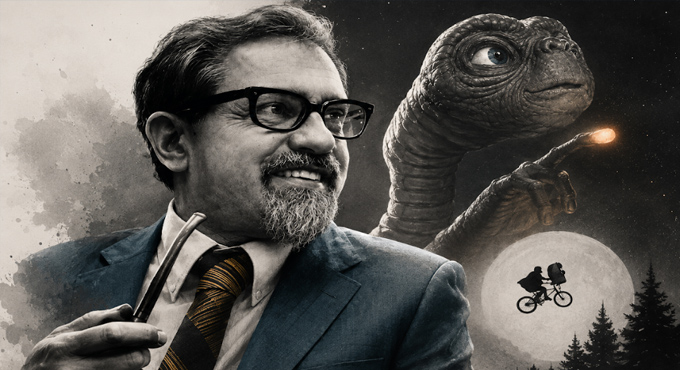
The Scientist Behind E.T.: Without J. Allen Hynek, Spielberg’s Greatest Alien Stories Might Never Have Existed
- Published By: techteam
- July 28, 2026 / 12:36 PM IST


By Surya Prakash Josyula
A brilliant light slowly descends from the night sky. Hundreds of people stand frozen, unable to look away as the glowing object comes closer. It is neither an airplane nor a helicopter. It is something humanity has never seen before. The craft lands, its door slowly opens, and a strange being steps out. Instead of panic, the people waiting below are filled with awe. It remains one of the most unforgettable endings in science-fiction history—the climax of Steven Spielberg’s Close Encounters of the Third Kind.
Most people believe those breathtaking visuals came entirely from Spielberg’s imagination. The truth, however, is far more fascinating. The inspiration behind those iconic scenes did not come from another filmmaker or a Hollywood writer. It came from a government scientist who spent decades investigating thousands of UFO reports. His name was Dr. J. Allen Hynek, and his extraordinary journey would eventually shape not only Close Encounters of the Third Kind but also influence one of the most beloved films ever made—E.T. the Extra-Terrestrial.
The story actually begins in 1948, when mysterious flying objects had become a national obsession across the United States. Concerned by growing public fear, the U.S. Air Force launched an official investigation and recruited respected astronomer Dr. J. Allen Hynek. His assignment was straightforward: investigate UFO reports and provide conventional explanations that would reassure the public. Whenever unusual objects appeared in the sky, Hynek visited the locations, interviewed witnesses, studied the evidence, and addressed the media with scientific explanations. Sometimes the sightings were explained as bright planets, atmospheric conditions, or aircraft. Yet with every investigation, he found himself carrying home more questions than answers.
Everything changed in 1966 during one of the most controversial UFO incidents in American history. Hundreds of people across Michigan reported seeing mysterious glowing objects hovering over swampy areas. The nation waited for Hynek’s explanation. Standing before reporters, he suggested that the lights were caused by “swamp gas” rising from marshland. Instead of calming the situation, the explanation became a national embarrassment. Newspapers mocked him, television comedians ridiculed the statement, and politicians questioned the credibility of the investigation. More importantly, Hynek himself began to realize that many cases were being dismissed far too easily.
The experience profoundly changed him. Over the following years, Hynek grew increasingly uncomfortable with simply explaining away every mystery. In 1973, he left government work and established the Center for UFO Studies (CUFOS), an independent organization dedicated to scientifically examining unexplained aerial phenomena. People from every walk of life—pilots, police officers, military personnel, scientists, and ordinary citizens—began sending him detailed reports. Before long, tens of thousands of case files filled his office.
Rather than treating every report as evidence of alien life—or dismissing them all as fantasy—Hynek believed they should be organized and studied systematically. He developed a classification system that grouped sightings according to the quality of evidence and the nature of the encounter. It included categories such as nocturnal lights, daylight discs, radar-visual sightings, and progressively closer encounters. The highest-profile category became known as Close Encounters of the Third Kind—a scientific term coined by Hynek long before Hollywood adopted it.
Around the same time, a young filmmaker named Steven Spielberg was searching for a fresh approach to telling an alien story. Unlike earlier science-fiction films that portrayed extraterrestrials as monsters or invaders, Spielberg wanted something grounded in mystery and human emotion. During his research, someone handed him Hynek’s landmark book, The UFO Experience. Spielberg was captivated. The eyewitness accounts, the scientific approach, and Hynek’s refusal to mock unexplained events offered a completely different perspective on the UFO phenomenon.
Spielberg contacted Hynek almost immediately. After securing permission to use the title Close Encounters of the Third Kind, he invited the scientist to serve as the film’s official UFO consultant. Hynek even made a brief cameo appearance in the movie’s unforgettable final scene, quietly observing the arrival of the alien spacecraft. For Spielberg, Hynek was more than an advisor—he was the bridge between science and imagination.
Hynek’s influence did not stop there. Among the thousands of case files he had collected was the famous 1955 Kelly-Hopkinsville incident in Kentucky, where a family claimed that strange creatures surrounded their farmhouse. Fascinated by the story, Spielberg initially planned to turn it into a horror film called Night Skies. However, the more he immersed himself in Hynek’s research, the more he noticed something unexpected. Many eyewitness accounts were not simply stories of fear. They were stories of curiosity, communication, and sometimes even empathy.
That realization transformed Spielberg’s creative vision. Instead of asking, “What if aliens invaded Earth?” he began asking a far more emotional question: What if an alien simply wanted a friend? That single idea eventually evolved into E.T. the Extra-Terrestrial, released in 1982. The gentle relationship between Elliott and E.T., the glowing nighttime atmosphere, the mysterious lights, and the sense of childlike wonder all reflected themes that had fascinated Hynek throughout his career.
The irony is impossible to ignore. A scientist originally hired to convince the public that UFOs had ordinary explanations ended up inspiring two of the greatest science-fiction films ever made. Hynek never claimed that every UFO report proved the existence of extraterrestrial life. His message was much simpler—and far more enduring. Genuine mysteries deserve careful investigation rather than immediate dismissal.
Without Hynek’s decades of research, Spielberg may never have created Close Encounters of the Third Kind. Without Close Encounters, the emotional journey that eventually became E.T. might never have taken shape. Sometimes the most extraordinary stories in cinema do not begin inside a film studio. They begin with a scientist who refuses to stop asking difficult questions.
Related News
From Freedom Fighter to Screen Legend: The Extraordinary Life of Ravi Kondala Rao

30 Minutes Across the Ocean: China’s Engineering Feat That Broke 10 World Records
Your Stuffy Nose Medicine Could Slow Aging, Finds Harvard Research!

Mister Middle Class Review: A Magical Book, But No Magic in the Screenplay

‘Sheep in the Box’: The Japanese Film That Blends AI, Love, and Loss