

30 Minutes Across the Ocean: China’s Engineering Feat That Broke 10 World Records
- Published By: Tech Team
- July 28, 2026 / 11:36 AM IST


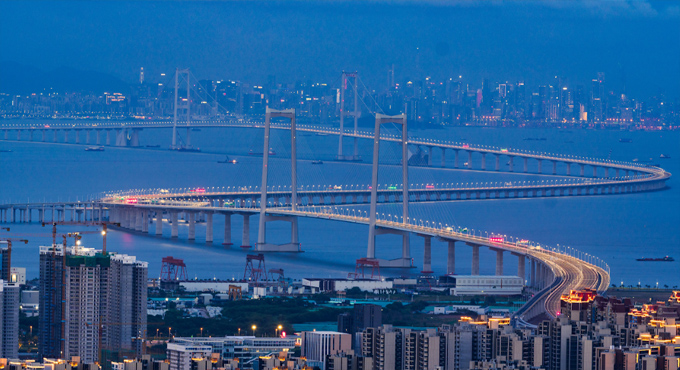
Imagine driving on an eight-lane highway over the open sea, descending onto a man-made island, entering an underwater tunnel directly beneath the seabed, and arriving in another city just 30 minutes later.
This is now a daily reality in southern China along the Pearl River Estuary. Opened in the summer of 2024, the Shenzhen–Zhongshan Link is a 15-mile (24-kilometer) mega-corridor that connects the technology hub of Shenzhen directly with the industrial city of Zhongshan.
Before this link was built, traveling around the bay required a long, heavily congested detour that often took more than two hours. Today, that same journey takes roughly 30 minutes.
A Record-Breaking Feat
This project did not just shorten commute times—it set 10 distinct world records during its construction:
Highest Bridge Clearance: To allow massive cargo ships to pass easily, the main bridge deck was built nearly 300 feet (91 meters) above sea level. This makes it the highest bridge deck over water in the world.
Extreme Wind Resistance: The structure was designed to withstand typhoon-force winds of over 185 mph (300 km/h).
Massive Underwater Tunnel: Beneath the waves lies the world’s longest and widest eight-lane underwater steel-and-concrete tunnel, assembled on the seabed with millimeter precision.
How the Shortcut Works: Bridge, Island, and Tunnel
Rather than building a single continuous bridge across the entire stretch of sea, engineers designed an integrated multi-stage system:
The Ocean Bridges: Drivers begin their journey on high-altitude suspension bridges elevated far above the waves.
The Artificial Islands: The road gently descends onto a custom-built artificial island resting in the middle of the bay.
The Underwater Tunnel: From the island, vehicles plunge directly into an eight-lane underwater tunnel built beneath the seabed.
The Mainland Exit: Drivers emerge smoothly on the opposite coast, leaving busy shipping channels overhead completely clear.
Overcoming Major Engineering Challenges
Building a massive highway through deep ocean waters and typhoon zones presented major real-world obstacles, which construction teams solved using clever engineering:
Allowing Giant Cargo Ships to Pass: As one of the busiest shipping lanes in the world, the estuary needed clear passage for large vessels. Engineers built the bridge 91 meters high. To prevent such a high bridge from swaying dangerously during storms, they gave it an aerodynamic shape that guides wind smoothly around the structure.
Building Islands in Deep Water: Creating artificial islands usually requires dredging massive amounts of soft ocean mud, a process that can take years. Instead, crews hammered dozens of giant steel cylinders—each as tall as an 18-story building—directly into the sea floor to form a sturdy outer wall. They then filled the interior, building two stable islands in record time.
Constructing the Eight-Lane Underwater Tunnel: To build the underwater section, massive steel-and-concrete blocks weighing tens of thousands of tons were pre-fabricated on land, towed out to sea, and submerged. Guided by satellite navigation systems, teams locked these giant sections together on the seabed without any gaps.
Impact on Everyday Commuters and the Economy
The mega-expressway now handles up to 100,000 vehicles per day. Beyond saving valuable time for daily commuters, it provides direct access to nearby international airports, boosts local trade and tourism, and allows goods to move across the region in a fraction of the time it once took.