
‘Sheep in the Box’: The Japanese Film That Blends AI, Love, and Loss
- Published By: Tech Team
- July 27, 2026 / 04:10 PM IST


By Surya Prakash Josyula
The mother opened the door after hearing the doorbell and stood frozen in shock. She couldn’t say a word. Standing in front of her was her seven-year-old son—the same boy whose funeral she had performed herself. It was the same face, the same innocent smile, and the same voice calling her “Mom.”
But there was one difference. His heart was no longer beating. Inside his chest was a processor. A company had collected her son’s old photos, videos, and voice notes, turned them into data, and created an AI robot that looked exactly like him.
Don’t worry—this never really happened. It is one of the key scenes from the recently released Japanese film “Sheep in the Box.” Directed by Hirokazu Kore-eda, the film has become a major talking point in Japan. It is not a big box office success and performed only average commercially. However, its concept has sparked discussions not only in the media but also across social media.
At first glance, the film looks like the story of a grieving family. But as it progresses, it slowly transforms into a story about human grief, memories, and love in a world that is increasingly shaped by AI.
What Is the Story?
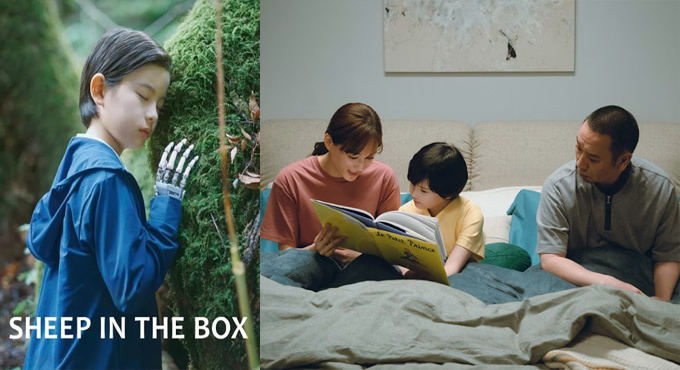
The story is set in a Japanese coastal town in the near future. Oton is an architect, while her husband Kensuke runs a carpentry and home construction business. Two years earlier, their seven-year-old son, Kakeru, died in an accident. Even after all this time, they are unable to recover from the loss and continue living in silent pain.
The Arrival of the AI Robot
A company called REbirth uses Kakeru’s old photos and videos as data to create an AI robot named Kakeru 2.0 with the help of generative AI. As part of a free trial, the company sends the robot to their home by drone.
Kensuke is disturbed by the idea and believes the company is turning people’s grief into a business. Oton, however, cannot let go of her son and accepts the robot as if it were her own child.
Life With the Robot
As time passes, even Kensuke slowly becomes attached to the robot. Kakeru 2.0 is no longer just a copy of the child they lost. It begins to develop its own way of thinking and becomes curious about the world around it. Inspired by its parents’ professions, it starts showing interest in architecture, wood, and trees.
Gradually, Kakeru 2.0 begins searching for its own identity and its own life. It can no longer completely accept the roles that the parents expect it to play. The story finally explores how the parents come to realize that no robot can truly bring back their son, how they learn to move forward instead of living only in memories, and how the AI child establishes its own identity.
The Meaning Behind the Title
The title of the film is inspired by the famous book The Little Prince. In the story, no one can actually see the sheep inside the box. In the same way, no one can truly know whether the emotions and thoughts inside this AI child are real. This metaphor forms the idea behind the film’s title.
The Film’s Biggest Strength
The biggest strength of Sheep in the Box is not its twists but the questions it raises.
Today, AI can imitate our voices and create videos using our photos. Around the world, researchers are experimenting with digital versions of people who have passed away. At a time like this, the question, “What if we could bring back the people we lost through AI?” feels more relevant than ever. That is why Sheep in the Box feels less like a traditional science fiction film and more like a story that belongs to today’s world. That is also why it has become a subject of discussion.
World cinema is changing as well. Science fiction was once associated with futuristic machines, aliens, and large-scale action. Today, it has become more personal. Modern science fiction is exploring how AI could change our relationships, memories, and grief. Sheep in the Box is a good example of this new direction.
Finally…
Stories may change with every generation.
Once, we told stories about wars. Then we told stories about science. Today, we are telling stories about AI. But one thing remains unchanged through every era—the human heart.
Many things in the world may change, but love, loss, and the memories we carry are emotions that belong only to human beings.
That is why Sheep in the Box leaves us with one simple but powerful question:
Can AI truly recreate human love, or is it only reflecting the memories we carry in our hearts?