

Your Stuffy Nose Medicine Could Slow Aging, Finds Harvard Research!
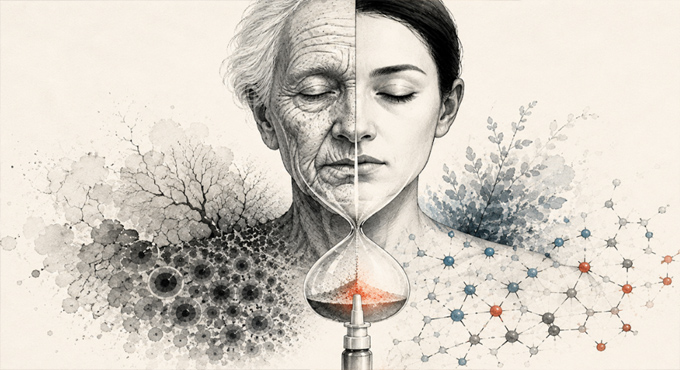
- Published By: Tech Team
- July 28, 2026 / 10:15 AM IST


— Surya Prakash Josyula
Even the most devastating wars in the world come to an end someday. Scientists have developed vaccines and medicines for deadly pandemics that once terrified millions. Humans have explored the deepest trenches of the ocean, planted flags in space, and even created Artificial Intelligence (AI) that thinks like us.
Yet, despite changing eras, there remains one single enemy that humanity has never been able to defeat: Aging.
Aging doesn’t happen overnight.
It begins quietly—two gray hairs that catch your eye while combing one morning, getting out of breath after climbing just a few stairs, or feeling completely exhausted the next day after staying up a little late.
We see it every day in our own homes: the wrinkles on our mother’s hands, our grandfather’s slowing pace, or our grandmother struggling to read small print.
That is why humanity has been asking one single question for thousands of years: Even if we cannot stop aging completely, can’t we at least slow it down?
Searching for an answer, researchers from Northeastern University and Harvard Medical School in the US tried a novel approach. Instead of spending billions to synthesize a brand-new chemical from scratch, they set out to check whether the answer might already be hidden inside medicines we are already using.
6,000 Medicines… One Single Map!
When we think of aging, we picture gray hair and wrinkled skin. But these are merely the outward signs. In reality, aging begins silently at the cellular and genetic levels. Over time, changes accumulate because cells stop communicating properly with one another and repair mechanisms slow down as energy production drops—eventually manifesting as old age.
Researchers first compiled nearly 1,250 genes associated with the aging process. When they mapped these genes onto the Human Interactome—a network of human protein interactions—they made a striking discovery.
These genes were not scattered randomly across the body! Instead, they were clustered in specific regions. This meant that if a drug could target these specific clusters simultaneously, it could slow down multiple biological processes driving aging all at once.
That’s where the real search began. Using computers, they analyzed millions of protein interactions to find which of the 6,442 drugs in their database could perform this exact task.
The “Old Drug” That Surprised Everyone
Passing thousands of drugs in the analysis, one name emerged that surprised even the scientists. It wasn’t a complex new molecule developed by an expensive biotech firm. It was Oxymetazoline—a drug that has been sitting in our home medical kits and local pharmacies for decades!
We have been using this drug for years in nasal sprays for stuffy noses, eye drops for red eyes, and topical creams for skin rashes.
As we age, cellular communication breaks down, making the body weaker. However, the study revealed that Oxymetazoline improves this inter-cellular connection, thereby slowing down the pace of aging. Alongside it, plain old Aspirin also made the list.
Does This Mean Aging Can Be Stopped?
The answer is no. Scientists haven’t made any such claim either. This is not a cure for aging, but rather the preliminary identification of a drug that shows promising characteristics.
It still needs to undergo extensive cell-level experiments, followed by animal testing and successful human clinical trials, before we can say anything for certain about its real-world efficacy.
Yet, what made this study so sensational isn’t just the drug itself—it is the new method of finding drugs.
Bringing a completely new drug from scratch to market takes over a decade and thousands of crores. Re-evaluating existing drugs that are already proven safe saves both time and immense cost.
In the future, this method could serve as a roadmap to rapidly discover solutions for conditions like Alzheimer’s, Parkinson’s, and heart disease.
A New Path Ahead
Average life expectancy is rising in our country too. But along with it, age-related health issues like diabetes, heart problems, and memory loss are becoming common in every household. A magic wand or single miracle pill to defeat aging hasn’t been found by anyone yet, and it might not happen tomorrow either.
However, behind every great change lies a simple idea. The question—”Why search elsewhere for new drugs when answers might be hiding in the old ones right in front of us?”—is what brought this research to life.
It proves once again that world-changing answers aren’t always born in secret laboratories; they appear when we learn to look at familiar things from a completely new perspective!