

The AI Behind the Attack? What a New Study Reveals About Terror Groups
- Published By: techteam
- July 21, 2026 / 11:35 AM IST


–Surya Prakash Josyula
It’s 2 AM at night. An African forest.
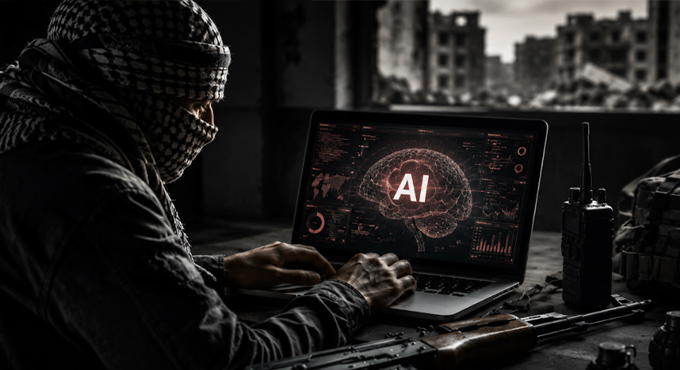
Thick fog all around. Hidden among those green trees in the middle of the forest is a small tent. From somewhere far away, the sounds of birds and animals can be heard occasionally. Piercing that silence, an old generator roars continuously. Only two sounds are heard inside the tent: the roar of the generator… and the sound of fingers tapping on a keyboard.
Inside that tent, only one light glows. It is a laptop screen. On the table… a dusty AK-47, a folded old map, a satellite phone, and a few empty bullet shells. Among all those, everyone’s eyes are fixed on that single object belonging to our world—the laptop. We might think it doesn’t belong in such an environment. But strangely, it is the most powerful weapon present there that night!
The light from that screen falls on the eyes of the person sitting in front of it. His fingers move rapidly across the keyboard. Everyone else in the tent watches the screen anxiously without speaking a word. A few seconds pass, breaking the silence with a ‘ting’ sound.
Something appears on the screen. Reading it, a smile flashes across his lips. The person next to him slowly picks up his gun. Outside the tent, vehicle engines start all at once. What exactly is happening there?
Why did everything change in an instant after seeing that one sentence on the screen? This is no movie scene. It is the stark reality revealed in a sensational research paper published by Cambridge University!
What Appeared on That Screen!
The very same AI tools like ChatGPT, Claude, Grok, and DeepSeek—which many of us use to write office emails or complete essays properly—were opened that night in that terrorist camp in the African forests. The details revealed in it are now forcing the world to think.
Cambridge researcher Antonia Juelich spoke directly with former members who left Boko Haram and ISWAP (Islamic State West Africa Province), groups causing destruction in Nigeria. The shocking truths they revealed form this report!
Until recently, everyone thought terrorists used AI only for online propaganda or to brainwash young people into joining their groups. But the scene changed long ago. It turned out that AI is being used not just for propaganda, but directly to plan terrorist attacks and draw up execution strategies.
As a ‘Force Multiplier’..?
Experts pointed out a key fact in this study. AI is not creating new types of weapons for terrorists. Instead, it is acting as a “Force Multiplier” (a tool that multiplies capability). It has given them the convenience of ‘trial and error’ right in front of a screen, without needing to launch attacks and lose lives just to learn lessons.
‘Jailbreaking’… Digital Classes in the Forest!
So, how did terrorists hiding in African forests acquire this high-tech knowledge? That’s your question, right? Trainers coming specifically from Iraq, Afghanistan, and North African countries reportedly taught these Nigerian groups digital classes.
AI generally has certain rules. If you ask ‘How to make a bomb?’ or ‘How to carry out an attack?’, it won’t answer. That is called a security wall. But these terrorist digital trainers drilled the skill of ‘Jailbreaking’ into them. That means prompting techniques where you don’t ask the question directly, but blindfold the AI, bypass its security guardrails, and extract the information you need.
Furthermore, dedicated AI units were formed in every batch. They had no other work. Their only job was to search for answers using AI for questions asked by militants on the ground and send them back.
The Chatbot That Turned into a Guide for New Weapons
Whenever they damaged military forces and seized new weapons, terrorists used to hesitate, not knowing how to operate them. But now, AI provides the operating guide for those new weapons within seconds. From increasing the intensity of bombs attached to drones to planning live attacks, AI’s fingerprints are everywhere!
The Nigerian military dug large trenches around their camps to prevent terrorists from approaching on motorcycles. It turns out they even asked AI how to jump those trenches on motorcycles and drew up their plans accordingly—showing just how severe the situation is.
“In the past, if we sent 200 people for an attack, 60 would die in the army’s counterattack. But with the plan provided by AI, we go with just 20 people and return after executing a precise attack,” said a surrendered former militant, sending chills through security forces. Most importantly, AI is providing and commanding the entire live attack planning.
Where Is the Real Danger?
However, can chemical or biological weapons be manufactured using AI? Since obtaining the dangerous chemicals and physical materials needed for them is not that easy, we can breathe a sigh of relief for now. But the threat of conventional attacks has increased a thousandfold.
You can use a knife in your hand to cut vegetables, or to cut a throat. Technology is just like that!
While technology is racing ahead… the security systems trying to stop it are panting behind. If this gap is not bridged, it wouldn’t be surprising if the very digital intelligence we created turns out to be our biggest threat tomorrow!
Related News

One Rule for Hero Vijay… Another Rule for CM Vijay!
The Trojan Horse Strategy: How Scientists Used Sugar to Trick the Brain and Attack Cancer

‘The Small Films That Stood Tall Against The Odyssey! Here Is Hollywood’s New Formula’

Warning! The New Dating App Scam Called ‘Chatfishing’

The Most Expensive Mistake in Real Estate… Are You Making It?