

The Trojan Horse Strategy: How Scientists Used Sugar to Trick the Brain and Attack Cancer
- Published By: Tech Team
- July 21, 2026 / 10:22 AM IST


By Surya Prakash Josyula
“Some stories do not just remain on the pages of history books.”
Even as time changes, the ideas hidden within them are reborn in new forms. Thousands of years ago, a tactic used to win a war has now become an inspiration for scientists fighting brain cancer. The name of that tactic is the ‘Trojan Horse’.
Here is how that story began…
After many years of war, the enemy appeared to be defeated. As they were leaving, as if to say, “The war is over… this is our final gift,” they left a massive wooden horse in front of the fortress gate. Slowly, the enemy army retreated.
Celebrations began inside the fortress. Saying, “We have achieved victory… and this is its symbol,” the people brought that massive horse inside the fortress.
That night… quietly… the belly of that wooden horse opened up. The soldiers hiding inside came out one by one. They opened the fortress gates. The waiting enemy army outside rushed in. By morning, the kingdom that had been celebrating victory fell into the hands of the enemy.
In history, this tactic is called the ‘Trojan Horse’.
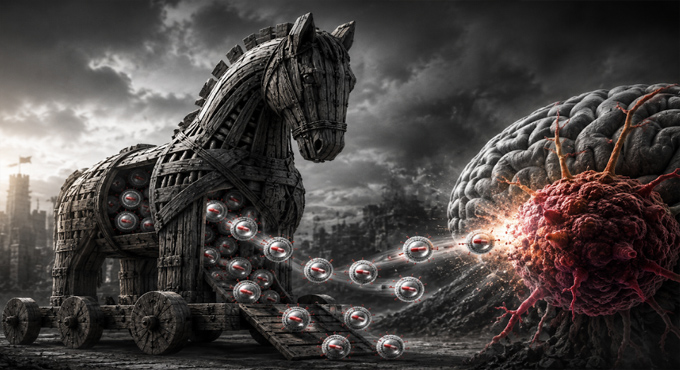
Thousands of years later, American scientists have now used the exact same strategy against brain cancer. The cancer medicine that was previously unable to enter the brain was hidden inside sugar-coated nanoparticles and delivered into the brain. That is the new research raising hopes in the medical field today. What is this research, and how useful will it be for cancer patients?
Why is Brain Cancer Treatment So Difficult?
One of the strict defense systems in our body is the Blood-Brain Barrier (BBB). It can be described as the brain’s ‘security gate’. It prevents viruses, bacteria, and toxins present in the blood from entering the brain. However, that very protection has become a major problem for doctors.
Because most cancer-killing drugs cannot cross this wall either. That is why treating Glioblastoma, a highly dangerous brain cancer, remains a massive challenge for global medicine.
Surgery… radiation… chemotherapy… no matter how many treatments are given, the disease often returns in many patients. Then, scientists had a single thought: “Instead of breaking the gate down… we must make the gate open itself.” That is where this ‘Trojan Horse’ trick was born.
The Sugar Trick… The ‘Trojan Horse’ Plan!
Just like in the story where an army was sent into the enemy’s fortress by gifting a giant wooden horse (Trojan Horse) with soldiers hidden inside, scientists did the exact same thing here.
Setting the Bait: The brain constantly needs glucose (sugar) to function. Therefore, the brain’s security guards allow sugar inside without any inspection.
Hiding the Treatment: Researchers at Oregon State University covered the nanoparticles with a dense layer of a sugar called ‘Mannose’.
The Deception Worked: Seeing this medicine, the brain assumed it was the “sugar” it needed for energy and welcomed it in!
Cancer’s Hunger: Moreover, compared to normal cells, cancer cells have a massive hunger for sugar. As a result, once inside the brain, the cancer cells actively grabbed this sugar-coated medicine.
How Did Sugar Become a Weapon?
First, one thing must be clearly understood. The sugar used here is not the regular sugar we put in tea. Researchers used nanoparticles specially made with ‘Mannose’ sugar molecules. This means the medicine did not break through the door to get inside; it chose the right path to make the door open.
Here is where the real twist lies!
The nanoparticles that entered the brain accumulated specifically near the cancer cells in higher amounts. There, they released a special mRNA. Its job was to make the cancer cells produce PTEN again—a protein that suppresses tumors. With this, control over the cancer’s growth was restored.
The Results in Experiments Were Substantial…
In tests conducted on mice, compared to regular nanoparticles, these sugar-coated nanoparticles entered the brain 9.9 times more effectively.
Even more surprising: after 28 days in untreated mice, the tumor occupied 52 percent of the brain. However, in the mice that received the new treatment, that number dropped to just 2.3 percent. Furthermore, their median survival time increased from 33 days to 49 days.
Another important detail observed by the researchers was that no significant organ toxicity was seen in major organs like the liver and kidneys.
When Will This Be Available for Humans?
Currently, this experiment has been successful only in laboratory mice. It will become available as a standard treatment only after clinical trials on humans are completed and proven completely safe. That will still take some time.
Is It Only for Brain Cancer?
Definitely not! This technology that bypasses the brain’s security gate is like a highway. In the future, through this ‘sugar route’, this research opens a new path to deliver medicines directly into the brain for other severe brain-related diseases such as Alzheimer’s (memory loss) and Parkinson’s (nerve weakness).
Also…
It should be remembered that this article does not mean “eating sugar reduces brain cancer.” The substance used in this research is specially engineered mannose-coated nanoparticles.
In Conclusion…
Some historical stories do not just remain on the pages of books. As time changes, the ideas hidden within them show new paths to science. The ‘Trojan Horse’ is one such idea. A strategy once used to conquer a kingdom is now becoming a guiding light for science to save lives.
Disclaimer: This is only a summary of a preliminary research article published in the Journal of Controlled Release. It is not yet an available medical treatment for patients. For any health issues, please consult qualified medical professionals.