
It Looks Like an Oil Deal. But Trump’s Real Plan Is Something Bigger
- Published By: Tech Team
- August 31, 2026 / 09:33 AM IST


—Surya Prakash Josyula
You don’t always need to capture a country’s capital to defeat it. If you can get control over its most valuable resources, that can be enough. Is America doing something similar in Venezuela now?
The latest oil deal brought by US President Donald Trump may look like a normal business deal on the surface. But behind it, there appears to be a much bigger political game. The deal is attracting attention around the world. So, what exactly is this deal? What does Trump gain from it? And how does America benefit? Let’s look at the bigger picture.
What is the deal?
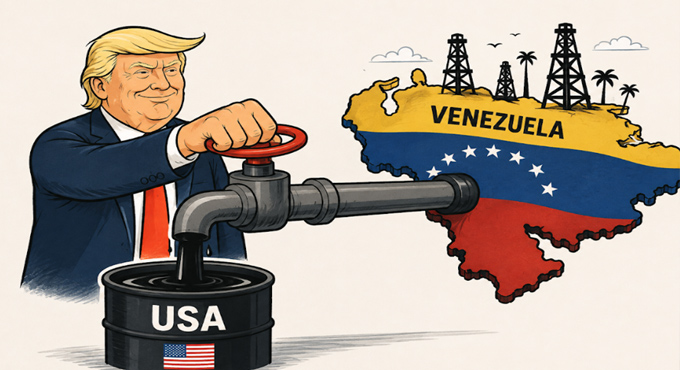
The main part of the deal is America gaining major control over about 65 billion barrels of proven oil reserves in Venezuela.
The US government is planning to start a new joint venture with a private company in Venezuela. Under the plan, the new company will get rights over 17 major oil fields for 100 years.
America will have control over 55% of the effective production from the venture. More importantly, the US will get the oil at the cost of production.
But there is something bigger here.
Venezuela has more than 300 billion barrels of oil reserves, the largest proven reserves in the world. The 65 billion barrels being targeted by the US are part of those reserves.
So, this is not just another business deal. It is a major strategic move to gain control over a large part of the resources of another country.
And one thing needs to be made clear. The oil is not suddenly coming to America. It is still underground in Venezuela. The deal is mainly about having control over the oil that will be produced from these fields in the future.
Why did Venezuela agree?
Think of it this way.
Imagine you have a huge amount of gold under your house. But you don’t have the money to dig it out. You don’t have the machines. And the system around you is badly damaged.
Then someone comes to you and says, “You can keep the gold. I will bring the money and machines and help you take it out. But I want the bigger share of what we produce.”
Would you agree?
That is more or less the situation Venezuela is facing now.
Venezuela has the world’s largest proven oil reserves. Hundreds of billions of barrels of oil are sitting underground. But strangely, the country has been struggling economically for years.
Its oil industry has also been badly damaged. Investment has fallen. Corruption, political crisis and US sanctions have all played a role in weakening the industry.
In simple terms, Venezuela has the oil, but it does not have enough money and infrastructure to fully use that wealth.
Its refineries, pipelines and other oil infrastructure need major investment and rebuilding. That could require hundreds of billions of dollars.
So America is not simply coming to take oil from the ground. It is also entering the picture to help rebuild the system needed to bring that oil out.
And it is doing that through a massive partnership.
For Venezuela, there are not many easy options. It needs money, investment and technology to bring its oil industry back to life.
For America, this is an opportunity to secure a major position in the global oil market.
What does the Venezuelan government say?
Venezuela’s interim president, Delcy Rodríguez, has called the agreement “historic.”
She says the oil projects could generate around $209 billion in tax revenue for the country.
From Venezuela’s point of view, the deal could bring money into a badly damaged industry. Oil production could increase. Jobs could be created. Government revenue could rise.
In other words, the deal could give Venezuela’s economy a chance to breathe again.
So… why does Trump want so much oil?
This is where the bigger story begins.
Trump appears to be playing five different games at the same time through this deal.
Game One — America’s energy security
Whenever there is a war or a major disruption in oil supplies, the impact eventually reaches American consumers through higher fuel prices.
After the Iran war, pressure on global oil supplies increased. Concerns also grew around key routes such as the Strait of Hormuz.
At the same time, America’s strategic oil reserves have been under pressure.
So what is Trump doing?
He is bringing a country with enormous oil reserves closer into America’s energy system.
That means Venezuela is not just another oil-producing country for Trump.
It could become a huge energy reserve for America.
If Venezuela’s oil production increases in the coming years, America could have another major source of oil close to home.
That could reduce some dependence on supplies from other parts of the world.
Game Two — Fuel prices
This may be even more important for Trump politically.
For many Americans, foreign policy is not the first thing they think about when they go to a gas station.
They look at the price on the board.
If fuel prices rise, the anger can quickly turn toward the president.
And with the November midterm elections approaching, fuel prices are a politically sensitive issue.
That gives Venezuela’s oil another value for Trump.
He can tell American voters that the US has access to another major source of oil and that he is working to increase supply and keep energy costs under control.
Of course, this does not mean fuel prices will suddenly fall tomorrow.
Venezuela’s oil industry needs huge investment and years of rebuilding.
But having access to a major future source of oil gives Trump something very valuable:
More control over America’s future energy supply.
Game Three — A check on China
This could be an even bigger part of the strategy.
China has expanded its influence across Latin America over the past several years. It has invested in infrastructure and built strong economic relationships in the region.
Venezuela has also had strong oil and economic ties with China.
Now Trump is moving into a place where China already has influence.
If America gains major control in Venezuela’s oil sector, it is not simply about America getting more oil.
It could also reduce China’s influence in the country.
In simple terms, Trump’s message could be:
“This is America’s neighborhood. I am not going to let China dominate it.”
That fits with Trump’s broader effort to strengthen US influence across the Western Hemisphere.
Game Four — Venezuela is about more than oil
Venezuela does not have only oil.
It also has gold, natural gas and other valuable minerals.
So gaining a strong position in the oil industry could open the door to more American business opportunities in Venezuela’s natural resources in the future.
From Trump’s point of view, oil could be the first door.
Once that door is open, there may be much more to explore.
That is why this deal can be seen as more than just an oil agreement.
It could be the beginning of a much larger American economic presence in Venezuela.
Game Five — The “victory story” Trump needs
This is the political part of the plan.
Trump has a very clear political style.
He likes to show that he came in, took control of a problem, made a deal and delivered something for America.
The Venezuela story fits perfectly into that narrative.
Venezuela was once a major opponent of the US.
Then America put pressure on the government of Nicolás Maduro.
Now the same country is moving toward a major oil partnership in which America gets a significant share of control and access to oil at production cost.
Trump can present this as another win for the United States.
In his political language, the message would be simple:
“America is winning again.”
And that may be the biggest story behind the entire Venezuela deal.
Related News

This City Doesn’t Sell Homes to the Middle Class!
Scientists Built Bacteria That Makes Medicine When Your Sugar Rises

From Classroom to Battlefield: Russia’s New Generation of Military Training

The Saree That Saved Lives: Tamil Survivors Recall Nepal Flood Horror

Did Ambani Try to Take Over Zee? Why Is Subhash Chandra Speaking Out Now?