
Scientists Built Bacteria That Makes Medicine When Your Sugar Rises
- Published By: Tech Team
- August 31, 2026 / 11:00 AM IST


People with diabetes know that controlling blood sugar is not as simple as taking a medicine once and forgetting about it. What you eat, when you eat, your sugar levels, and when to take your medicine—all of these have to be watched regularly. Now, scientists are exploring a completely different idea: what if the body itself could respond when blood sugar rises and make the medicine when it is actually needed?
That is exactly what researchers in China are trying to develop.
They have genetically modified a probiotic bacterium so that it can sense rising blood sugar and release GLP-1, a hormone that helps the body produce insulin. In simple terms, instead of taking a medicine from outside every time, the treatment could potentially be produced inside the body when it is needed.
The experimental treatment is called GIFT (Glucose-responsive Insulin-Fostering Therapy). It was developed by a research team led by Professor Haifeng Ye at East China Normal University.
How does the bacteria know that blood sugar is rising?
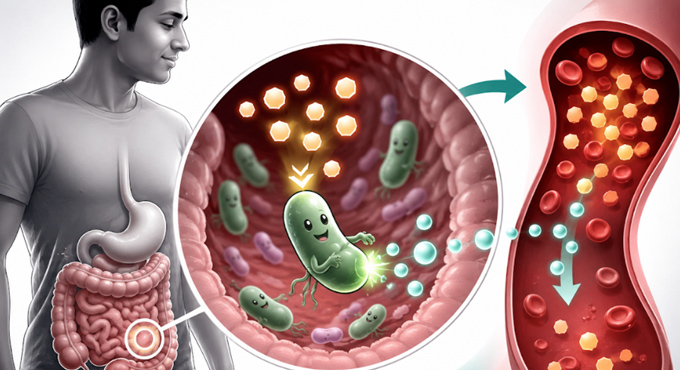
The bacteria used in GIFT can be thought of as a tiny “living factory.”
When glucose levels rise, the engineered bacteria detect the change and activate their genetic system. This triggers the production and release of GLP-1.
GLP-1 helps the body increase insulin production, which in turn helps control glucose in the blood. When blood sugar returns closer to normal, the bacteria reduce their GLP-1 production.
So, the basic idea is simple:
Blood sugar rises → bacteria detect it → GLP-1 is released → insulin response increases → blood sugar comes down.
In other words, the body’s sugar level helps decide when the treatment should switch on and when it should slow down.
How is this different from Ozempic?
GLP-1 is important here because it is already a major part of some modern diabetes and weight-loss medicines.
Drugs based on semaglutide, including Ozempic and Wegovy, work through the same GLP-1 pathway. But GIFT takes a different approach.
Instead of giving a GLP-1-based drug from outside the body, the researchers want the engineered bacteria in the gut to produce GLP-1 when blood sugar rises.
So, in simple terms:
The idea is not just to give the body the medicine. It is to make the body produce the medicine when needed.
What did the animal tests show?
Researchers first tested the technology in diabetic mice and later in monkeys. The experiments showed improvements in blood sugar control and the body’s response to insulin. HbA1c, an important measure of longer-term blood sugar control, also improved.
However, these results are still from animal studies. They do not yet prove that the treatment will work in humans.
When could this reach humans?
This is where things become important. GIFT has not yet been tested in humans, and human clinical trials have not started.
The researchers have filed patents for the technology and are working on scaling up production to pharmaceutical standards.
Before it can be tested widely in people, researchers will need to establish its safety, the right dose, and its long-term effects. Using genetically modified bacteria inside the human body also requires careful safety testing.
So, this is not a new diabetes medicine available to patients yet.
But the idea behind it is certainly interesting. Instead of taking a fixed treatment on a fixed schedule, future medicines could potentially respond to what is happening inside the body and switch on only when they are needed.
That raises a fascinating possibility for the future of diabetes care: what if your body could detect a rise in blood sugar and trigger its own treatment?
—Surya Prakash Josyula
Related News

This City Doesn’t Sell Homes to the Middle Class!

From Classroom to Battlefield: Russia’s New Generation of Military Training

It Looks Like an Oil Deal. But Trump’s Real Plan Is Something Bigger

The Saree That Saved Lives: Tamil Survivors Recall Nepal Flood Horror

Did Ambani Try to Take Over Zee? Why Is Subhash Chandra Speaking Out Now?