
The Saree That Saved Lives: Tamil Survivors Recall Nepal Flood Horror
- Published By: Tech Team
- August 29, 2026 / 05:10 PM IST


—Surya Prakash Josyula
Sometimes, the most ordinary things become extremely valuable when disaster strikes. A saree is something millions of women wear every day. But in Nepal that day, a woman’s saree became much more than a piece of clothing. It became a lifeline between life and death. When the floodwaters suddenly rose, vehicles around the pilgrims began getting swept away one after another. A group of Tamil Nadu pilgrims was travelling in three buses. Before they could understand what was happening, the situation had become extremely dangerous. One bus somehow remained on the road, and the 21 people inside it got out one by one and rushed towards a nearby hill.
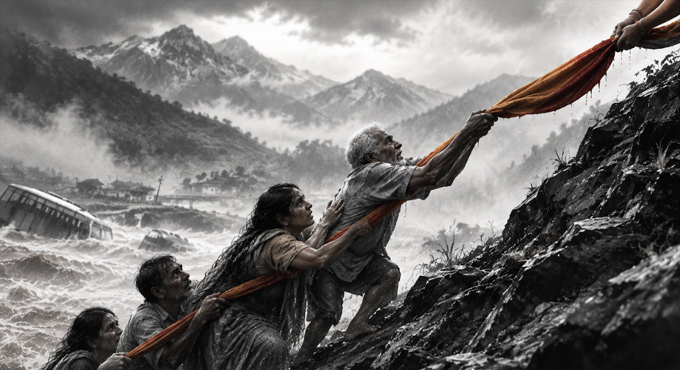
But reaching the hill did not mean everyone was safe. Some elderly pilgrims could not climb up. They were still down below, while the floodwater was rising rapidly around them. There was no rescue rope or special equipment, and there was very little time to act. That was when a woman took a quick decision. She removed her saree and threw one end down towards the people who were stuck below. The saree was nearly six metres long. The elderly pilgrims held on to it while people above pulled them up, one by one. That day, the saree was no longer just a piece of clothing. It became a lifeline.
A normal journey suddenly became a fight for survival
At around 9 am on August 26, the Tamil Nadu pilgrims were travelling in three buses near the Bhotekoshi River in Nepal’s Rasuwa district. They had no idea that the next few minutes would completely change their lives. Suddenly, powerful floodwaters came rushing towards them. The river began carrying everything in its path, and vehicles were swept away as the road quickly turned into a danger zone.
“Our bus was the only one that remained there. All the vehicles around us were being swept away by the flood,” Mayiladuthurai resident Manimegalai recalled. Within minutes, the group went from being ordinary pilgrims to people running for their lives. They got out through the driver’s side of the bus and started climbing the nearby hill. But even after reaching higher ground, they realised that some elderly members of their group were still trapped below.
A woman’s saree became a lifeline
There was no rescue rope, no special equipment and no rescue team at that moment. The people below could not climb the steep hill on their own, while the floodwater continued to rise. Then the woman used what she had with her — her saree. She threw it down and gave the people below something they could hold on to. Those who were already on the hill pulled them up to safety.
It was not a large rescue operation with helicopters and sophisticated equipment. It was simply a group of frightened people trying to save one another in the middle of a disaster. There was a saree, a few helping hands and a strong desire to survive. Sometimes, during the first few minutes of a disaster, the person who can save you is not a trained rescuer. It can simply be the person standing next to you.
Behind the numbers are real people
In the coming days, there will be many numbers connected to the Nepal floods — how many people were trapped, how many were rescued, how many remain missing and how many vehicles were swept away. But behind every number are real people and real stories. The statement that 21 people were rescued may look like just another number in a news report, but behind it is the story of a woman who used her saree to help elderly pilgrims escape rising floodwaters.
That is what makes this story different. When a disaster strikes, we usually talk about governments, rescue teams, helicopters and emergency operations. All of them are important. But in the first few minutes, when help is still far away, the person who can make the biggest difference may simply be another human being standing beside you.
They survived, but the story is not over
The 21 survivors were eventually taken to safety. After reaching higher ground, they walked several kilometres to the nearest Armed Police Force camp, where they received medical treatment and other necessary assistance. They were later flown by the Nepal Army to Kathmandu and brought from there to Delhi on August 28.
At the Delhi airport, Union External Affairs Minister S Jaishankar, Tamil Nadu ministers Aadhav Arjuna and A Rajmohan, Tamil Nadu BJP president Nainar Nagendran and others received them. For the survivors, reaching India was a moment of relief. But their minds were still with the people who had travelled with them.
Several people who were part of their larger group are still missing. According to the Ministry of External Affairs, 288 Indian nationals in Nepal were yet to be contacted. More than 100 affected pilgrims were from Tamil Nadu and Puducherry, while the whereabouts of another 80 people associated with the Isha Yoga Centre were also unknown.
For the 21 survivors, therefore, this is not simply a story about being rescued. It is also a story of fear, uncertainty and the pain of not knowing what happened to those who travelled with them. Chidambaram resident Thiagarajan described his survival as a “rebirth.” Manimegalai spoke about the distress of not knowing what happened to the others.
They survived. But whether everyone survived is still an unanswered question.
And among all the frightening memories of that day, one image will probably stay with them forever — a woman’s saree stretched between a dangerous flood below and a safe hillside above.
She may not have thought she was doing anything extraordinary. She simply used what she had and did what she could. But those few metres of cloth gave some people another chance at life.
A saree normally covers a woman. That day, it helped save lives.
Related News

Did Ambani Try to Take Over Zee? Why Is Subhash Chandra Speaking Out Now?

Satya Nadella’s ₹923 Crore Microsoft Package: The Real Story Behind the Numbers

What If the Car Becomes the Killer? Autokill Review: A Thriller About the Dark Side of Self-Driving Cars
Meta Wanted to Cut Jobs, But AI Told Them Not To
Instagram After Midnight? Why Meta Is Changing the Rules for Teens