
From Classroom to Battlefield: Russia’s New Generation of Military Training
- Published By: Tech Team
- August 31, 2026 / 10:00 AM IST


Dear Parents,
To improve your children’s education and prepare them for the future, our school is introducing a few new subjects this year. Monday: Introduction to Rifles. Tuesday: Introduction to Grenades. Wednesday: Drone Operation. Thursday: First Aid for War Injuries. Friday: Patriotism. Please make sure your children come to school on time. Note: Pencil box is required. A helmet would be even better.
Of course, this is not a real school circular. But looking at the kind of military training now entering Russian schools, it would not be completely surprising if something like this appeared one day. Because the strange thing about this story is not just that Russian children are being introduced to military training. It is that weapons, drones, battlefield medicine and military discipline are slowly becoming part of what a school education looks like.
Now, let us walk into the classroom.
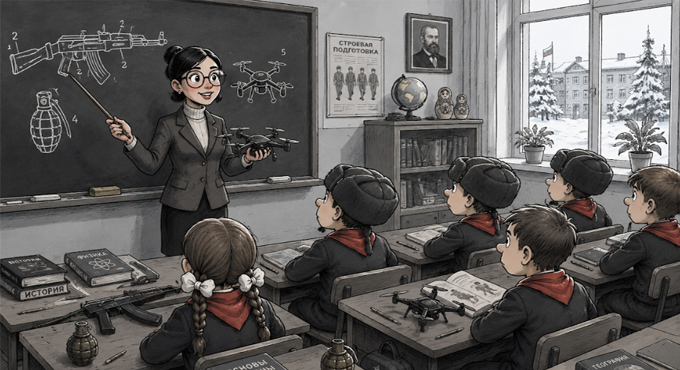
The children are sitting quietly at their desks. The teacher walks to the blackboard. There is no mathematics book in his hand. No science textbook either. Instead, he is holding a model of a rifle. “What is this?” he asks. Several hands go up. “A rifle,” one child answers. The teacher nods and then holds up another object. “And this?” There is silence for a moment. “A grenade,” another student says. The teacher nods again and writes one more word on the blackboard — Drone.
A boy at the back raises his hand. “Sir, what subject is this?” The teacher looks at him seriously and says, “Patriotism.” The boy then asks, “Sir, when is maths?” The answer comes quickly: “Later. First, you need to learn how to defend your country.” It sounds like a scene from a political comedy. But it isn’t. This is the direction in which Russia’s school system is moving.
For Indian parents, the comparison is almost too easy to make. We worry about our children’s marks, entrance exams, JEE preparation and whether they finished their homework. A Russian parent may increasingly have another kind of school lesson to think about — military preparedness. In simple terms, while Indian children may be worrying about the JEE syllabus, Russian children are being introduced to something that looks like a war syllabus.
Yes, this is actually happening
Russia has expanded military training under a school course called “Fundamentals of Security and Defense of the Motherland.” The revised programme includes basic knowledge of rifles, anti-tank weapons and hand grenades, along with military discipline and how to behave in conflict situations. Students are also taught first aid for battlefield injuries, survival skills and how to respond to chemical and radiation threats.
For a 13-year-old, this is a very different kind of school education. The Russian government presents it as preparation for national security and defence. But critics are asking a more uncomfortable question: why is military preparedness becoming such an important part of childhood?
The real twist is not the rifle. It is the drone
The rifle may remind people of the Soviet era. The drone makes the story much more modern. Warfare has changed dramatically, and the Ukraine war has shown just how important drones have become on the battlefield. Russia is now bringing that technology into youth training as well.
Students are being introduced to drones and, in some programmes, to simulators and other technology-based military exercises. So this is not simply about teaching children how soldiers once marched or handled rifles. It is about introducing them to the technology of modern warfare.
We normally associate new technology in schools with coding, robotics, artificial intelligence and science laboratories. In Russia, some of that technological education is taking another direction. The classroom is also becoming a place where children learn about the technology of war.
Not just lessons. Practical training too
And this is where the story gets even more interesting. Russia has revived a Soviet-era youth military game called Zarnitsa, now in a modern form. Children are divided into teams and given different military roles. One can be a commander, another a drone operator, someone else a medic or a member of an assault team.
The activities include laser-tag equipment, virtual reality simulators, trench exercises and mock weapons. Technically, it is a game. There are no real bullets flying around. But the message is still powerful. A child is being introduced to military roles through play, and that creates a rather unusual equation: war, adventure and patriotism become part of the same childhood experience.
That is precisely what worries critics. The concern is not that every child who plays a military game will become a soldier. The concern is that repeated exposure can slowly make military life, combat and war seem normal rather than exceptional.
Eight lakh children… and now 25 lakh?
The scale makes this much bigger than an interesting school experiment. Around 800,000 children took part in such programmes in 2024, while the number is expected to reach about 2.5 million this year.
That means these programmes are no longer limited to a small group of children from military families or specialist schools. They are reaching millions of young people. In India, when we hear “summer camp”, we usually think of cricket, swimming, painting, music or dance. In some Russian programmes, the menu looks rather different: drone training today, military exercises tomorrow.
Apparently, even childhood now needs a little military preparedness.
And who is teaching these children?
It is not only schoolteachers. Russia is also bringing veterans of the Ukraine war into schools and kindergartens to speak to children about their experiences, military service and patriotism.
Vyacheslav Volodin, the speaker of Russia’s lower house of parliament, has even called for war veterans to be present in every school, so that their experience can be used in educating children. Imagine the conversation at home: “How was school today?” “Fine, Mom.” “What did you learn?” “History.” “Who taught it?” “Not the history teacher. A soldier who fought in Ukraine.”
It sounds like satire again. But the trend behind the joke is very real.
This is not happening in just a few schools
A survey of more than 2,600 Russian school leaders and teachers found that 95% of schools hold events related to the war in Ukraine. More than 80% invite combatants to speak to students, while nearly 75% conduct special lessons about the war.
So this is not simply one teacher deciding that military training would be a good idea. It is becoming part of a wider, state-backed education system.
And that is what makes the story important. When military ideas enter a classroom once, it can be an event. When they become regular lessons, school activities, youth games, camps and talks by veterans, they begin to look like a system.
Is there now a pipeline from school to the army?
Put all these pieces together and a bigger picture begins to appear. A child enters school and is introduced to military training. Then come military games, drone training, camps and cadet programmes. War veterans visit schools and speak to students. At 18, Russian men are required to undergo military service. If a young person wants to move towards a military career, there are already established routes to do so.
Seen together, it starts looking less like a collection of separate programmes and more like a pipeline from the classroom to the military.
The question is obvious: is Russia simply teaching children about national defence, or is it preparing future soldiers from a very young age?
Russia has an answer
The Russian government would reject the second interpretation. Its argument is straightforward: children need patriotism, discipline and the ability to protect themselves and their country during an emergency.
There is nothing unusual about teaching children basic safety or national defence. But then comes the uncomfortable question: how much military training is too much for a child?
If patriotism is the lesson, why do you need a grenade? If national security is the goal, why do you need drone training? If discipline is what you want to teach, why do children need trench exercises? And when rifles, grenades, drones, battlefield first aid, military camps and war veterans all enter the same education system, the bigger question becomes unavoidable: what kind of young citizen is this system trying to create?
When soldiers become heroes
Children are especially influenced by the idea of heroes. A hero can be a film star, a cricketer, a footballer or a pilot. But if a country repeatedly presents soldiers as heroes, war as an act of patriotism and the enemy as a permanent national threat, children may slowly begin to see military service as a normal part of adult life.
That does not mean every child will grow up wanting to become a soldier. But it does mean that war is being introduced into childhood in a very different way. Critics describe this as the militarisation of education — bringing military thinking, military values and war-related ideas deeper into everyday civilian life.
The Soviet past is back — but with new technology
Russia has been here before. During the Soviet era, schools also had basic military training. Children learned things such as gas-mask drills, marching and rifle assembly. The official logic was that the country had to be ready to defend itself.
But there was an important difference. The memory of the Second World War was still extremely powerful, and the war was largely presented as a terrible national tragedy that must never be repeated.
Today, critics see a different message emerging. Instead of simply saying “war must never happen again,” the emphasis increasingly appears to be “if war comes, be ready.”
The difference may sound small. For a generation of children, it is not.
Finally, look at the school bag
Childhood is usually the time when children are asked what they want to become. A doctor. An engineer. A scientist. A teacher. A sportsperson. But if a country repeatedly places the image of the soldier in front of its children, it also tells them something about the kind of future it expects.
And that brings us back to the school bag.
A Russian mother may still ask her child, “Did you bring your pen? Did you finish your homework? Did you study for tomorrow’s test?” But perhaps, in this new version of school life, another question could eventually join the list:
“Did you charge the drone?”
That is where the joke ends.
Because behind the joke is a serious question. Is Russia preparing its children for the future? Or is it preparing them for the wars of the future?
And perhaps the most uncomfortable part is this: the answer may be decided inside a classroom, long before the child ever sees a battlefield.
— Surya Prakash Josyula
Related News
This City Doesn’t Sell Homes to the Middle Class!

Scientists Built Bacteria That Makes Medicine When Your Sugar Rises
It Looks Like an Oil Deal. But Trump’s Real Plan Is Something Bigger
The Saree That Saved Lives: Tamil Survivors Recall Nepal Flood Horror

Did Ambani Try to Take Over Zee? Why Is Subhash Chandra Speaking Out Now?