
Did Ambani Try to Take Over Zee? Why Is Subhash Chandra Speaking Out Now?
- Published By: Tech Team
- August 29, 2026 / 04:40 PM IST


—Surya Prakash Josyula
Once upon a time, when people in India talked about television, Zee was one of the first names that came to mind. News, movies, entertainment—Zee had something for everyone. Subhash Chandra built that massive media empire over several decades. But the business world does not always stay kind to its biggest players. The Essel Group later ran into serious financial trouble. Debt piled up, assets had to be sold and the share prices of its companies came under pressure.
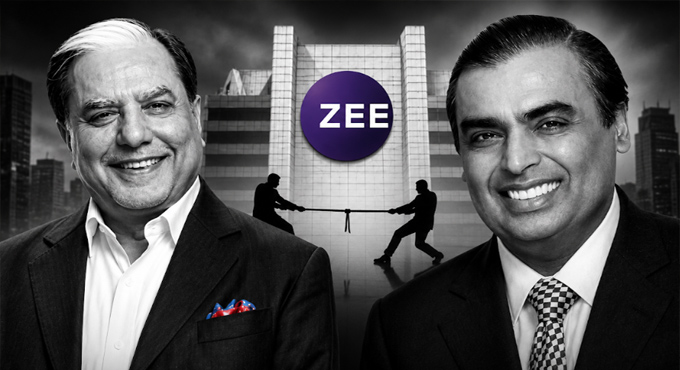
And that is where the story suddenly gets interesting. When a large business group becomes financially weak, there can be people trying to help it survive, but there can also be others who see the situation as an opportunity. Subhash Chandra is now making a serious allegation that something like this happened with Zee. He says Mukesh Ambani tried to “capture” Zee when the Essel Group was going through its financial troubles.
So, did Ambani really try to take over Zee? What exactly happened when the Essel Group was under pressure? And why has Subhash Chandra chosen to speak about it so openly now? These are the questions behind the latest corporate controversy.
It started with the Rs 22,000-crore controversy
Before getting into the Ambani angle, it is important to understand why Subhash Chandra is in the news right now. In his personal insolvency case, the National Company Law Tribunal, or NCLT, approved a repayment plan under which creditors will receive only around Rs 6.5 crore, even though admitted claims against him were around Rs 22,006 crore.
On the face of it, the numbers look shocking. A claim of more than Rs 22,000 crore and a repayment of just Rs 6.5 crore means creditors are recovering almost nothing. The recovery works out to roughly 0.03 per cent, leaving creditors with a massive haircut of around 99.97 per cent.
But Chandra strongly objects to the way this figure is being presented. He says the Rs 22,000 crore was not money that he personally borrowed. According to him, he had given personal guarantees for loans taken by companies linked to the Essel Group. Chandra says the claims against him as a personal guarantor were around Rs 3,900 crore, not Rs 22,000 crore. He also says around Rs 620 crore had already been settled, while another roughly Rs 1,100 crore had been offered as settlement.
In other words, Chandra’s argument is simple: the headline figure and his actual personal liability are two different things.
Then where does Mukesh Ambani come into this?
This is where the story takes a completely different turn. According to Subhash Chandra, when the Essel Group was struggling financially, there was an attempt to “capture” Zee. And he has directly linked that alleged attempt to Mukesh Ambani.
The word “capture” is particularly interesting. Chandra could simply have said that someone wanted to buy Zee. Instead, he used a much stronger word, suggesting an attempt to gain control of the company when the group behind it was financially vulnerable.
But there is an important catch. Chandra has made the allegation, but the details needed to establish the claim publicly are still missing. He has not, at least so far, laid out a complete trail showing when the alleged attempt happened, how much of Zee was targeted, whether there was a formal offer, who was involved in the discussions or why the alleged deal did not happen.
So, for now, this should be seen as Subhash Chandra’s allegation, not as an established fact.
Why does 2019 matter so much?
To understand why Chandra is bringing up this issue, we have to go back to the financial crisis that hit the Essel Group around 2019. The group was under huge pressure to repay its lenders. Assets were being sold and the shares of group companies came under serious pressure. The situation was difficult enough to raise questions about the future of some of its biggest businesses.
Chandra himself has said that at one point the debt burden on his family and group was around Rs 45,000 crore. He says the group later repaid around Rs 43,000 crore by selling its assets. Whether you agree with his version or not, the picture he describes is that of a business empire fighting to survive under enormous financial pressure.
And this is precisely the kind of situation in which corporate control can become a major issue. A company that looks strong during good times can suddenly become vulnerable when its promoter is under financial pressure. If its share price falls and the promoter starts selling assets to repay debt, potential buyers can see an opportunity.
That is the background to Chandra’s claim that someone tried to “capture” Zee.
Was there actually a takeover plan?
This is the biggest unanswered question. If Chandra’s allegation is correct, what exactly did the alleged takeover attempt look like? Was the plan to buy Zee shares from the market? Was there an attempt to acquire promoter holdings? Or was there some other strategy to gain influence over the company while the Essel Group was struggling?
At present, there are no publicly established details that answer these questions conclusively. The financial problems of the Essel Group around that period are one thing. Linking those problems to an alleged attempt by Ambani to take control of Zee is another.
That distinction is important because the two issues should not automatically be treated as one established story.
Why has TV18 entered the picture?
Subhash Chandra’s allegations do not stop with the alleged takeover attempt. He has also accused the Reliance-linked TV18 media network of spreading what he calls misinformation about his insolvency case.
His complaint is mainly about the way the Rs 22,000-crore figure is being reported. Chandra says that presenting the story as “Rs 22,000 crore debt settled for Rs 6.5 crore” creates a misleading picture because he was a personal guarantor and not the original borrower.
He has also made another serious claim. According to Chandra, a person known to him spoke to an editor at TV18 and was allegedly told that there were “instructions from above”. Chandra has used this as part of his argument that the coverage against him was not simply independent reporting.
But once again, there is a major unanswered question: who supposedly gave those instructions, and is there evidence to prove that such instructions existed? Chandra has not publicly established that part of the allegation.
Reliance, for its part, has rejected his claims and denied that its media businesses were used to target him or the Essel Group.
Why did Chandra try to contact Ambani?
According to Chandra, he did not immediately go public with his complaints. He says he first tried to contact Mukesh Ambani directly. He claims he called Ambani but did not receive a response. He then sent him a letter about what he described as the false reports appearing on Reliance-linked media platforms.
When he felt that the situation had not changed, Chandra decided to speak publicly. His message to Ambani was unusually direct. He asked him to stop what he called the “wrong propaganda” against him and his group and urged him to restrain the people he believed were behind it.
At the same time, Chandra said that he had reached a point where he had “nothing left to lose.” That statement gives the controversy a much more personal tone.
And what about Zee today?
There is an irony at the heart of this entire story. Subhash Chandra was the man who built Zee into one of India’s biggest media brands. But after years of financial stress, debt repayment, asset sales and corporate restructuring, he says he no longer owns or controls the company.
That changes the meaning of his latest allegation. This is not simply a businessman saying someone once tried to buy his company. It is a promoter who built a huge media empire saying that, when his business group became vulnerable, there may have been an attempt to take control of the very company he had built.
That is why the word “capture” has attracted so much attention. It turns what could have been an ordinary business story into a question about corporate power, financial distress and control.
But why reveal this now?
This may actually be the most interesting question in the entire story. If the alleged attempt to take over Zee happened years ago, why is Subhash Chandra speaking about it so openly now?
There are two possible ways to look at it. One is that Chandra has decided that the time has come to tell his side of a story that, according to him, remained hidden during the Essel Group’s financial crisis. The other possibility is that the intense criticism surrounding his personal insolvency case has pushed him to bring an old corporate battle back into the public conversation.
At this point, there is no evidence strong enough to conclusively choose between these two explanations.
The real mystery is still unanswered
What began as a controversy over Rs 22,000 crore versus Rs 6.5 crore has now turned into a much bigger corporate story involving Zee, Reliance, TV18 and the financial crisis that hit the Essel Group.
Did Mukesh Ambani really try to take control of Zee when the Essel Group was struggling? If yes, how far did that attempt go? Was there a serious offer or negotiation? Who was involved? And why did it not happen?
On the other hand, if Chandra’s allegation is not correct, why has he chosen this moment to make such a serious claim?
For now, there are more questions than answers. Chandra has put the allegation on the table, while Reliance has rejected it. The evidence needed to turn that allegation into an established story has not yet emerged publicly.
But one thing has certainly changed. A case that began with an extraordinary Rs 22,000-crore claim and a Rs 6.5-crore repayment plan has now opened up an entirely different question about what happened to Zee when its founder’s business empire was at its weakest.
Was it simply a financial crisis? Or was there a bigger corporate battle for control happening behind the scenes?
That is the mystery Subhash Chandra has now put back in the spotlight.
Related News

The Saree That Saved Lives: Tamil Survivors Recall Nepal Flood Horror
Satya Nadella’s ₹923 Crore Microsoft Package: The Real Story Behind the Numbers

What If the Car Becomes the Killer? Autokill Review: A Thriller About the Dark Side of Self-Driving Cars
Meta Wanted to Cut Jobs, But AI Told Them Not To

Instagram After Midnight? Why Meta Is Changing the Rules for Teens