Beyond the BSC Degree: How Indian Graduates are Driving US Healthcare from Home
- Published By: techteam
- July 27, 2026 / 10:20 AM IST


By Surya Prakash Josyula
“Dad… I wish you had enrolled me in engineering instead.”
When his son asked this right after graduating, the father had no answer.
The family simply could not afford expensive courses like engineering or medicine. So, doing the best he could, the father had enrolled him in a B.Sc. program. “As long as he gets a degree, he’ll find a way to stand on his own feet.” That was his belief.
Three years went by. The degree was in hand, but the career started with a meager monthly salary of ₹15,000. Seeing that paycheck, the father was even more heartbroken than the son. The unspoken question lingered in the household: “Did we struggle so much just for this?”
Meanwhile, the world was gripped by a new panic: “AI is coming… millions of jobs will vanish!” Like every middle-class youth starting out, he harbored the same fear: “What if the job I just got disappears tomorrow? What if AI takes it away?”
Unbeknownst to him, however, another door was opening.
The US healthcare system—not looking for engineers or doctors, but for thousands of science graduates just like him—was quietly waiting. How did the B.Sc. degree, often overlooked at home, become the foundation for a lucrative career tied to the US? The answer lay in this young man’s journey.
From a ₹15,000 Job to a Key Player for US Hospitals
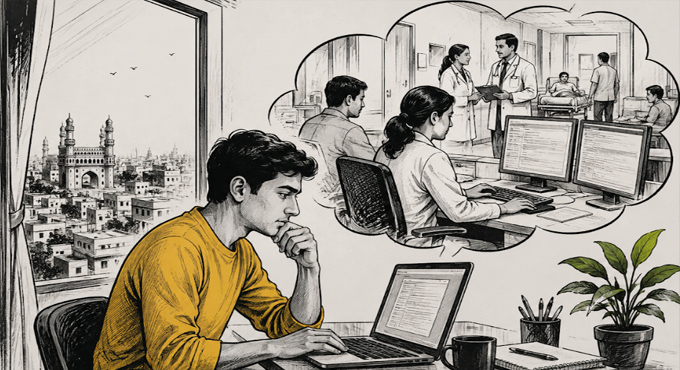
The young man who once thought his future had hit a dead end saw his life transform completely within a few years. He didn’t move to America; he still lives in Hyderabad. But every morning when he opens his laptop, his screen displays patient files from leading US hospitals.
His daily job is to review those files and check whether the treatment details entered by the doctor match the medical codes in the system. This work is vital for hospitals. A single mistake could freeze thousands of dollars in insurance claims. Identifying and correcting those discrepancies takes only a few minutes, but it saves the hospital from massive financial losses.
The interesting part? The person doing this isn’t a doctor, nor are they located in the US. It is a B.Sc. graduate sitting in Hyderabad.
Many young men and women who started out three years ago with a ₹15,000 salary are now working as Senior Medical Coders and Team Leads for the US healthcare ecosystem, earning up to ₹22 lakh a year.
What Exactly Is Medical Coding?
When a patient visits a hospital in the United States, receiving treatment from a doctor is only the first step. Every test, procedure, and medication provided must be translated into standardized medical codes that insurance companies can process. This process is known as Medical Coding.
The broader framework that manages these billings, claims, and payments is called Revenue Cycle Management (RCM).
While it might sound like backend administrative work, it is one of the most critical responsibilities in the US healthcare framework. If a single code is incorrect, the insurance company can reject the claim, leading to significant financial losses for the hospital. This creates a high demand for skilled professionals who can perform this task with extreme accuracy.
Where AI Stops, This Career Begins
AI is the talk of the world right now. ChatGPT analyzes data, and advanced AI systems process information rapidly. However, the responsibility of final review and approval for a US hospital bill still rests with humans.
Why? Because if AI makes a minor error, it isn’t just a software bug—it risks a claim worth thousands of dollars being rejected. While AI serves as a helpful assistant in this industry, the final sign-off is always made by a trained human medical coder.
A Day in the Life of a Medical Coder
Upon logging in each morning, cases assigned from US hospitals appear on the system. Coders review the documentation entered by physicians, assign the appropriate medical codes, and ensure there are no errors in the insurance claim. Once a quality check is completed, the final report is transmitted back to the US.
It may sound straightforward, but every single case requires an equal measure of precision and accountability.
Common Myths About the Profession
Myth: It is a job only for doctors.
Reality: Graduates from Life Sciences, Zoology, Biotechnology, Microbiology, and Chemistry—as well as B.Pharmacy, Nursing, and Physiotherapy—are all eligible for this field.
Myth: You have to move to the US.
Reality: Thousands of professionals work out of Indian cities like Hyderabad, Visakhapatnam, and Bengaluru, serving US hospitals. Many companies even offer Work From Home (WFH) options.
Myth: You need to know Software Coding.
Reality: Medical Coding has nothing to do with software programming. What matters here is an understanding of medical terminology, attention to detail, and a willingness to learn.
Salary Trajectory and Growth
Fresh graduates entering the field typically start with a monthly salary ranging between ₹25,000 and ₹30,000. As experience grows, professionals advance into roles such as Senior Medical Coder, Quality Analyst, Team Lead, and Operations Manager.
With three to five years of experience, packages between ₹15 lakh and ₹22+ lakh per annum are common in this sector.
Opportunities at Home
Prominent organizations such as IKS Health, Omega Healthcare, Access Healthcare, CorroHealth, and GeBBS Healthcare regularly hire for these roles across India. Holding a Certified Professional Coder (CPC) certification from the AAPC enhances prospects, though several companies also hire freshers and provide in-house training.
The Father Finally Got His Answer
Relatives who once looked down on a B.Sc. degree now ask, “Which company are you working for?”
Life-changing outcomes don’t always require an expensive degree; sometimes, all it takes is the right opportunity at the right time. Medical coding is one such opportunity. Without having to cross oceans, it allows Indian graduates to become an integral part of the US healthcare system.
Perhaps, after reading this, the answer to “What can you do with a B.Sc.?” might just change.
Related News

Behind the Peel: How Drug Cartels Highjacked the Global Fruit Trade
Just Five Words.. One Decision That Helped Break the Shackles of Slavery
India’s ‘Invisible’ James Bond… The Story of the Creator of R&AW!

Big Collections, Bigger Disappointment: Why ‘Kung Fu Soccer’ Is the Ultimate Remake Failure
From a Godavari Village to OpenAI: The Journey of Telugu Engineer Uday Rudraraju