

Behind the Peel: How Drug Cartels Highjacked the Global Fruit Trade
- Published By: Tech Team
- July 27, 2026 / 09:58 AM IST


— Surya Prakash Josyula
At midnight, the massive port in Italy was still wide awake as cranes slowly lowered huge containers one by one. Right in the middle of them stood an ordinary-looking refrigerated container bearing a single sticker that read “Fresh Bananas.” No one would ever look at it twice, but on that day, an officer stopped by that container—whether driven by actionable intelligence or sheer suspicion. Within seconds, the atmosphere shifted completely.
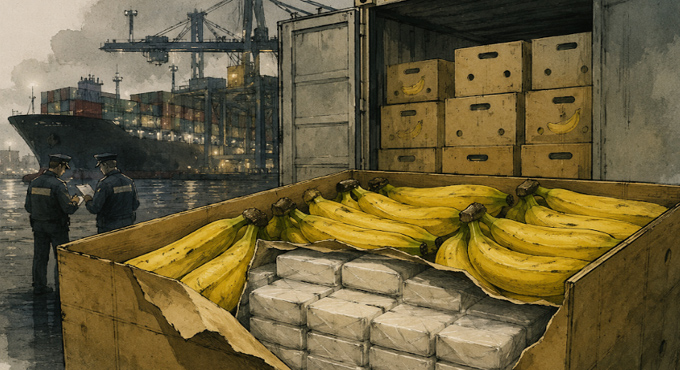
As the heavy iron doors opened, a blast of cold air rushed out, revealing rows of banana boxes. The officers began removing them one by one, but as soon as the last row was cleared, white packets neatly arranged behind the bananas were exposed.
They uncovered 650 packets of pure cocaine weighing 770 kilograms, carrying a staggering market value of ₹2,500 crores ($290 million). The banana, a fruit grown to feed the world, had turned into a billion-dollar cover for the international drug mafia.
This was not an isolated incident. The bananas we buy in our local markets travel thousands of kilometers to reach us in these same massive shipping containers, and the drug mafia has exploited this exact supply chain. The bust at Italy’s Vado Ligure port was not a random coincidence; it was backed by meticulous scientific planning.
Because bananas are perishable goods, customs officers face immense pressure to clear containers quickly to prevent crops from rotting. Furthermore, these fruits travel in specialized reefer containers kept at 13°C, where the cold temperature and internal moisture help mask the scent of drugs from sniffer dogs. Combined with the sheer volume of millions of banana boxes moving globally every day, inspecting every container becomes nearly impossible for authorities.
On the global drug map, Ecuador occupies a strategically vital position for these operations. Beyond being one of the world’s largest banana exporters, it directly borders top cocaine-producing nations like Colombia and Peru.
Cartels transport cocaine produced in neighboring countries into Ecuadorian ports, skillfully concealing it within legitimate agricultural exports. Driven by the massive European demand for cocaine, the Ecuador-to-Europe shipping lane has effectively become a primary golden route for international drug cartels.
The numbers behind this single bust—770 kilograms, 650 packets, and $290 million—reveal the immense scale of these global networks. To put it in perspective, a sum of ₹2,500 crores could build hundreds of schools or construct thousands of homes, yet the mafia risked it all inside a single shipment. Successfully sneaking just one container across port borders yields hundreds of crores in pure profit for these criminal empires.
This interception was not the result of routine random checks, but rather months of dedicated cargo profiling and risk analysis. Italy’s financial police (Guardia di Finanza) and customs officials acted on prior intelligence, using advanced X-ray scanners to analyze internal packing structures without opening the doors. Once their suspicions were confirmed, officers conducted a physical raid to seize the illicit cargo.
Using food and produce as a cover is a well-established tactic among global drug cartels. In past operations, hundreds of kilograms of cocaine were discovered inside banana crates delivered directly to supermarkets across Britain, Spain, and Poland. Mexican cartels have previously replaced avocado pits with plastic-molded cocaine balls, while Colombian networks have chemically bonded cocaine directly into coffee powder to extract it later.
Similar busts in Spanish ports have uncovered pineapples cored out and stuffed with plastic drug packets, as well as cocaine bricks concealed within shipments of frozen fish.
Had this single container slipped past port authorities, the street-level fallout across Europe would have been devastating. Distributed through thousands of local dealers into cities and nightlife venues, it would have claimed countesses lives while funneling ₹2,400 crores into cartel coffers.
While drug trafficking was once viewed strictly as a border-crossing issue, international cartels now routinely hijack the legitimate global food chain—from bananas and avocados to coffee beans and flowers. That night at the Italian port, opening a single refrigerated container exposed the sophisticated strategic machinery of the global drug trade.
Related News

Can Humans Have Sex in Space? And What Happens If They Do?
Why Did America’s Spy Agency, the CIA, Come Looking for Steve Jobs?

The Shocking Truth a Mother Found on TikTok After Her Son Died

America Moves First in Venezuela’s Oil Hunt. Where Does That Leave India?

Why Did Elon Musk Name His Son ‘Sekhar’? The Story of the Great Indian Scientist Behind the Name