
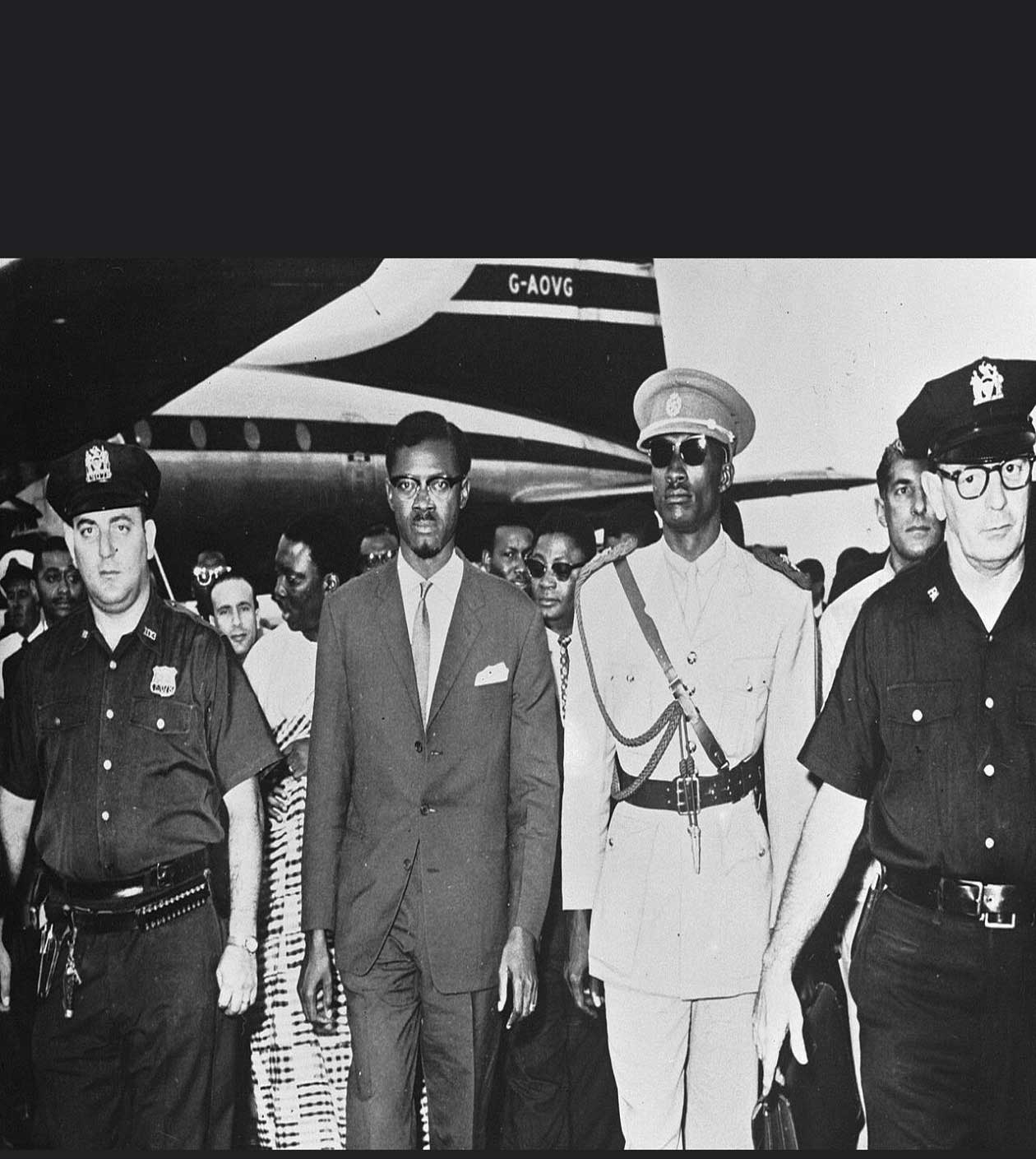
Prophet of Freedom: The Rise, Martyrdom, and Unbroken Vision of Patrice Lumumba
- Published By: shivaduvvuru
- June 29, 2026 / 11:59 AM IST


Lumumba: There are rare moments in history when a single voice is so powerful, so fiercely defiant, that the most formidable empires on Earth unite simply to silence it.
Patrice Lumumba was that voice.
He was a man who went from being a postal clerk to the first democratically elected Prime Minister of the Republic of the Congo in the span of just a few years. His offense? Believing that Africa’s vast wealth belonged to African people. For this audacity, he was targeted, overthrown, and assassinated in a plot involving multiple world superpowers.
1. The Foundation: From Postal Clerk to Political Firebrand:
Born in 1925 in Onalua, a small village in the Kasai province of what was then the Belgian Congo, Lumumba’s early life gave little hint of the global storm he would later spark. Educated at mission schools, he eventually found work as a postal clerk and traveling beer salesman.
These early jobs were critical. They allowed him to travel across a fractured country, witness the uniform cruelty of Belgian colonial rule, and build a massive, cross-tribal network of contacts.
In a colony where Belgian authorities deliberately stoked ethnic divisions to keep the population fragmented, Lumumba saw a different path. In 1958, he co-founded the Mouvement National Congolais (MNC). Unlike other regional or tribal parties, the MNC was built on a singular, radical premise. a united, pan-African Congo.
Lumumba was a mesmerizing orator. Armed with a fierce intellect, sharp glasses, and an electric presence, he spoke directly to the dignity of the Congolese people. His message spread like wildfire. By 1960, as pressure mounted across the continent during the “Year of Africa,” Belgium realized it could no longer hold the territory by brute force. They abruptly agreed to grant independence.
2. The Catalyst: The Speech That Changed Everything:
On June 30, 1960, the official Independence Day ceremonies took place in Leopoldville (now Kinshasa). King Baudouin of Belgium gave a patronizing speech, praising the “genius” of his ancestor, King Leopold II the man whose brutal rubber-extraction regime had resulted in the deaths of millions of Congolese.
The official program did not include a speech by the newly elected Prime Minister. But Lumumba rose to the podium anyway. What followed was one of the most fiercely defiant speeches in human history:
> “Our lot was eighty years of colonial rule… We have known ironies, insults, blows which we had to undergo morning, noon and night because we were Negroes… We have seen our lands despoiled in the name of so-called legal laws, which only recognized the right of the strongest.”
>
While the Western press reacted with shock and outrage, labeling Lumumba a dangerous radical, the Congolese masses erupted in joy. He had spoken the unspoken truth. But in doing so, he signed his own death warrant. The Western powers realized that Lumumba would never be a compliant puppet.
3. The Geopolitical Crucible: A Country Fractured by Design
Almost immediately after independence, the Congo was plunged into chaos a crisis heavily engineered from the outside.
The Congolese army mutinied against their remaining Belgian officers. Seizing on the instability, Belgium sent troops back into the country under the guise of protecting its citizens. More devastatingly, the mineral-rich province of Katangawhich contained the world’s most lucrative deposits of copper, uranium, and cobaltdeclared secession under Moise Tshombe, backed fully by Belgian mining interests and military assets.
Desperate, Lumumba turned to the United Nations for help to expel the Belgian troops and restore order. When the UN refused to use force to end the Katanga secession, Lumumba made a decision that sealed his fate in the eyes of the West: he asked the Soviet Union for planes and military advisors.
In the dead of the Cold War, this was the ultimate taboo. The United States and its allies immediately painted Lumumba as a communist threat, despite his repeated assertions that he was a non-aligned nationalist.
4. Journalistic & Historical Disclaimers:
> On Executive Accountability and the Paper Trail
> While historical consensus heavily implicates U.S. President Dwight D. Eisenhower in authorizing the elimination of Lumumba, readers should note that no surviving written directive or executive order signed by Eisenhower exists. In the early 1960s, operations of this nature relied on “plausible deniability” and verbal instructions. The primary evidence linking the President directly to the assassination directive stems from the 1975 Senate Church Committee testimony of Robert H. Johnson, a National Security Council note-taker, who testified under oath that he heard Eisenhower order Lumumba’s elimination. Other officials present recalled aggressive language regarding Lumumba but could not verify a literal execution order, though they conceded intelligence leaders reasonably interpreted the White House’s posture as an authorization for assassination.
> On the Execution and Intelligence Involvement
> The physical execution of Patrice Lumumba on January 17, 1961, was carried out by a Katangese firing squad under the direct command of Belgian officers. Decades of declassified documents and investigative research confirm that while the U.S. CIA and Belgian intelligence actively plotted his removal and shipped biological toxins to the Congo (which were ultimately discarded unused), neither U.S. personnel nor the CIA were physically present at the clearing where Lumumba was shot. The assassination was the result of a convergence of interests between local Congolese rivals, Belgian mining syndicates, and Western intelligence agencies operating within the broader anxieties of the Cold War.
>
5. The Superpower Intervention: The Execution of a Visionary:
The plot to eliminate Lumumba was not the result of an organic political downfall; it was a highly orchestrated assassination.
Knowing his life was in imminent danger after a military coup launched by Colonel Joseph-Désiré Mobutu, Lumumba slipped away in the middle of a stormy night in late November 1960, hoping to reach his stronghold of Stanleyville. He was hunted across the country by Mobutu’s troops. On December 1, he was captured while trying to cross the Sankuru River.
What followed was weeks of severe torture. Lumumba was flown to Thysville Prison, where he wrote his prophetic last letter to his wife, Pauline, predicting that Africa would one day write its own history of dignity.
On January 17, 1961, knowing he was too powerful a symbol to keep alive behind bars, his captors flew him to the breakaway province of Katanga straight into the hands of his bitterest enemies. That evening, Lumumba and two of his loyal ministers, Joseph Okito and Maurice Mpolo, were driven into a secluded savanna forest.
The Assassination:
January 17, 1961 Night
Under the supervision of Belgian officers and Katangese troops, Lumumba and his ministers were lined up against a large tree. He faced his executioners with total dignity before being shot by a firing squad.
The Cover-Up
January 18, 1961
Fearing his grave would become a sacred place of pilgrimage for revolutionaries, the executioners dug up the bodies and moved them to a hidden location.
The Attempted Erasure:
January 21, 1961
Belgian police officer Gerard Soete and his brother took the bodies, hacked them to pieces, and dissolved them in vats of sulfuric acid. They tried to leave nothing behind yet Soete secretly kept a single gold-crowned tooth as a macabre trophy, which was finally returned by Belgium to Lumumba’s family in 2022.
6. The Modern Awakening: A Vision Fulfilled:
What makes Lumumba a true prophet of freedom is how accurately his final words map onto the geopolitical shifts happening today. In his final letter, captured in image.png, he wrote:
> “The day will come when history will speak. But it will not be the history which will be taught in Brussels, Paris, Washington or the United Nations… Africa will write its own history and in both north and south it will be a history of glory and dignity.”
>
Decades after a coalition of global powers tried to erase his legacy, the independent path he predicted is actively taking shape. Sixty-five years later, we are witnessing a historic restructuring of sovereignty across the continent, particularly in West Africa.
Sovereign Rejection: Nations like Mali, Burkina Faso, and Niger are moving away from historical, Western-centric diplomatic frameworks and institutions built in Paris, Washington, and The Hague.
Institutional Exits: The formal moves by the Alliance of Sahel States (AES) to step away from traditional regional blocs like ECOWAS, alongside Niger’s filing to leave the International Criminal Court (ICC), mark a profound shift toward self-directed governance.
Resource Nationalism: A massive wave of renegotiations is underway across Africa, ensuring that local populations rather than foreign conglomerates rightfully profit from their own gold, oil, and lithium.
Lumumba only governed for twelve turbulent weeks, and he never lived to see these modern movements. Yet, by standing entirely unbroken against the empires of his time, he wrote the blueprint for a future he knew would eventually arrive. He was not a victim of a tragic fall; he was a visionary whose voice could not be buried.
Bare-Chested Against Empires:
On January 17, 1961, in a remote corner of the Katanga bush, a dynamic dream died. Patrice Lumumba, the first democratically elected Prime Minister of the Democratic Republic of the Congo, was stood before a hastily dug mass grave and executed. To ensure he would be forgotten, Belgian officers later dug up his body, hacked it to pieces, and dissolved it in a vat of sulfuric acid.
What the conspirators didn’t count on was that you cannot dissolve an ideal. They also didn’t count on his widow, Pauline Opango.
From Independence Hero to Cold War Target:
Just months earlier, on June 30, 1960, Lumumba had stood triumphantly before the Belgian King, delivering a legendary speech that shook the foundations of colonialism. He didn’t just thank the colonizers; he spoke bluntly about the “humiliating bondage” his people had endured.
Lumumba envisioned a fully unified Congo that controlled its own immense wealth of rubber, gold, and uranium. But this vision made him immediate enemies. Terrified of losing access to these resources during the height of the Cold War, Western powers labeled Lumumba a dangerous communist threat.
To destroy him from within, they looked to his closest confidant: a young military officer named Joseph-Désiré Mobutu.
The Judas of the Congo:
Lumumba trusted Mobutu completely, appointing him as his Secretary of State for National Defense. It was a fatal mistake. Mobutu’s personal ambition outweighed his loyalty to the revolution.
The Coup: On September 14, 1960, backed directly by funding and intelligence from the CIA and Belgian authorities, Mobutu led a military coup.
The Isolation: Mobutu placed his former friend under strict house arrest, cutting him off from the United Nations and his passionate base of supporters.
The Handover: Knowing that keeping Lumumba alive posed a threat to his new grip on power, Mobutu sanctioned his transfer directly into the hands of his bitterest regional enemies in Katanga.
With Lumumba murdered and his remains scattered into the wind, Mobutu consolidated his absolute rule. He renamed the nation Zaire and embarked on a 32-year totalitarian dictatorship defined by terrifying repression and the systematic looting of billions from his own country.
Pauline Opango: The Bare-Chested Defiance
Mobutu believed that by eradicating Lumumba’s physical body, he had eradicated his legacy. He was wrong.
While history often relegates the wives of revolutionaries to the background, Pauline Opango Lumumba refused to be hidden. Upon receiving confirmation of her husband’s horrific assassination, she chose an unforgettable, visceral method of protest.
Instead of mourning quietly at home, Pauline led a massive, solemn march through the chaotic streets of Leopoldville straight to the United Nations headquarters.
> The Power of the March:* Pauline walked entirely bare-chested. In traditional Congolese culture, this is the ultimate manifestation of grief, truth, and profound moral outrage. It is a visual curse cast upon wrongdoers.
>
By exposing her bare body to the world, she stripped away the polished lies of the UN and Mobutu’s regime, forcing global cameras to look directly at the raw, unvarnished trauma of the Congolese people.
An Unbroken Spirit:
Following her legendary march, Pauline’s life became a battleground of survival. Targeted by Mobutu’s regime and foreign intelligence, she was forced into decades of lonely exile, moving her children between Egypt, Cuba, and Tanzania.
She lived under constant surveillance, knowing her husband’s killers walked free in positions of immense power. Yet, she never remarried, famously stating that after being loved by a leader of Lumumba’s caliber, no other man could compare. She spent the rest of her days ensuring the world never forgot the crime committed against her family.
Mobutu built a legacy of stolen gold and broken promises that crumbled the moment he died in exile. Patrice and Pauline Lumumba, however, left behind something far more durable: an immortal symbol of African sovereignty and a reminder that true courage cannot be dissolved.
Related News
GOPIO Presents Memorandum on Diaspora Issues and Suggestions to Minister Jaishankar

Top 6 Stays in Dubai for Your Next Workation

SriLankan Airlines Restores Complete Middle East Network With Kuwait Service Resumption

Two Years After Trump’s Inflation Spotlight, Rising Grocery Prices Loom as a Political Vulnerability for Republicans Ahead of Midterms
US Imposes Up to 100% Tariffs on Drones to Curb Chinese Dominance and Bolster Security