
Mumbai 3.0: Maharashtra’s Mega Plan for the Karnala-Sai-Chirner (KSC) New Town
- Published By: Phanindra
- August 25, 2026 / 03:30 PM IST


Mumbai is the financial heart of India, but it is rapidly running out of room to beat. With land scarcity driving property prices to astronomical heights and existing infrastructure buckling under immense pressure, the Maharashtra government has initiated a visionary expansion plan.
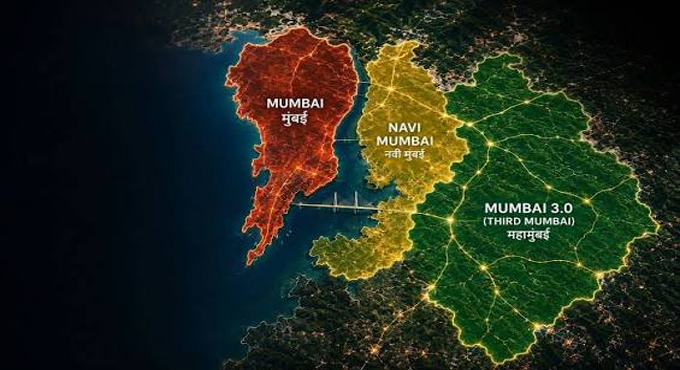
Dubbed ‘Mumbai 3.0’, the government has announced the development of the Karnala-Sai-Chirner (KSC) New Town.
Unlike organic urban sprawl, this will be a meticulously pre-planned city. The KSC New Town will span a massive 323.44 square kilometers, encompassing 124 villages across the Uran, Panvel, and Pen talukas of the Raigad district. The Mumbai Metropolitan Region Development Authority (MMRDA) has been officially appointed as the New Town Development Authority for this mega project.
Why Do We Need Mumbai 3.0?
Mumbai has long expanded beyond its original island city limits. While Navi Mumbai was successfully developed as a major satellite city, it is now experiencing its own surge in land demand and saturation.
To accommodate future population growth, emerging industries, and massive housing requirements, a new, large-scale urban center is an absolute necessity. The vision for Mumbai 3.0 goes beyond just constructing residential buildings; it aims to create an integrated ecosystem that houses employment hubs, educational institutions, healthcare facilities, technology parks, and logistics corridors all in one region.
According to the preliminary plans, roughly 104 square kilometers will be dedicated to modern townships and industrial corridors. Crucially, the plan emphasizes the protection of existing green zones, forests, and rural areas, striving for a balance between robust economic development and environmental sustainability.
Connectivity: The Backbone of the New City
The greatest advantage of Mumbai 3.0 is its strategic connectivity. The recently inaugurated Atal Bihari Vajpayee Sewri-Nhava Sheva Atal Setu (MTHL), which drastically reduces travel time between Mumbai and Navi Mumbai, acts as the primary catalyst for this region’s growth.
Furthermore, the new city will be seamlessly integrated with the rest of the Mumbai Metropolitan Region (MMR) through major infrastructure nodes, including:
– Navi Mumbai International Airport
– Panvel-Karjat Railway Corridor
– Virar-Alibaug Multimodal Corridor
– Mumbai-Pune Expressway
This exceptional connectivity is expected to make Mumbai 3.0 a highly attractive destination for IT hubs, Financial Services, Global Capability Centers (GCCs), Data Centers, and massive logistics operations.
Real Estate Impact and Massive Investments
The announcement of Mumbai 3.0 is poised to create massive new opportunities in the real estate sector. Historically, large-scale infrastructure projects trigger the development of new residential and commercial micro-markets. As the Atal Setu, the new airport, and the multimodal corridors become fully operational, the demand for housing, commercial office spaces, shopping complexes, and social infrastructure will inevitably surge.
However, experts caution that this should be viewed as a long-term urban development plan rather than a trigger for an immediate real estate boom. It will take several years for a project of this magnitude to fully materialize.
To kickstart the process, the MMRDA has allocated a significant budget of approximately ₹4,000 crore for the 2026-27 fiscal year specifically for the development of the Karnala-Sai-Chirner New Town.
A critical hurdle moving forward will be managing land acquisition across the 124 villages. The government is exploring various compensation models for landowners, including cash payouts, development rights, and land pooling. The ultimate success of Mumbai 3.0 will heavily depend on how efficiently the authorities handle land acquisition, public sentiment, and equitable rehabilitation. While the first phases of the project may take shape towards the end of this decade, the complete realization of Mumbai 3.0 is a vision for the distant future.
Related News
GPACTS 2026: Global Pharma AI, Compliance and Technology Summit to Convene in Hyderabad

3D Bioprinting: How Scientists Are Printing Human Organs and Tissues
360 ONE Appoints Abhishek Bhalotia as Chief Growth & People Officer

Freedom Oils Owner Gemini Edibles & Fats Files for IPO
U.S. Ambassador Sergio Gor Visits TLMAL Facility in Hyderabad to Highlight Defense Partnership