

Shocking: Are Governments Using Criminals to Carry Out Killings?
- Published By: Tech Team
- August 25, 2026 / 01:14 PM IST


— Surya Prakash Josyula
“Sir… if you have some money, please give me a little. I am in serious trouble.”
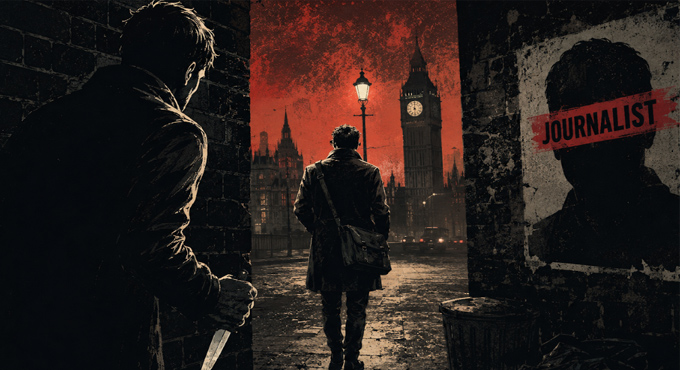
The journalist was in a hurry. He was on his way to cover a story when the young man stopped him. He was a stranger. The journalist had never seen him before. For a moment, he thought the man might genuinely need help. Without thinking too much, he put his hand into his pocket.
That was when someone suddenly grabbed him from behind. He turned around. In the very next second, a knife flashed.
One stab.
He screamed. Then came a second stab. His leg began to shake. A third stab sent him crashing to the ground.
The whole attack lasted only a few seconds. Before the people around them could understand what was happening, the two attackers ran towards a car waiting across the road. Its engine was already running. They jumped inside and sped away.
All that was left behind was a blood-stained road, a knife and an injured journalist.
Blood was pouring from his leg. A construction worker nearby rushed to help him. He took his tool belt and tied it tightly around the journalist’s leg to slow the bleeding. A few minutes later, the police arrived, followed by an ambulance. The journalist was taken to hospital.
He survived.
But the biggest questions remained: Who attacked him? And why?
The police began examining every piece of evidence they could find. Then they got hold of one of the attackers’ phones. They found messages, phone numbers and locations. But one message immediately caught their attention. It contained the journalist’s home address and apartment number.
That changed everything.
This was not a random attack. The attackers knew where he lived. They knew his movements. They knew when he would leave home and where he was going. Someone had been watching him for some time.
Then investigators discovered something even more important. The attackers had no personal connection with the journalist. They did not know him. There was no personal fight or dispute between them. So why would they try to kill him?
The answer appeared to be simple.
Money.
Someone had paid them. Someone had given them a job. And the job was to kill the journalist.
Until this point, it could still have been a criminal story involving hired killers. But then the case took a shocking turn.
The people behind the operation were allegedly not an ordinary criminal gang. They were not drug dealers. They were not personal enemies.
The trail allegedly led to a foreign government.
That government was Iran.
And that raised a much bigger question: Why would a government use criminals to attack someone?
A government can send soldiers. It can use intelligence agents. But sending hired criminals offers one major advantage. If the criminals are caught, the government can deny any connection with them. The people carrying out the attack can be arrested, while those who ordered it remain far away from the crime scene.
But who was important enough to become the target of such an operation?
Why would anyone spend so much money to kill this journalist?
What had he done?
What was his crime?
That is where the story takes another shocking turn.
His “crime” was simply speaking out.
He openly criticized his own government. He spoke about repression in Iran. He supported anti-government protests and questioned Iran’s rulers.
The journalist at the centre of this story was Pouria Zeraati, a prominent Iranian journalist and a strong critic of the Iranian government.
And the attack happened not in Iran, but thousands of kilometres away, on the streets of London.
But the story did not end with Zeraati.
As investigators looked deeper, other alleged plots and attacks against critics of the Iranian government in countries including the United States, Britain, the Netherlands, Germany and Sweden began to attract attention. In some cases, local criminal gangs were allegedly involved. In others, criminals were reportedly offered money to carry out specific tasks. There were also allegations that young people were contacted through social media and recruited for such operations.
That is where this story becomes much bigger than one attack on one journalist.
It raises a disturbing question about a different kind of warfare.
What happens when a country starts using criminals instead of soldiers to target its enemies?
There are no uniforms. No military vehicles. No soldiers crossing a border. The people carrying out the attack may simply look like ordinary criminals. They may not even know the full story behind the job they have been paid to do.
And that makes the threat even harder to see.
A journalist walks out of his home. He stops to help a stranger asking for money. A few seconds later, a knife comes out.
What looks like a street crime may actually be something much bigger.
The man holding the knife may be a criminal. But who paid him? Who gave him the target? And who gave the order?
That is the question at the heart of this case.
Because if governments really start using criminal networks to hunt their critics abroad, then the battlefield is no longer somewhere across a border.
It could be the street outside your home.
Related News
Do You Need to Pay ₹1 Crore to Go to America? Trump’s New H-1B Shock

Flying Abroad from India? This Airport Routine Is About to Disappear
America Is Fighting Russia. Why Could India End Up Paying the Bill?
One QR Code Scan Could Empty Your Bank Account?!

Flipkart’s New Rule: One Mistake and Sellers Could Face a Big Hit