3D Bioprinting: How Scientists Are Printing Human Organs and Tissues
- Published By: Phanindra
- August 25, 2026 / 02:00 PM IST


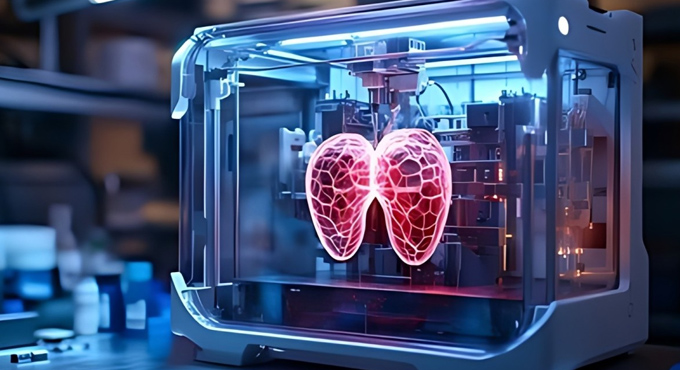
We already use 3D printers to manufacture everything from plastic toys to complex rocket components. But what if those same printers could create human ears, lungs, or skin? That reality is fast approaching. Scientists are currently using living cells as “ink” to build functional human tissue models.
While the concept mirrors traditional 3D printing—layering materials to build an object—printing body parts is infinitely more complex than melting plastic. You cannot simply stack living cells and expect them to form an organ. They require a specific environment and a gel-like medium to survive, communicate, and grow.
The Secret is in the “Bioink”
Unlike standard 3D printers that use metals or plastics, bioprinters use bioinks—specialized, jelly-like substances containing living cells.
Hydrogels: These bioinks are primarily made of hydrogels using materials like ‘alginate’ (derived from seaweed) or ‘collagen’ (a protein found in our skin and bones).
Cell Survival: The gel protects the cells, maintaining their shape while keeping them soft and flexible. It is fortified with artificial nutrients to mimic the human body’s natural environment.
Incubation: Once the printing process is complete, the fragile structures are placed inside special incubators. Here, they receive the exact conditions needed to grow, strengthen, and fuse into actual functional tissues, such as skin layers or cartilage.
How Bioprinting Works: Three Main Methods
Engineers have developed different techniques depending on the type of tissue being created:
Extrusion: Similar to squeezing toothpaste from a tube, the bioink is pushed through a nozzle layer by layer. It is highly effective for thicker tissues like skin and cartilage, though it is a slower process and puts slight pressure on the cells.
Inkjet Bioprinting: Much like a standard office printer spraying ink on paper, this method sprays droplets of bioink. It is faster, more delicate, and ideal for creating very thin layers of cells.
Laser-Assisted Printing: The most advanced and rapid method. A laser is directed at a tube containing the cell-infused gel. The light instantly solidifies the gel into the desired shape. This speed is crucial for creating complex, branching networks in seconds before the cells deteriorate from environmental exposure.
Milestones in Bioprinting
The field has already seen remarkable real-world applications:
Skin Grafts: This is the most advanced area of bioprinting. In 2025, researchers in Australia successfully treated a burn victim by bioprinting skin cells directly onto her wounds, resulting in complete healing.
Sensory Organs: In 2022, a patient received a 3D-printed ear made from their own cells. By late 2025, scientists successfully implanted a bioprinted cornea into a visually impaired patient.
Space Research: In September 2025, NASA astronaut Jonny Kim tested bioprinted liver tissue aboard the International Space Station to study how tissues form blood vessels in zero gravity.
The Ultimate Challenge: Blood Vessels
While skin and cartilage are seeing success, complex organs like the heart and kidneys remain elusive. The primary hurdle is vascularization—the creation of blood vessels.
Oxygen and nutrients can only naturally diffuse a few millimeters into tissue. In thicker, 3D-printed organs, the cells deep inside quickly suffocate and die without a blood supply. To solve this, scientists are experimenting with “Sacrificial Inks.” They print a temporary vascular network using this ink, then print the actual tissue around it. Once the tissue hardens, the temporary ink melts away, leaving hollow tubes for blood to flow through.
A major breakthrough occurred in September 2025 with a technology called ‘GRACE’. It uses computer vision to map cell locations and AI to instantly design an optimal blood vessel network. The bioprinter then creates this network in seconds, drastically reducing cell death.
While fully functioning artificial hearts and kidneys are still years away—connecting microscopic artificial capillaries to a human circulatory system is incredibly difficult—rapid advancements in bioinks and AI mean that 3D-printed organs are no longer a question of if, but when.
Related News

360 ONE Appoints Abhishek Bhalotia as Chief Growth & People Officer
Freedom Oils Owner Gemini Edibles & Fats Files for IPO
U.S. Ambassador Sergio Gor Visits TLMAL Facility in Hyderabad to Highlight Defense Partnership

AMFI Announces Nationwide Investor Awareness Initiatives to Expand Mutual Fund Reach

Interio by Godrej Scales Technology-Led E-Commerce with 14x Growth