

8.7 Crore Indian Youth Lack Jobs and Training: NITI Aayog’s Blueprint for ‘Viksit Bharat’
- Published By: Phanindra
- August 25, 2026 / 03:40 PM IST


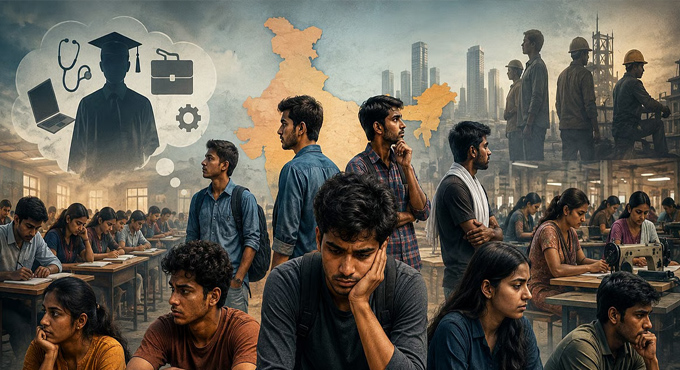
As India accelerates towards its goal of becoming a developed nation (‘Viksit Bharat @2047’), a new report by NITI Aayog has sounded a critical alarm regarding the country’s youth.
According to the report titled ‘Reimagining Skilling for Viksit Bharat @2047’, an estimated 8.7 crore youth between the ages of 15 and 29 are currently sitting idle—without education, employment, or formal skill training.
The report highlights a severe financial barrier: students from lower and middle-class families spend significant amounts of money on regular college fees and private tuition. Consequently, they are unable to afford additional, job-oriented technical or coding courses. This forces many graduates to either take up minor, unrelated jobs immediately after finishing their studies or remain confined to their homes without any work. Furthermore, the report reveals a stark mismatch in the job market, noting that only 8.25 percent of skilled graduates are employed in roles that actually align with their educational qualifications.
The Way Forward: Self-Employment and Free Training
To overcome this mounting crisis, NITI Aayog has outlined several key recommendations to overhaul the skilling ecosystem:
Free and Subsidized Training: The government must provide subsidized or entirely free skill training programs specifically targeted at NEET (Not in Education, Employment, or Training) youth and women.
Earn-While-You-Learn: Implementing flexible models that allow students to earn money while pursuing their education, alongside special financial assistance for those from economically weaker backgrounds.
Industry-Aligned Practical Courses: Indian youth can only secure suitable employment if training courses are directly matched with local job opportunities. The report stresses the need to introduce courses equipped with practical projects tailored to the specific needs of local industries.
Focus on Self-Employment: NITI Aayog emphasized that the ultimate goal should not merely be training for formal jobs. Instead, the focus must shift toward equipping youth with the skills required for self-employment, meeting local market demands, and preparing them for rapidly growing new sectors.
Related News
BJP Leadership Announces Dedicated Committee to Attract Gen Z

Three Aspects to Learn from Southern States: Amit Shah

US Says Jammu & Kashmir is an Integral Part of India… Pakistan Condemns
Only Two Stanzas of Vande Mataram… CWC’s Key Decision
CM Fadnavis… Now an Even More “Most Powerful CM”.. A New Rule There