
FICCI Hosts ‘Hyderabad 2035’ Conference, Unveiling Report Positioning City as India’s Global Capability Capital
- Published By: Vishal
- September 10, 2026 / 06:47 PM IST


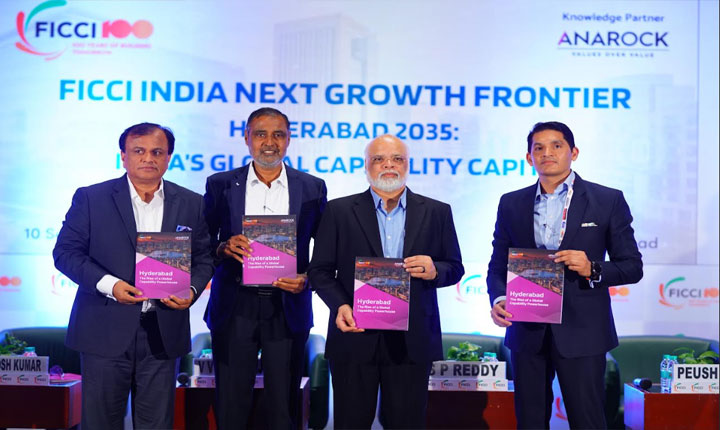
The Federation of Indian Chambers of Commerce and Industry (FICCI), in collaboration with knowledge partner ANAROCK, hosted the “FICCI India Next Growth Frontier: Hyderabad 2035: India’s Global Capability Capital” conference on September 10, 2026. The event featured the launch of the knowledge report titled “Hyderabad – The Rise of a Global Capability Powerhouse,” which highlights the city’s emergence as India’s leading hub for technology innovation and Global Capability Centers (GCCs). Terminus Group CMD S.P. Reddy shared that Hyderabad witnessed 5.2 million square feet of commercial space absorption in H1 2026, with GCCs making up 40 to 45 percent of that share and helping drive a 12 percent year-on-year increase in residential sales to 23,700 units.
Economic Multipliers and Real Estate Dynamics:
Addressing the gathering, FICCI Telangana State Council Chairman V.V. Rama Raju noted that Hyderabad is now home to more than 500 GCCs supporting over 300,000 professionals constituting 20 percent of India’s total GCC workforce. ANAROCK Managing Director Peush Jain added that the city features world-class infrastructure spanning over 1.4 billion square feet. Industry discussions centered on the ‘BHP Triangle’ (Bengaluru, Hyderabad, and Pune), noting that occupiers frequently scale from 500 seats to several thousand within a few years, driving a demand for “15-minute city” ecosystems that combine retail, healthcare, and office spaces while expanding west and south toward the airport.
Future-Proofing Assets and Addressing Ecosystem Challenges:
Panelists focused on transitioning GCCs from cost-arbitrage models into strategic value-creation hubs prioritizing talent development, product ownership, and AI-ready infrastructure such as heavy power capacity and high-efficiency chillers. To sustain Hyderabad’s growth through 2030 and beyond, industry leaders underscored the importance of cultivating AI-mature talent pools, enhancing last-mile transit connectivity, and preserving rental competitiveness amid high-density urban expansion.
Related News
Marriott International Launches Project Prarambh to Empower India’s Youth with Hospitality Careers
NephroPlus Launches NIDA to Build Global Pipeline of Dialysis-Trained Nurses

Complan Launches ‘India ka Complan Boy’ Campaign Featuring Young Cricket Sensation Vaibhav Sooryavanshi

Aditya Birla Housing Finance Expands Telangana Presence With New Branch in Nagole, Hyderabad
Kinetic Watts and Volts Expands Andhra Pradesh Footprint with Vizag 3S Facility and 100 Milestone Deliveries