

Who Is Shaking Colgate’s Mighty Empire?
- Published By: Tech Team
- August 27, 2026 / 10:30 AM IST


— Surya Prakash Josyula
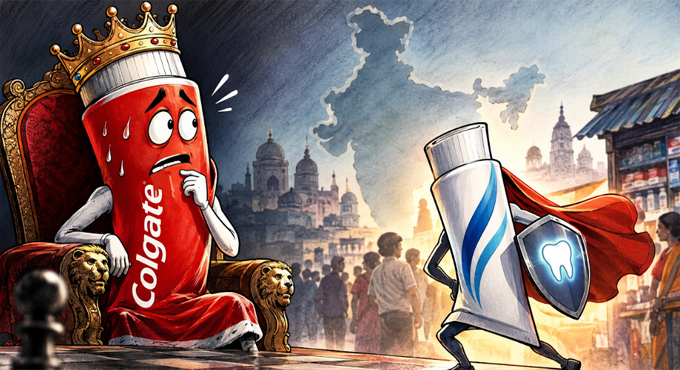
Once upon a time, when the toothpaste at home was over, nobody said, “Bring toothpaste.” They simply said, “Bring Colgate.” That is how deeply the brand became part of Indian life. As Indians slowly moved from traditional methods of cleaning their teeth to toothbrushes and toothpaste, Colgate became a part of their daily morning routine. For decades, it has been one of the most familiar brands in millions of Indian homes. But now, Colgate is facing a serious challenge.
The problem is not that a new brand has suddenly entered the market. The bigger worry is that an existing competitor is slowly taking away some of Colgate’s own customers. Colgate once enjoyed a dominant position in the toothpaste market. But its market share has been falling, while its sales growth has been slower than that of some of its major competitors.
And here comes the twist. The biggest threat is not Patanjali. It is not even the herbal toothpaste wave that once shook the market. A brand that focused on one specific dental problem is now giving Colgate a tough fight.
That brand is Sensodyne.
Sensodyne was once mainly known as a toothpaste recommended by dentists. Today, it is easily available in supermarkets, medical stores and online platforms. It has built a strong market around a simple problem — tooth sensitivity. If cold water makes your teeth hurt, or eating ice cream causes a sharp pain, Sensodyne tells you that it has a solution.
That is where the real twist in the Colgate story begins.
Colgate told people, “Brush your teeth every day.” Sensodyne asked, “Do you have this particular problem with your teeth?”
The difference between these two approaches tells us a lot about how India’s toothpaste market is changing.
For years, toothpaste was simply a daily-use product. Now, consumers are increasingly looking for products for specific dental needs. One toothpaste for sensitivity, another for gum care and another for whitening. The market is slowly moving from “one toothpaste for everyone” to “the right toothpaste for my problem.”
Sensodyne understood this change early.
That is what has made the game difficult for Colgate.
Colgate built its strength through the mass market. From a small kirana shop in a village to a supermarket in a big city, Colgate is almost everywhere. Sensodyne followed a different route. It first built credibility through dentists, then expanded through pharmacies, supermarkets and online platforms.
Earlier, many people bought Sensodyne because a dentist recommended it. Today, more consumers are actively asking for it in stores. That is the real strength of the brand.
And there is big money in this shift.
Consumers are often willing to pay more for a toothpaste that promises to solve a specific problem. This is the premium toothpaste market, and it is growing. Colgate is also trying to take a bigger share of this opportunity.
According to the company’s latest figures, the share of premium toothpaste increased from 14.8% in 2023 to 18.6% in 2026. This shows that consumers are not looking only at price anymore. They are also asking, “Which toothpaste is better for my problem?”
For Colgate, this is both a threat and an opportunity.
The bigger opportunity is that India’s oral-care market is still far from fully developed. Millions of Indians are yet to adopt better oral-care habits. That means there is still a huge market waiting to grow.
But there is no guarantee that every new consumer will choose Colgate.
The big challenge for the new CEO
This is why the leadership change at Colgate-Palmolive India comes at an important time. Prabha Narasimhan is moving to a larger Asia-Pacific role, while Manish Anandani is returning to Colgate as the new CEO.
His challenge is not simply to increase sales.
The real question is:
Can Colgate move from being “the toothpaste brand everyone knows” to being “the toothpaste brand that has the right solution for every dental problem”?
That will be the real test.
Because the question Indians once asked was:
“Which toothpaste should I buy?”
The question today is changing to:
“Which toothpaste is right for my teeth?”
Whoever understands that change faster will have a better chance of winning the next battle in India’s oral-care market.
Related News

Meta Smart Glasses Put Cinemas on Piracy and Privacy Alert
India Made Generics Its Strength. Why Is That Now Becoming a Problem?

Don’t Make This Mistake When Buying a Swimsuit for Your Child.. They May Be Hard to See in Water!

Companies Spent Crores on AI.. But Did They Really Gain Anything?

Buying Property From an NRI? October 1 Brings a Key Tax Rule Change