

Companies Spent Crores on AI.. But Did They Really Gain Anything?
- Published By: Tech Team
- August 27, 2026 / 09:45 AM IST


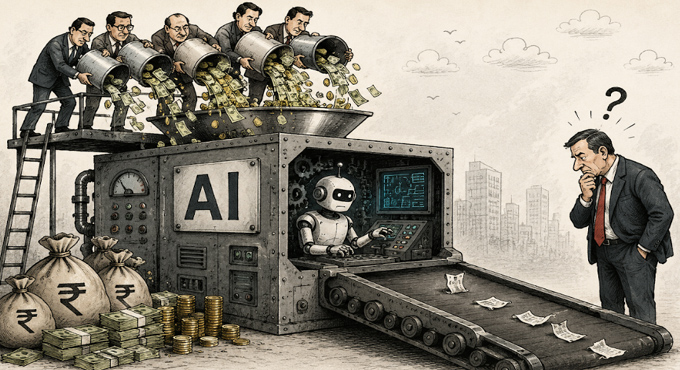
To keep up with the changing world, the management of a company decides to bring AI into the workplace. The company spends crores of rupees on it. Employees get AI tools, special software is bought, and training is provided. Soon, AI becomes the talk of the office. At first, it looks like the company is all set to make huge profits.
But ask the boss one simple question: “Sir, you spent so much money on AI. How much profit did the company actually get from it?” The answer may not be that easy.
This is now a question troubling companies around the world. Earlier, the question was, “Are we using AI or not?” Today, the bigger question is, “Are we getting enough results from the money we are spending on AI? Is it actually increasing our returns?”
When AI first entered companies, things were different. Companies encouraged employees to use AI as much as possible. They even started tracking who was using AI more and who was spending more tokens. In some places, using more AI almost became a sign of being a better employee. This trend even got a funny name — “tokenmaxxing.”
But now companies are taking a step back and asking a basic question: “Okay, our employees are using AI all day. But what has the company actually gained from it?”
And this is where things get interesting. Suppose an employee uses AI and finishes his work two hours earlier than before. Sounds great, right? But what is he doing with those extra two hours? Did he do another useful task for the company? Did he come up with a new idea? Did he solve a customer problem? Or did he spend that time shopping online? Maybe he was simply chatting with colleagues and killing time.
At that point, you can almost imagine someone asking AI itself: “Hey AI, what exactly are you useful for?”
So, in many cases, AI has saved the employee’s time, but that does not automatically mean the company has gained anything. That is why companies are slowly moving away from simply counting how many hours employees use AI or how many tokens they spend. The real question is now: “What has AI actually improved?”
Suppose a task used to take eight hours. With AI, it now takes only four hours. That sounds like a big improvement. But if the employee uses the remaining four hours to complete another important task, that is where the real value of AI appears. Earlier, a customer response may have taken three days. Now it may take just one day. Training a new employee may have taken a month. Now it may take only two weeks. These are the kinds of changes that create real value for a company.
But there is another important question: Is working faster enough? Imagine an AI tool producing 100 reports a day. Earlier, employees could produce only 20. Wow! Productivity has gone up five times. But what if half of those 100 reports contain mistakes? Then what is the use?
This is one of the biggest lessons companies are learning about AI. Speed alone is not enough. Quality matters too. Producing bad work quickly is not necessarily better than producing good work a little more slowly.
There is another thing companies need to remember. AI investment does not always produce profits immediately. Employees need time to learn the technology. They need to get used to new ways of working. Old processes may have to change. Sometimes, when one department starts working faster because of AI, another department suddenly gets more work and becomes a bottleneck.
So, in the beginning, a company’s performance may actually go down before it starts improving. This is known as the “J-curve” effect.
Now comes another obvious question: If AI saves employees’ time, why not reduce the number of employees and save more money?
The answer is: sometimes yes, but not always. If AI reduces an employee’s workload from eight hours to four, removing that employee is not the only option. The company can use those extra four hours differently. The employee can work on a new product, find new customers, solve more customer problems, or develop skills in areas where AI cannot easily replace human judgement.
There is another useful way for companies to calculate the value of AI. They can ask: “If we did not have AI, how many new employees would we need over the next two years?”
For example, suppose a company would normally need 500 additional employees to handle its growing workload. If AI allows it to manage the same workload with only 200 additional employees, the company has already gained significant financial value from AI.
But calculating how much extra revenue came directly from AI is much harder. Suppose a product suddenly starts selling very well. Was it because of AI? Or because of better marketing? A lower price? Less competition? A new market? It is difficult to give all the credit to AI.
That is why companies need to know what their performance was before AI and what changed after AI. Only then can they get a clearer picture of the real impact.
There is one more major uncertainty. Nobody knows exactly where AI is going. A tool that looks powerful today may become outdated tomorrow. A task that requires a human today may be completely automated tomorrow. At the same time, new kinds of jobs and skills that AI cannot handle may also emerge.
So companies cannot look only at one question: “How much money did AI save us?” They also need to ask: “Are our employees learning to use AI properly? Are we building skills in areas where AI cannot replace humans? Are we preparing the company for the next wave of AI?”
In the end, the idea is quite simple. Just saying “We are using AI” does not mean a company is successful. Giving every employee an AI tool does not automatically create value either. After spending crores of rupees on AI, the real question is: “Is the company getting enough value back from that investment?”
And that is the question companies will increasingly have to answer. Not “How much are our employees using AI?” but “For every rupee we spend on AI, how much value are we getting back?”
That is the real calculation in the AI era.
—Surya Prakash Josyula
Related News

Meta Smart Glasses Put Cinemas on Piracy and Privacy Alert

India Made Generics Its Strength. Why Is That Now Becoming a Problem?

Don’t Make This Mistake When Buying a Swimsuit for Your Child.. They May Be Hard to See in Water!

Who Is Shaking Colgate’s Mighty Empire?

Buying Property From an NRI? October 1 Brings a Key Tax Rule Change