

India Made Generics Its Strength. Why Is That Now Becoming a Problem?
- Published By: Tech Team
- August 27, 2026 / 11:10 AM IST


Imagine you go to a medical shop and ask for a new medicine. You find the same medicine being sold by three different companies. As a customer, you may be happy. You may think, “More competition means lower prices.”
But the company that originally developed the medicine may not feel the same way.
It may think: “We spent years and huge amounts of money developing this medicine. If other companies quickly bring the same medicine to the market as generics, what is left for us?”
This is now becoming a major concern in India’s pharmaceutical industry.
And this is not just a fight between pharma companies. It could also affect the price of the medicines you buy in the future.
Where did this issue begin?
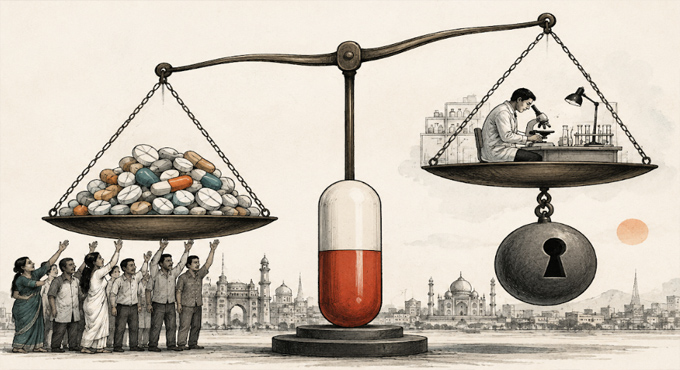
India became one of the world’s biggest manufacturers of generic medicines partly because of its drug policies.
When a company developed a new medicine, other companies could make and sell the same drug at a lower price after the patent expired. This increased competition, brought down prices and made medicines more affordable for millions of patients.
So, generic medicines are not really a problem for India’s pharma industry. They are one of its biggest strengths.
But now, the same system is creating a new challenge.
Developing a new medicine is not simply about making the drug. Companies have to prove that the medicine is safe, effective and does not have unacceptable side effects. This requires years of clinical trials and huge amounts of money.
And here comes the important point.
India provides patent protection for medicines. But there is no separate protection for the clinical data submitted by a company to get regulatory approval for its new medicine.
Because of this, other companies may be able to use that existing data as a reference when seeking approval for their own versions of the medicine.
Is the motivation to innovate dying?
Think about it.
One company spends years researching a new medicine and invests a huge amount of money. Another company may not have to spend nearly as much on the same research. If it can use the available information and carry out smaller studies to enter the market, will the first company still be willing to invest heavily in developing new medicines?
This is the fear among companies developing innovative drugs.
The recent semaglutide story has added more fuel to this debate. Once the patent period ended, nearly 50 brands were ready to enter the market.
From a patient’s point of view, that sounds good. More companies mean more competition. More competition can mean lower prices.
But from the point of view of the company that developed the original medicine, the situation is very different.
There is another interesting twist here.
For years, Indian pharma companies built their global business by making generic medicines. But now some of these same Indian companies are trying to develop new and innovative medicines themselves.
So, a company that was once mainly a generic drug maker can become an innovator. And once it becomes an innovator, the same rules that once helped it can start looking like a problem.
Mumbai-based Entod Pharmaceuticals is one example. The company says it developed the world’s first medicine for myopia. But its CEO Nikkhil K. Masurkar said that because the drug did not receive special clinical data protection, another large Indian pharma company entered the market within a few months after getting approval.
So, what is the solution?
This is why organisations representing research-based pharmaceutical companies are now asking India to introduce regulatory data protection.
In simple terms, this would mean that when a company spends years developing a new medicine and submits clinical data for regulatory approval, other companies would not be allowed to use that data for their own approvals for a certain period.
Different industry groups are asking for 6 to 12 years of protection.
But there is another side to this story.
If clinical data gets protection for many years, generic companies may have to wait longer before entering the market. Less competition could mean that some medicines remain expensive for longer.
That is why Dr Reddy’s Laboratories chairman Satish Reddy has also warned that India should not weaken its powerful generic medicine industry in the name of introducing new data-protection rules.
So, the real question is not whether India should have generic medicines or new medicines.
Patients need affordable medicines. Generic companies need competition. And companies developing new medicines need enough protection to justify the huge investment in research.
Balancing all three will be the real challenge for India’s pharma industry.
Because the future question is simple:
How do you keep medicines affordable today while making sure companies still have enough reason to develop the medicines of tomorrow?
—Surya Prakash Josyula
Related News

Meta Smart Glasses Put Cinemas on Piracy and Privacy Alert

Don’t Make This Mistake When Buying a Swimsuit for Your Child.. They May Be Hard to See in Water!
Who Is Shaking Colgate’s Mighty Empire?
Companies Spent Crores on AI.. But Did They Really Gain Anything?

Buying Property From an NRI? October 1 Brings a Key Tax Rule Change