

The AI Phantom Ballot: How Fake Virtual Influencers Are Rigging Elections
- Published By: Tech Team
- August 28, 2026 / 05:15 PM IST


—Surya Prakash Josyula
The strategy meeting late that night looked like any other political gathering, but the decision made behind closed doors was set to rewrite the future of national politics.
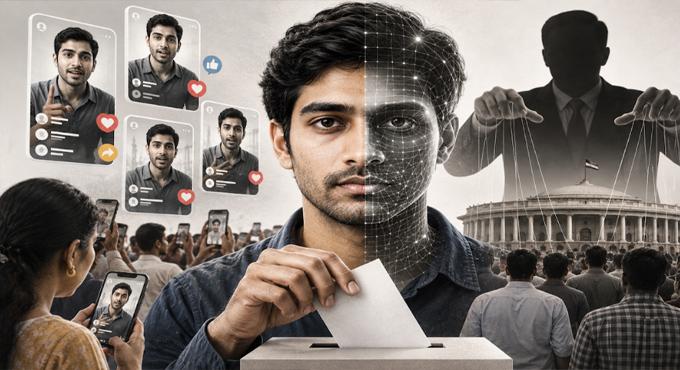
Fast forward a few months, and election campaigns are running at full throttle. Open any smartphone, and feeds are flooded with speeches, promises, and political crossfire. Yet, amid the noise, one particular commentator stands out. He addresses the audience with raw urgency: “Does anyone actually care about your struggles?” He takes direct aim at the government, voicing everyday hardships with genuine-sounding anger, pain, and authenticity.
His videos rack up thousands of likes and hundreds of comments. “He speaks our language,” “It’s time for real change,” and “He’s telling the truth” flood the comment section. Day after day, he returns with sharp insights on unemployment, inflation, and upcoming polls. Over time, viewers develop a deep sense of connection, convinced that “this guy is one of us.”
Then comes the plot twist.
He does not exist.
He has no home, no past, no family, and was never born. He is an entirely synthetic creation engineered by artificial intelligence.
While this sounds like the premise of a sci-fi thriller, it is fast becoming the reality of modern elections worldwide. Brazil’s upcoming presidential race is turning into a prime testing ground for this new political weapon. Political operatives are deploying AI-generated virtual personalities—complete with tailored faces, voices, and behavioral traits—to serve as mainstream social media influencers.
Unlike deepfakes, which manipulate the face or voice of a real person, this technology operates on a completely different level. Creators are building entirely fictional entities from scratch. These avatars have names, distinct appearances, unique viewpoints, active social media accounts, and hundreds of thousands of followers. Rather than tarnishing a real person, creators are building artificial figures designed to look and feel like trusted, relatable influencers.
These synthetic personas do not need to trick viewers into believing they are flesh-and-blood humans. By simply echoing voters’ frustrations and validating their existing biases, they effortlessly win public affection. They start out as social media personalities, transition into trusted confidants, and ultimately end up shaping voting decisions. Given Brazil’s heavy reliance on digital platforms and influencer culture, it has become a natural breeding ground for these algorithmic campaigns.
The Operational Advantage of Synthetic Leaders
Traditional politicians face strict physical limitations, struggling to make it to more than a couple of rallies a day. An AI influencer, however, never tires, takes no breaks, and demands no salary. It can scale infinitely, appearing across hundreds of accounts simultaneously. It can tailor its messaging on the fly—discussing job creation with young professionals, inflation with homemakers, and stoking anti-establishment anger in other demographics. A single AI system can deploy countless faces, thousands of messages, and sway millions of voters at once.
Regulating this phenomenon remains a massive hurdle. Tracing the masterminds, funders, and creators behind these digital avatars is exceptionally difficult for modern legal frameworks, which were built strictly for human politicians and registered political parties. Voters are left facing a troubling dilemma: are they listening to a genuine political representative, or a corporate-backed script driven by lines of code? On election day, the ballot box remains human, but the months of psychological priming, fear-mongering, and targeted persuasion leading up to it may well be orchestrated entirely by artificial intelligence.
Ultimately, future political battles will no longer be fought solely at physical campaign rallies or at the ballot box. They will be decided right on phone screens. The real challenge is no longer identifying who appears on the display, but unmasking the hidden operators pulling the strings.
Related News

Instagram After Midnight? Why Meta Is Changing the Rules for Teens

Why Higher Education is Leading to Lower Employment: The Brutal Numbers Behind India’s Degree Paradox

‘Toxic’ Review Row: Producers Send Legal Notices to YouTubers

Meta Smart Glasses Put Cinemas on Piracy and Privacy Alert

India Made Generics Its Strength. Why Is That Now Becoming a Problem?