

Instagram After Midnight? Why Meta Is Changing the Rules for Teens
- Published By: Tech Team
- August 28, 2026 / 07:00 PM IST


— Surya Prakash Josyula
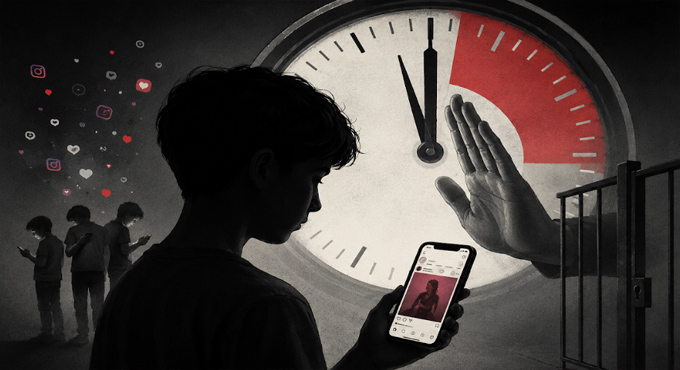
It is midnight. A teenager is supposed to be asleep, but instead opens Instagram. He watches one video, and another one immediately appears. Then comes a notification. He checks it and starts watching again.
He tells himself, “Just one more video and I’ll sleep.” But another hour passes. School starts in the morning, his eyes are already tired, but he still cannot take them off the screen. Now, that situation could be about to change.
Instagram After Midnight? Here’s What Is Changing
Under a new agreement reached by Meta in the US, teenagers under 18 will get a default “Night Mode” on Instagram and Facebook. Between midnight and 6am, notifications will be blocked, making it much harder for young users to keep using the platforms through the night. Parents or guardians will have the ability to change the restriction.
But is this only happening in the US? Could similar rules come to India as well? And why has Meta suddenly agreed to such strict restrictions? Why this concern about children now?
That is where the real story begins.
It Started With a Court Case
In 2023, 29 US states filed a case against Meta. They alleged that platforms such as Facebook and Instagram were designed in ways that attracted children and teenagers and encouraged them to spend more time on the platforms. The states also accused Meta of violating federal and state child privacy laws.
One of their key arguments was that Meta knew that very young children were using its platforms, but did not do enough to keep them away.
This was not just a case based on accusations from outside the company. Millions of internal Meta documents became part of the case, including research, employee emails and internal chats. And that is where the story took a more serious turn.
Did Meta Know What Was Happening?
Think about the teenager who is still glued to Instagram at midnight. The technology needed to stop that behaviour was already available at Meta.
The company could turn off notifications at night, put time limits on accounts and warn users when they had been using the platform for too long. So the obvious question is: if Meta already had these tools, why did it take so long to make them default rules?
That is exactly the question now being raised in the US courts, and it has put Meta under serious pressure.
As the case examined the impact of Facebook and Instagram on children’s minds and health, 48 US states came together in the legal action. Meta eventually agreed to pay $18 billion, or around ₹1.72 lakh crore, as part of the settlement. The amount will be paid in instalments over the next 10 years.
But the money is only one part of the story.
The bigger issue is what Meta has now agreed to change.
What Will Change for Teenagers?
Under the settlement, Meta will have to make major changes to the way teenagers use its platforms.
There will be a default daily limit of two hours across Instagram and Facebook. At night, notifications will be blocked between midnight and 6am. During school hours, notifications will also be muted.
If a teenager continuously uses social media for 15 minutes, a warning will appear. Further notifications will come when total usage reaches 60 and 90 minutes. Users will also be given the option to choose a feed that is not driven by an algorithm, while autoplay for videos can be turned off.
On paper, these look like simple safety features. But that raises another uncomfortable question.
Did Meta Have These Features All Along?
Why did the company need a court case to introduce these changes? Was it really impossible to think of them years earlier?
This is where one of the most important revelations in the case came out.
George Volichenko, a former Meta researcher, told the court that his team had worked on a feature called “Quiet Mode” to reduce teenagers’ use of the platforms at night.
The feature could mute notifications during the night. More importantly, his team already knew that teenagers were much more likely to use it if it was turned on by default.
But according to Volichenko, his team did not have enough freedom to widely implement the feature.
That makes the issue much bigger than a simple technology problem.
Why Would Meta Not Turn It On?
The answer goes back to the basic business model of social media.
The longer children and teenagers stay on Instagram and keep watching Reels, the more content they consume. More content means more opportunities for advertisements. And more advertisements mean more money for the company.
So there is an obvious conflict. If a teenager puts the phone away after two hours, that may be better for the child. But it also means less time on the platform.
This is where the controversy around Meta becomes much bigger. The question is not whether the company knows how to make its platforms safer. The question is whether making them safer could also reduce the amount of time users spend on them.
The “Quiet Mode” Controversy
The court also heard claims about why “Quiet Mode” was not made widely available.
Volichenko said that his manager had told him not to worry too much about low adoption numbers because the team partly existed to protect the company against upcoming lawsuits.
If that account is correct, the issue becomes even more uncomfortable: were safety features being treated not just as tools to protect children, but also as a legal shield for the company?
Meta, however, has denied wrongdoing and did not admit liability as part of the settlement.
Still, the court case has clearly forced the company to make changes that could significantly alter how teenagers use Instagram and Facebook.
So, Will Instagram Shut Down at Midnight in India?
Not under this settlement.
The agreement is between Meta and US states and applies to teenagers in the US. So it would be wrong to assume that Instagram will now shut down worldwide at midnight.
There is currently no such rule for India under this agreement.
But the question is still worth asking because if similar legal action or regulation comes to India, similar restrictions could potentially become an issue here as well.
Instagram Alone Cannot Solve the Problem
There is another catch.
Even if Instagram limits teenagers to two hours, what happens next? A teenager can simply move to TikTok or YouTube.
That is why restrictions on just one platform may not be enough. For a real change, similar rules would have to apply across social media platforms.
The US authorities are already looking at the Meta settlement as a possible blueprint for the wider industry, while other major platforms such as TikTok, YouTube and Snap are also being pushed towards stronger restrictions for younger users.
The Bigger Question Behind the $18 Billion
For years, the competition in social media was simple: who can attract more users and keep them on the platform for longer?
Now, that competition could be changing.
The new question may be: who can run a successful social media platform while also keeping children safe?
That is the real significance of Meta’s $18 billion settlement.
The company is not just paying a huge amount of money. It is being forced to put limits on the very thing that makes social media valuable—people’s time and attention.
For years, the business was built around keeping users connected for as long as possible. Now, companies may increasingly have to answer another question: how much of a child’s time should they be allowed to take?
And that could be the biggest change to come out of this entire battle.
Related News

Why Higher Education is Leading to Lower Employment: The Brutal Numbers Behind India’s Degree Paradox
The AI Phantom Ballot: How Fake Virtual Influencers Are Rigging Elections
‘Toxic’ Review Row: Producers Send Legal Notices to YouTubers

Meta Smart Glasses Put Cinemas on Piracy and Privacy Alert
India Made Generics Its Strength. Why Is That Now Becoming a Problem?