

Space War: The Mega Battle for Internet in the Skies! Who Will Win?
- Published By: Tech Team
- July 9, 2026 / 06:40 AM IST


— Surya Prakash Josyula
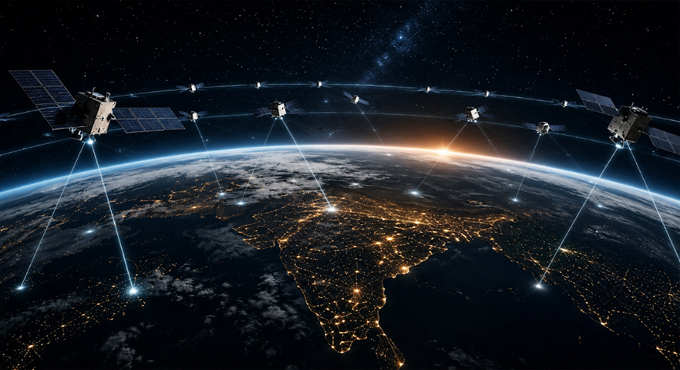
Tonight, while you are fast asleep, hundreds of satellites are racing across the sky right above your home at incredible speeds. One of these satellites could soon become a vital part of the network providing uninterrupted internet to your mobile phone, another might be delivering crucial connectivity to a massive cargo ship sailing in the middle of the ocean, and yet another could be linking a remote village hidden deep in the hills—currently struggling without a single bar of signal—to the rest of the civilization.
Without our knowledge, thousands of these silent digital conversations are happening in the skies at every given moment.
If you look up at the night sky right now, it is no longer just filled with stars. A quiet, invisible war for the future of the global internet empire is unfolding right there above us.
There is no sound, and there are no explosions, but whoever wins this high-stakes battle will likely hold the power to dictate and influence tomorrow’s global digital connectivity. This is not a scene from a Hollywood science-fiction film; it is a new digital reality shaping up right before our eyes.
In the previous century, nations fought bitterly over oil reserves, which was followed by a global race to control semiconductors. Today, the world’s biggest technology titans have set their eyes on an even more valuable resource: the foundational internet infrastructure capable of connecting anyone, anywhere, at any time.
This ambition has sparked a massive corporate race in space, with Elon Musk’s Starlink on one side and Jeff Bezos’ Amazon Project Kuiper on the other, leaving the very future of global internet hanging in the balance between them.
The event that took place last night was far more than just a routine rocket launch. An Atlas V rocket belonging to the United Launch Alliance (ULA) successfully roared into the skies from the Cape Canaveral Space Force Station in the United States, carrying another batch of 29 LEO (Low Earth Orbit) satellites for Amazon.
This latest mission has successfully pushed the total number of Amazon satellites currently in orbit past the 390 mark. According to Amazon officials, the company now possesses the minimum satellite constellation required to roll out its initial satellite broadband services later this year, marking a massive milestone in Amazon’s long-term cosmic journey.
This naturally brings up a question that puzzles most people: why do we even need 390 satellites when just a few should theoretically do the trick? The traditional communication satellites we rely on for our home TV dishes are placed in a geostationary orbit, sitting steadily at a massive altitude of nearly 36,000 kilometers above the Earth.
However, modern services like Starlink and Project Kuiper choose to position their constellations much closer to home in the Low Earth Orbit (LEO). By drastically shortening the distance data needs to travel, this setup significantly cuts down internet delay, known as latency.
The catch, however, is that these LEO satellites travel at a terrifying speed of thousands of kilometers per hour to stay in orbit. Because a single satellite will cross your region and vanish over the horizon in just a matter of minutes, another satellite must instantly move into position and seamlessly pick up the signal to ensure your connection never drops.
To make this work flawlessly on a global scale, tech companies have to weave a massive digital blanket in space using thousands of interconnected satellites instead of just a handful.
The reason behind Amazon’s aggressive hurry to enter this market is quite simple—their primary competitor is already miles ahead in the race. Elon Musk’s Starlink is already fully operational in several countries, boasting a massive fleet of over 6,000 satellites in orbit. In the business world, the ‘first-mover advantage’ is incredibly powerful, as it allows a company to capture early customers, lock in key partnerships, and gain invaluable operational experience.
This is exactly why Amazon is speeding up the expansion of Project Kuiper; it is not just about launching another internet service provider, but a calculated, multi-billion-dollar strategy to capture a dominant share in one of the world’s largest digital markets.
The real story hidden behind this space race extends far beyond our daily mobile data usage or streaming habits. The global infrastructure of tomorrow—ranging from autonomous driverless cars and global maritime shipping to commercial aviation, emergency communication during natural disasters, defense systems, and remote healthcare services in isolated regions—is going to heavily rely on this ultra-reliable, space-based connectivity.
This explains why governments, global tech giants, and heavy investors around the world are treating this sector as a highly critical, strategic asset.
Looking at a country like India, there are still vast, challenging terrains such as remote mountain ranges, deep forest settlements, isolated islands, and fishermen venturing out into the deep seas where traditional mobile towers and fiber cables simply cannot reach. For these underserved populations, satellite internet could emerge as a genuine, life-changing blessing in the coming years.
At the same time, it is unrealistic to assume that space internet will completely wipe out or replace the cellular towers in our towns and cities anytime soon. Industry experts predict that the future will instead belong to a hybrid model where ground-based mobile networks, fiber-optic cables, and satellite networks work hand in hand to keep the world connected.
To a casual observer, this entire saga might look like a personal ego war between two billionaires, Elon Musk and Jeff Bezos. However, a deeper analysis reveals that the core conflict revolves around a much bigger question: Who is going to control the foundational digital infrastructure of the modern world?
Today the battleground is satellites, tomorrow it will be the data they collect, and the day after it will be Artificial Intelligence—all of which are merely interconnected links in the very same digital chain.
When you look up at the sky again tonight, you might only see a scattering of quiet stars, but moving invisibly among them are hundreds of operational satellites actively building a brand-new world. Centuries ago, it was oceanic trade routes that connected global civilizations, which were later replaced by the expansion of railways, and eventually by thousands of miles of fiber-optic cables buried under the ground and seas.
Today, that monumental responsibility of keeping the world together is slowly shifting into deep space. In the past, those who controlled the oil reserves dictated the global economy, but tomorrow, those who command the strongest satellite networks in the sky will hold the power to shape our digital future. This silent war in space has already intensified, leaving us with one ultimate question: Which network will tomorrow’s world choose to depend on?