
Have You Ever Experienced Something Strange Like Jamais Vu?
- Published By: Tech Team
- August 8, 2026 / 04:30 PM IST


—Surya Prakash Josyula
One night, you come home and open the door. It is the same house, with the same walls and the same sofa. Your keys are on the table, just where you left them. Everything around you is familiar.
Then you see a woman standing in the hall. She looks at you and smiles. “Did you come home?” You know that voice. But suddenly, you cannot remember who she is.
You keep looking at her. She walks towards you and asks, “What happened?” You cannot answer. You don’t know why, but a small fear starts growing inside you. Why is this woman in my house?
She reaches out to hold your hand, but you suddenly pull your hand away. There is confusion on her face and fear in your heart. Then your eyes fall on a photograph hanging on the wall.
You see yourself. You see her. You see your child. As you look at the photograph, something suddenly clicks in your mind. “Oh… she is my wife.”
Her name comes back. The years you have spent together come back. The house starts feeling like your home again. Everything becomes normal.
But what exactly happened during those few seconds?
You did not forget her. Her name was not erased from your memory. You had not forgotten that she was your wife. Then why did someone you know so well suddenly feel like a stranger?
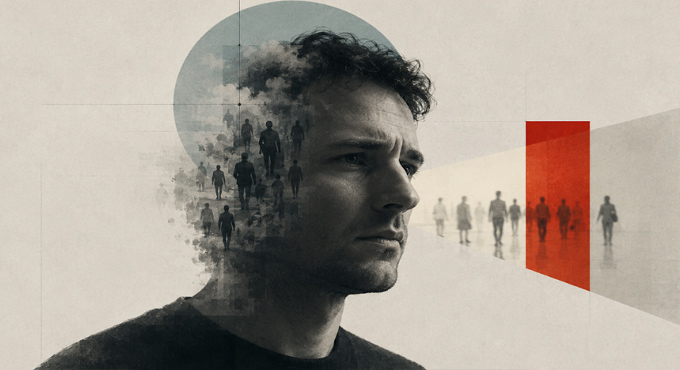
There is a name for this strange experience: Jamais Vu. In French, it means “never seen.”
You may already know about Déjà Vu. In Déjà Vu, something happening for the first time feels as if it has happened before. Jamais Vu is almost the opposite. Something you have seen many times suddenly feels as if you are seeing it for the first time.
So why does this happen?
Normally, our brain does not work this way. Imagine if your brain had to treat everything you see as if you were seeing it for the first time. Life would become exhausting and confusing.
So the brain does something very clever. It remembers things it has seen before and connects their appearance with past experiences and meaning. From all of that, it creates a simple feeling: “I know this.”
When you see your home every day, your brain does not need to study it again. It does not have to think about the walls, doors and windows. It quickly tells you, “This is my home.”
The same thing happens when you see your wife. Your brain does not examine every part of her face as if you are seeing her for the first time. It simply recognizes her: “I know this person.”
The same process works with your car, your regular road, your office, your name and countless other things around you. We are not seeing the world as if everything is new every day. Our brain uses the past to make the present feel familiar.
Most of the time, we never notice that this process is happening. But what if that process briefly stops working properly?
Then something strange can happen.
Something familiar can suddenly feel unfamiliar.
That is the strange part of Jamais Vu. And it is not limited to people. A road you travel every day may suddenly look unfamiliar. A word you have read hundreds of times may start looking like a meaningless collection of letters. Even your own name can suddenly look strange.
You could think of it a little like an “overload” in the brain.
Neuropsychologists including Akira O’Connor and Chris Moulin have studied this strange experience. Their experiment was surprisingly simple. They asked students to write the same familiar word again and again and told them to stop whenever the word started to feel strange.
Around 70 percent of the participants actually stopped. For many of them, this happened after about a minute, or roughly 33 repetitions.
There is an even simpler experiment you can try yourself. Take a piece of paper and write your name. Write it again, and again. Keep going 20 or 30 times.
After a while, look at the word. You may suddenly think, “Is this really my name?”
The spelling has not changed. The word has not changed. But for a moment, its meaning and familiarity may feel strangely distant. Researchers have tested this effect in controlled experiments.
Does Jamais Vu have any benefits or dangers?
In most ordinary cases, there is no major benefit or harm. It is usually a brief and temporary experience that passes on its own.
However, if these experiences happen very often, last for a long time, or appear together with other neurological symptoms, they should not simply be dismissed as ordinary Jamais Vu.
Finally…
Our brain does more than simply show us the world. It recognizes the world first. It gives familiar things a sense of familiarity and quietly tells us, “This is my home. This is my family. This is my name. This is something I know.”
But if that recognition briefly fails, the world around us can suddenly feel completely new.
Something we have seen hundreds of times can feel like something we are seeing for the first time.
That is the strange world of Jamais Vu.