
A Two-Minute Story… An $11 Billion Industry! The Magic Behind Micro Dramas
- Published By: Tech Team
- August 3, 2026 / 11:40 AM IST


— Surya Prakash Josyula
“I’ll watch just one episode.”
A young woman picked up her phone and tapped the play button. Two minutes later, the episode ended with a shocking question: Did the hero really die? A single button appeared on the screen—Next Episode. She clicked it. Another two minutes, another twist, another cliffhanger. Before she realized it, nearly ninety minutes had passed.
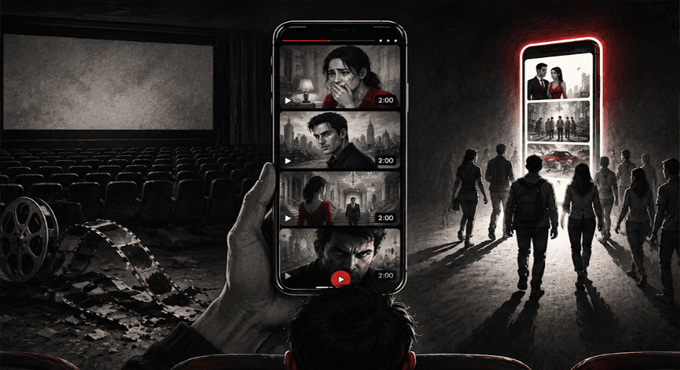
This isn’t just one person’s story. Millions of people around the world are consuming entertainment in exactly the same way. There was a time when audiences waited for Friday movie releases and spent hours inside theaters. Today, many of them are glued to their phones, waiting for the next two-minute twist.
This isn’t a Reel. It isn’t a television serial. It isn’t even a web series. It is called a micro drama, a format that was dismissed as cheap entertainment in China just a few years ago. Today, it has become an $11 billion industry, with analysts predicting it could grow to $26 billion by 2030. Even more surprising is the fact that Hollywood, which once ignored the format, is now embracing it.
But this story isn’t really about China or money. It’s about us. It’s about how the way we consume stories has quietly changed.
Our Lives Changed… So Storytelling Changed Too
Watching a movie was once an event. People planned their evenings, bought popcorn, and dedicated two or three uninterrupted hours to a film. That lifestyle is slowly disappearing. Today, entertainment happens in small moments—while waiting for a bus, during a tea break at work, before going to bed, or even while waiting for an elevator.
Our free time is no longer available in long blocks. It comes in short bursts, and content creators have adapted to that reality. Micro dramas are designed specifically for these tiny pockets of time, delivering complete stories in bite-sized episodes.
What Exactly Is a Micro Drama?
Many people assume micro dramas are simply another version of Reels, but they are fundamentally different. A Reel is an individual short video that you watch and immediately move past. A micro drama, on the other hand, is a complete story divided into dozens of episodes. Each episode lasts only two or three minutes, but a single series can have fifty, sixty, or even one hundred episodes.
That is why watching a micro drama feels completely different. Instead of consuming random videos, viewers become emotionally invested in a single story. A simple way to understand it is this: a Reel is like a snack, while a micro drama is a full meal served in very small portions.
Why Are Micro Dramas So Addictive?
The biggest difference between Reels and micro dramas is their purpose. Reels compete for attention. Micro dramas compete for time. A Reel simply wants you to watch one video. A micro drama wants you to stay until the entire story is over.
The storytelling is carefully designed around cliffhangers. Every episode ends with a mystery, a betrayal, a shocking revelation, or an emotional twist. Just when viewers think they have found an answer, the story introduces another question. That constant cycle keeps audiences clicking on the next episode.
This is not just clever writing. It is psychology. The human brain naturally wants to complete unfinished stories, which is why cliffhangers have always been effective in books, television, and cinema. Micro dramas simply compress that experience into two-minute episodes, giving viewers a sense of reward every few minutes.
How China Turned a Small Experiment into a Global Business
Micro dramas first emerged in China around 2018. Initially, many people dismissed them as low-quality soap operas with exaggerated plots. However, audiences quickly embraced the format because it perfectly matched the growing habit of consuming entertainment on smartphones.
Once the Chinese market became saturated, major companies expanded aggressively into the United States, India, Latin America, and Southeast Asia. Today, hundreds of dedicated micro drama apps compete for viewers across the world, turning what once seemed like a niche experiment into one of the fastest-growing entertainment businesses.
Why Is Hollywood Paying Attention Now?
Hollywood has seen this story before. When TikTok became popular, many traditional media companies underestimated short-form video. Within a few years, nearly every major platform had launched its own version.
The same pattern is now unfolding with micro dramas. Large studios and streaming services have realized that audiences are changing. People have less uninterrupted time, shorter attention spans, and increasingly prefer entertainment designed for mobile screens. Ignoring that shift is no longer an option.
AI Is Accelerating the Revolution
Artificial Intelligence is making the business even more attractive. Production costs are falling rapidly as companies use AI for script development, dubbing, editing, and visual production. Some studios are already experimenting with fully AI-generated micro dramas, reducing both production time and expenses.
While this creates exciting opportunities for producers, it also raises concerns about the future of writers, actors, and technicians as automation becomes a larger part of the creative process.
Can Micro Dramas Succeed in India?
The answer is likely yes. Indian audiences are already deeply familiar with two habits that perfectly support this format. They spend hours watching short-form videos on social media, and they have followed television serials for decades.
Micro dramas combine these two habits into one experience. That makes India one of the most promising markets for this format.
However, there is one important difference. Chinese audiences are more willing to pay for individual episodes, while Indian viewers generally prefer free content supported by advertising. That means the business model in India may look very different from China’s.
A New Opportunity for Tollywood
For emerging filmmakers, creating a full-length feature film requires significant investment and carries considerable risk. Producing a high-quality micro drama series is far more achievable and could open new opportunities for writers, directors, actors, and producers.
Just as YouTube created an entirely new generation of content creators, micro dramas could become the next platform where fresh storytelling talent is discovered.
Will Micro Dramas Replace Movies?
Probably not.
History shows that every new entertainment format creates its own audience rather than eliminating existing ones. Television did not kill cinema. OTT platforms did not destroy theaters. Micro dramas are unlikely to replace movies either.
What they will compete for is something even more valuable—our spare moments throughout the day.
The Final Thought
Stories have always followed audiences wherever they go. They moved from theaters into living rooms through television, then into smartphones through streaming platforms. Now they are shrinking into two-minute episodes designed for the way we live today.
In the future, success may not belong to the biggest studio or the biggest movie star. It may belong to whoever can capture the audience’s next two minutes.