

“Emergency” as a Syllabus in Textbooks…
- Published By: techteam
- June 25, 2026 / 03:40 PM IST


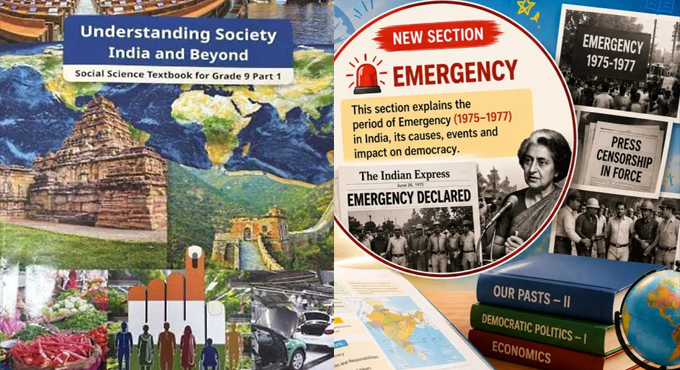
NCERT has taken a key decision. It has decided to include the conditions of the 1975 Emergency imposed in the country as a lesson in the 9th-grade Social Science textbooks. Terming it as “one of the major challenges” due to the suspension of several fundamental rights, this topic has been incorporated into the Class 9 textbook. This reference appears in the newly designed Social Science textbook titled ‘Understanding Society: India and Beyond’.
The Emergency has been included in a chapter that examines the strengths and challenges of Indian democracy. This addition stands as a significant inclusion to the school curriculum, especially coming at a time when the country recently observed the 50th anniversary of the 1975 Emergency declaration.
The Challenges of Democracy
The textbook describes the National Emergency imposed between 1975 and 1977 as one of the greatest challenges faced by Indian democracy.
“In the early 1970s, public discontent against the government led by Indira Gandhi grew. Widespread protests erupted across the country due to rising unemployment, inflation, and allegations of corruption. Consequently, in June 1975, the government imposed a National Emergency on the pretext of internal disturbances,” the textbook states.
The Role of Jayaprakash Narayan
The lesson specifically highlights the role of socialist leader ‘Lok Nayak’ Jayaprakash Narayan, who mobilized the public to restore democracy during this difficult period. It explains how he organized students and citizens in the states of Bihar and Gujarat. The book also notes that lifting the Emergency in 1977, holding elections, and the subsequent defeat of the then-ruling party proved the power of the people and the strength of Indian democracy.
Other Modern Challenges
Along with the Emergency, the chapter also includes several other factors that pose a threat to democracy in today’s society. It attempts to explain issues such as:
Fake news and misinformation
Violation of government regulations
Destruction of public property
Poverty and regionalism
Social discrimination and gender inequality”Emergency” as a Syllabus in Textbooks…
NCERT has taken a key decision. It has decided to include the conditions of the 1975 Emergency imposed in the country as a lesson in the 9th-grade Social Science textbooks. Terming it as “one of the major challenges” due to the suspension of several fundamental rights, this topic has been incorporated into the Class 9 textbook. This reference appears in the newly designed Social Science textbook titled ‘Understanding Society: India and Beyond’.
The Emergency has been included in a chapter that examines the strengths and challenges of Indian democracy. This addition stands as a significant inclusion to the school curriculum, especially coming at a time when the country recently observed the 50th anniversary of the 1975 Emergency declaration.
The Challenges of Democracy
The textbook describes the National Emergency imposed between 1975 and 1977 as one of the greatest challenges faced by Indian democracy.
“In the early 1970s, public discontent against the government led by Indira Gandhi grew. Widespread protests erupted across the country due to rising unemployment, inflation, and allegations of corruption. Consequently, in June 1975, the government imposed a National Emergency on the pretext of internal disturbances,” the textbook states.
The Role of Jayaprakash Narayan
The lesson specifically highlights the role of socialist leader ‘Lok Nayak’ Jayaprakash Narayan, who mobilized the public to restore democracy during this difficult period. It explains how he organized students and citizens in the states of Bihar and Gujarat. The book also notes that lifting the Emergency in 1977, holding elections, and the subsequent defeat of the then-ruling party proved the power of the people and the strength of Indian democracy.
Other Modern Challenges
Along with the Emergency, the chapter also includes several other factors that pose a threat to democracy in today’s society. It attempts to explain issues such as:
Fake news and misinformation
Violation of government regulations
Destruction of public property
Poverty and regionalism
Social discrimination and gender inequality
Related News

Before We Were Women, a Debut Novel by Dr. Sunita Reddy, Captures Hearts with a Powerful Story of Resilience and Sisterhood

Fire Accident in Lucknow Coaching Center.. 15 Dead
Securing the Sikh Vote, Attracting Hindu Voters: Congress’s New Game in Punjab

Central Government Bans 16 Medicine Combinations Immediately Over Safety Concerns

India Pivots to American LPG as Middle East Crisis Bleeds State Oil Companies