
The Domino Effect of History From a Wrong Turn to Deliberate Catastrophe
- Published By: shivaduvvuru
- June 2, 2026 / 12:50 PM IST


History books naturally gravitate toward the sweeping mechanics of global conflict: the shifting borders, the tactical maneuvers, and the industrial innovations that redefine warfare. Yet, when sifting through the vast photographic archives of World War I, the most striking images are not those of jagged trenches or titanic artillery pieces. Instead, they are the quiet, frozen moments featuring the human beings caught in the gears of global chaos.
Looking into the eyes of these individuals a century later offers an extraordinary gift. Stripped of the anonymity of uniforms, nationalities, and historical abstractions, their raw humanity laid bare provides an intimate window into a world torn apart. While front-line soldiers bore the physical brunt of the cataclysm, the Great War engulfed entire societies. From millions of refugees displaced by advancing armies to the volunteer ambulance drivers, nurses, logistical laborers, and cooks, ordinary people from every continent found themselves thrust into an unprecedented global maelstrom.
This collection offers a poignant glimpse into those lives capturing humanity at play, at rest, in agony, and at work during the war that changed everything.
Moments of Comradeship and Culture:
Despite the bleak backdrop of industrial warfare, cultural identities and rare moments of levity persisted across the various theaters of conflict.
Decorated Bravery: In the wake of the devastating Battle of the Somme, a relaxed group of French soldiers stands together. They wear distinctively crested French helmets and proudly display the Military Medal, established on March 25, 1916, for exceptional acts of bravery.
An Exotic Theater: Highlighting the global scale of the conflict, three unidentified New Zealand servicemen navigate the Egyptian desert on camels, with the timeless silhouettes of the Sphinx and the Pyramids rising in the background.
Spirited Defiance: Captured in a moment of pure exuberance, a large group of Highland infantrymen—likely South Africans wearing kilts and balmorals stamp their feet, pull humorous faces, and brandish everything from walking sticks to swords for the camera.
Cross-Cultural Intermission: Demonstrating the coalition nature of the Allied effort, a French officer shares a quiet afternoon tea with English military personnel.
The Shared Burden: Women and Labor on the Front Lines:
The Great War completely redefined the domestic and military roles of women, who stepped directly into dangerous forward areas to keep the war machine functioning.
The Hello Girls: In an advance sector just three kilometers from the active trenches in France, female telephone operators of the U.S. Signal Corps manage vital communications lines. Signaling the constant danger, helmets and gas masks hang ready over the backs of their chairs.
The Luxury of Angels: Demonstrating the upper-class origins of its early recruits, five members of the First Aid Nursing Yeomanry (FANY) pose in fur coats and army boots before their Red Cross ambulances. Established in 1907 as an auxiliary unit on horseback, these women operated as drivers, cooks, and nurses in highly perilous zones, eventually earning dozens of military decorations for bravery.
Behind-the-Scenes Construction: In France, female carpenters belonging to Queen Mary’s Army Auxiliary Corps (Q.M.A.A.C.) work diligently in a lumber yard constructing wooden military huts, clad in protective pinafores over their clothing.
A Forgotten Tragedy: Some 20,000 black South Africans served in the South African Native Labour Contingent (SANLC). Though restricted from direct combat, they suffered heavy casualties from aerial bombardments. Their greatest tragedy occurred on February 21, 1917, when the troopship SS Mendi sank in the English Channel, drowning 617 brave laborers.
The Harsh Realities of Captivity and Casualties:
The equalizer of the war was suffering, a truth shared intimately between opposing forces as the tides of battle ebbed and flowed.
Bonds of Survival: Transcending wartime hatred, German prisoners are documented assisting in bringing in wounded Australian soldiers from the battlefield.
The Grim Toll: In Thiepval, September 1916, the brutal finality of the conflict is laid bare, showing the bodies of fallen German soldiers strewn haphazardly across the muddy floor of a captured trench.
The Cost of Survival: The physical trauma of industrial weaponry is encapsulated in the image of a mutilated French soldier being meticulously fitted with a customized facial prosthetic at the American Red Cross studio of artist Anna Coleman Ladd.
The Final Stretch and Aftermath:
As the conflict wore on toward its eventual conclusion in November 1918, the exhaustion of a generation became impossible to mask.
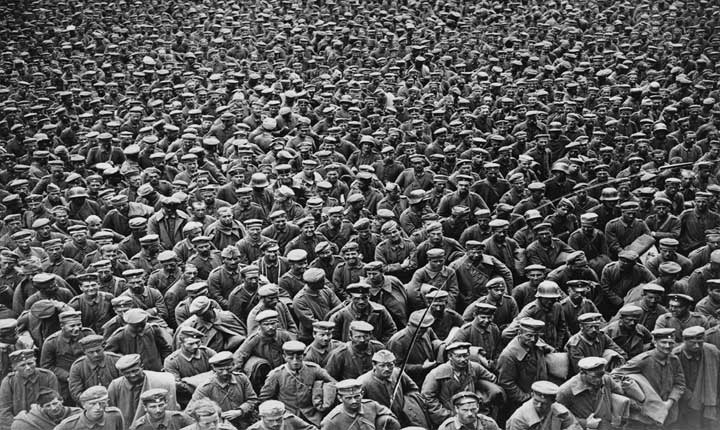
The Class of 1918: Mud-caked and wearing a makeshift hodgepodge of uniforms, three young German prisoners of war stare blankly at the camera, their heads wrapped in bloody bandages.
An Unsettling Foreshadowing: An undated photograph captures a young German Corporal named Adolf Hitler standing alongside his comrades in a military band called “Kapelle Krach,” recovering from an injury sustained on the Western Front.
The Dawn of Victory: In early 1919, members of the famous African-American 369th Infantry Regiment the celebrated “Harlem Hellfighters”arrive back in New York City, celebrated for their extraordinary courage under fire.
Ultimately, whether tracing the line through a fallen Russian soldier being buried in a makeshift grave by local civilians, or German machine-gunners lying dead beside their weapons just one week before the armistice, the lesson of these images is identical. These were not just statistics or dots on a map. They were a generation of ordinary people caught in an extraordinary firestorm, leaving behind a legacy carved in sacrifice and etched forever into their photographed faces.
sourse: The atlantic
Related News
GOPIO Presents Memorandum on Diaspora Issues and Suggestions to Minister Jaishankar

Top 6 Stays in Dubai for Your Next Workation
SriLankan Airlines Restores Complete Middle East Network With Kuwait Service Resumption

Two Years After Trump’s Inflation Spotlight, Rising Grocery Prices Loom as a Political Vulnerability for Republicans Ahead of Midterms

US Imposes Up to 100% Tariffs on Drones to Curb Chinese Dominance and Bolster Security