

500x Stronger Than Heroin: NCB Warns of Deadly Nitazenes and Surging Cartel Violence
- Published By: shivaduvvuru
- June 29, 2026 / 11:24 AM IST


Nitazenes: A global drug crisis driven by ultra-potent synthetic opioids, organized violence, and encrypted distribution.
A lethal shift toward synthetic chemicals and an explosion of organized cartel violence have combined to create an unpredictable global drug crisis. In its latest assessment, India’s Narcotics Control Bureau (NCB) warned that trafficking supply chains are outpacing law enforcement, propelled by ultra-potent synthetic compounds and the digital infrastructure now used to move them.
The warning came in the NCB’s Annual Report 2025, released alongside a new Vision Document on Drug Control (2026–2029) that reframes enforcement around dismantling entire networks rather than chasing individual couriers. Two threats were singled out for urgent attention: a new class of synthetic opioids, and the deepening link between drug money and violence in transit economies.
The Synthetic Shift: The Threat of Nitazenes:
While fentanyl has dominated headlines, a newer and in some cases even more lethal class of synthetic opioids nitazenes is emerging as a major global health threat. Citing figures consistent with the UN World Drug Report 2025, the NCB noted that certain nitazene analogues can be up to 500 times stronger than heroin, with several variants several times more potent than fentanyl.
The compounds are not new. They were first developed by a Swiss pharmaceutical laboratory in the 1950s but were never approved for medical use, judged too dangerous for human consumption. Today they are easily synthesized in illicit labs, and minor chemical tweaks let manufacturers stay a step ahead of legal bans while keeping the drugs extraordinarily potent. Because they require no poppy crop, they are cheap to produce and simple to ship.
The danger is amplified by polydrug mixing the lacing of traditional street drugs with cheap nitazenes to stretch supply and boost profits. The result is an erratic market in which users rarely know what they are taking, making overdoses both more frequent and harder to treat.
The U.S. Frontline: The “Next Wave” of the Opioid Crisis:
The United States has become a major destination for these trends. Even as overall U.S. overdose deaths have begun to fall from their pandemic-era peaks, public health agencies describe nitazenes as the potential “next wave” of the synthetic opioid crisis.
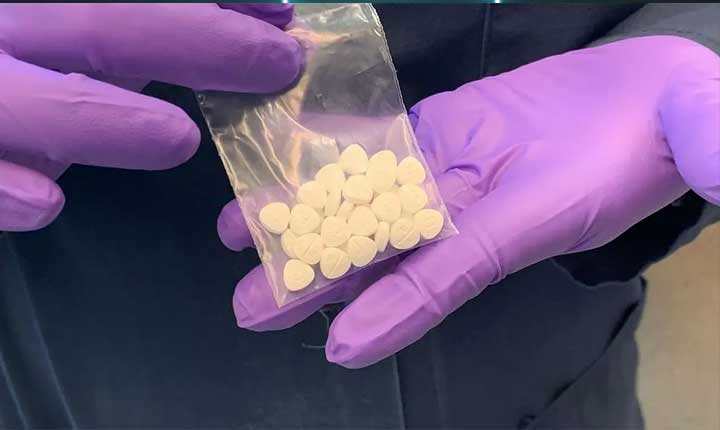
Contaminated supplies. In the U.S., nitazenes are rarely sold under their own name. The DEA and state agencies have found them mixed into heroin and fentanyl and pressed into counterfeit prescription pills resembling Xanax or oxycodone, as well as turning up in cocaine, unregulated cannabis products and vape liquids often without the user’s knowledge.
Wastewater detection. Missouri’s voluntary school wastewater monitoring program detected nitazenes in 26 of 37 participating schools roughly 70 percent within months of launching in early 2026, spanning small rural districts and the Kansas City and St. Louis metro areas. Officials stressed that a school’s wastewater reflects the surrounding community, not just its students. Nitazenes were linked to 14 overdose deaths in Missouri in 2024, more than triple the total over the previous five years combined.
Naloxone resistance. Because nitazenes are so potent, they can cause rapid respiratory depression, and first responders report that reversing an overdose often requires multiple doses of naloxone (Narcan) rather than one. Complicating matters, standard drug screens and fentanyl test strips do not reliably detect them.
Cartel Rivalries and Rising Violence:
The second pillar of the NCB’s warning is a sharp rise in drug-related violence that has evolved from localized crime into a systemic threat to state security in some transit countries.
Ecuador is the starkest case study. Once considered one of Latin America’s safest nations, with a homicide rate of about 6.7 per 100,000 in 2019, it saw that rate climb to roughly 45 per 100,000 by 2023 close to a six-fold increase — as rival gangs fought for control of cocaine routes bound for U.S. and European markets. The country’s Pacific ports, especially Guayaquil, have become primary departure points for cocaine headed to Antwerp and Rotterdam, drawing Mexican, Colombian and Albanian criminal networks into local turf wars.
 The violence reflects an aggressive global market in which record production volumes routinely overwhelm local enforcement capacity.
Dark Channels: Distribution via Encrypted Apps
Trafficking networks have adapted quickly to modern communications. The NCB report flagged encrypted messaging platforms specifically Telegram, WhatsApp and Signal as major channels for drug distribution, with Telegram emerging as a key venue for advertising. Officials noted these apps can be harder to police than the darknet because they require no special access, run on any smartphone, and lower the barrier to entry for sellers and buyers alike.
Using end-to-end encryption, auto-deleting messages, layered accounts and cryptocurrency payments, dealer networks can coordinate bulk shipments and hyper-local deliveries with minimal risk of interception. The effect is a more decentralized market in which traditional crackdowns on physical kingpins yield diminishing returns a pattern investigators say is visible in both India and the United States.
Related News

GOPIO Presents Memorandum on Diaspora Issues and Suggestions to Minister Jaishankar

Top 6 Stays in Dubai for Your Next Workation

SriLankan Airlines Restores Complete Middle East Network With Kuwait Service Resumption

Two Years After Trump’s Inflation Spotlight, Rising Grocery Prices Loom as a Political Vulnerability for Republicans Ahead of Midterms

US Imposes Up to 100% Tariffs on Drones to Curb Chinese Dominance and Bolster Security